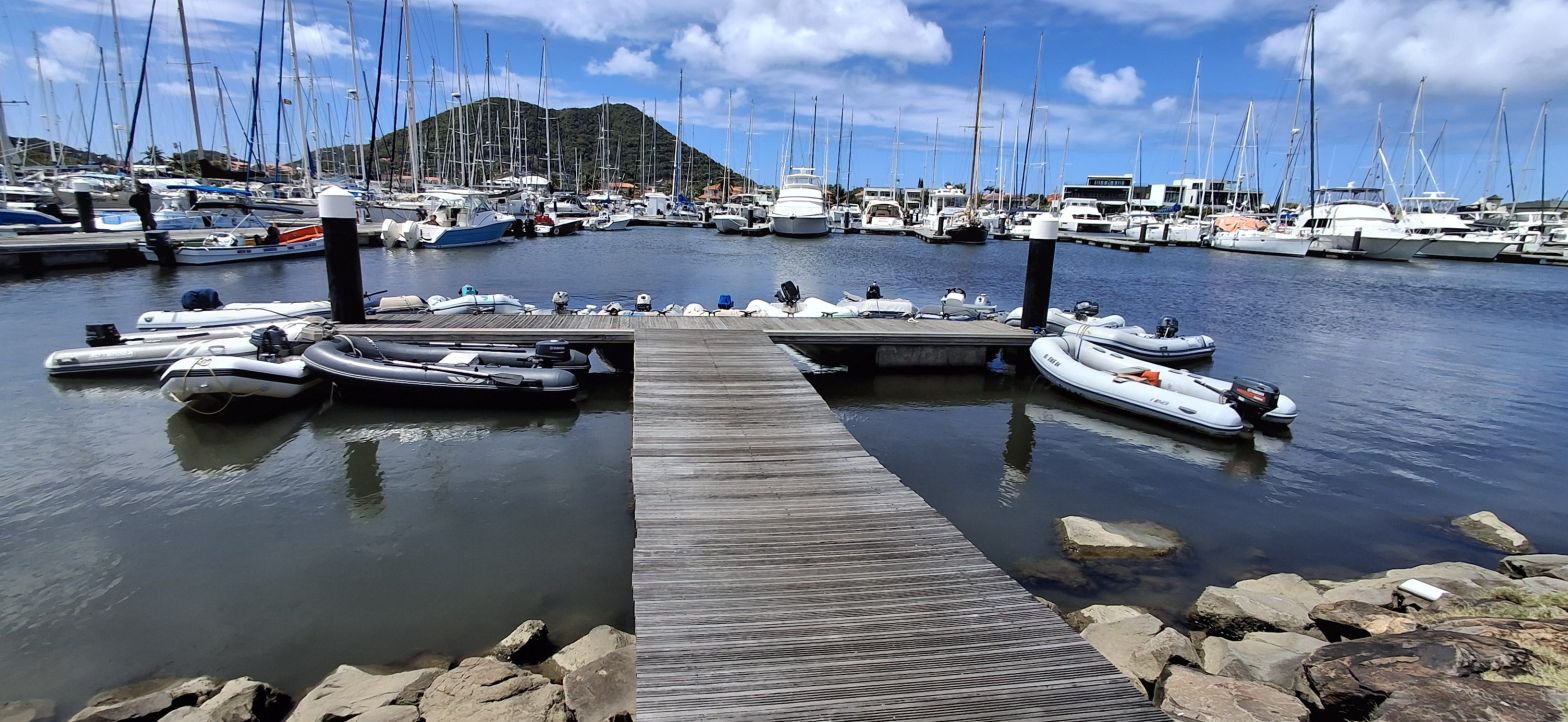
We spent three weeks in Martinique. Maureen and I managed to remember a few words in French which didn’t carry us much beyond “Good day”, or “2 chocolate croissants”. Our friends Polda and Nada, staying at an Airbnb in St. Anne, graciously drove us to the Pottery Village (last blog), the Decathlon for some sporting goods and a few restaurants. We also spent time with other cruisers we knew who passed thru St. Anne including two jam sessions aboard Kalunamoo. One thing about staying in one place for an extended period is that eventually cruisers that you know will stop by and say hello.
“Just don’t stop and stare, say hello in there, Hello”. Thanks John Prine, we’re almost at that age.
By the end of February, we were ready to move south. “February made me shiver, with every forecast I predicted…” Thanks Don Mclean.
The weather, since the end of January through most of February was not the best for island passages. The Trade winds were roaring almost constantly, and rain squalls were a virtual daily occurrence. Wind 25 knots plus with higher gusts in squalls and seas over 10 feet kept us in port. We recorded 30 knot gusts at anchor in St Anne. The total rainfall we measured (yes, we have a rain gauge) for February was 5.46 inches. For comparison, the average February rainfall in Martinique is 2.17 inches. The average wettest month in Martinique is October with a total of 9.4 inches. Their yearly total is 81 inches. No need for a water maker last month!
The weather window on the last day of February was predicted to be fair to sail south. St Lucia is only a 4-hour sail, and conditions were good until the north end of the island. Of course, as luck would have it, just as the compressed winds at the end of the island kick in and boost winds 5-10 knots, a squall was also coming off the island. Rain, wind and waves made the last hour into Rodney Bay “salty” but all ended well in the calm water of the bay. We dropped the hook, lowered the dink, went ashore, entered Customs and had and wonderful lunch at Sea Salt.
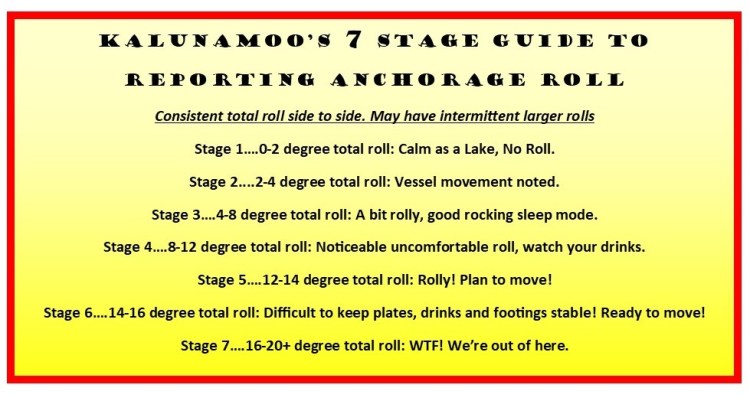
That brings me to the topic of this blog. Among the many concerns cruisers have when discussing ports and sailing are two that are ubiquitous. The first is the question of how rolly the anchorage is in the chosen port. I wrote about this before and quantified the answer in Kalunamoo’s 7 Stage Roll Guide. From 1, which is “Calm as a lake” to 7 which is “WTF? We’re out of here”. We have experienced all seven stages over the last number of years. Of course, conditions are not static and so all anchorages could experience different stages at any time. Hence the question of “How’s the Parking” is germane to specific time and place.
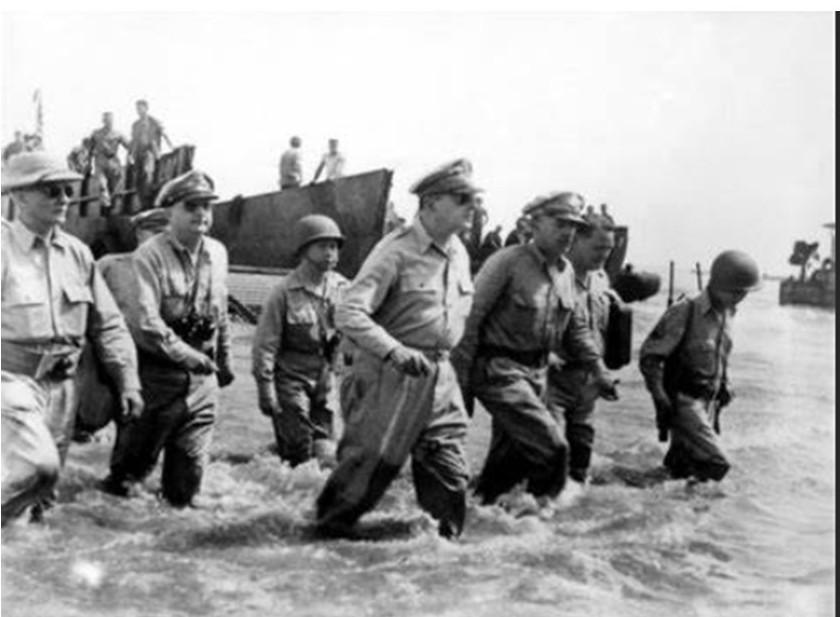
The second concern asks the question of “How’s the Parking” in regard to the anchorage and also to the vessel’s car, (i.e – the dinghy). This entails wanting to know the location, condition, size, safety, and popularity of the “parking spot” for the car when going ashore. It is true that most dinghies can be landed ashore on a beach. Provided that is where you want to be, maybe to go swimming or have a brie on the beach, and that is fine. You do have to consider the surf conditions at the shoreline as most dinghys and passengers prefer to stay dry while aboard the craft and expect to walk off on dry land. It is rather embarrassing to land on a beach after a wave fills it with sand and water because your timing was off, judging the surf. Remember pictures of the Normandy landing? For those who have never experienced this type of adventure, they haven’t cruised enough. We have cruised enough.
The other option is to park the car at a specified “dingy dock”. I’m not too sure if that term is meant to describe the dock itself or the craft it is meant to serve. We have seen, and used, many that must refer to the former as one can almost experience the Normandy Beach Landing on such “dinghy docks”.
Two of the above described “docks” come to mind. The floating pontoon dock at Pirates Beach, St Anne and the “walk the plank” dock in English Harbor. I can accept the Pirates Beach situation more than the English Harbor one (which is literally in the shadow of the mega-yachts there). There are others which I will not mention, that fit the same bill. All I can say is that good coordination and balance is required when using these docks or proper swimsuits are recommended. (Note to self – get pictures of these!)

As mentioned above, finding a suitable place to park one’s car (see cruiser’s definitions above) extends to other concerns. Many docks are specific to businesses that maintain them (like a parking lot for their customers). These don’t always mean they are maintained as well as their shore based parking lots. The one for Budget Marine in Falmouth Harbor, Antigua requires a certain agility and a “leap of Faith”. Some require rock climbing experience, especially at low tide (I’m thinking of you, St. Anne, Martinique). Some require expertise in short distance sprints when ocean swells gush up from under your feet if you’re not fast enough to outrun them (I’m thinking of you Deshaies, Guadeloupe).
To be fair there are some very good docks to be found: Jolly Harbor Marina, and the Falmouth town dinghy dock in Antigua. Bequia, Le Marin, and others, if sometimes too small are really good. (I’m thinking of the very small one at Marina Bas-du-Fort, Guadeloupe). Most marinas have decent dinghy docks although some restrict who can use them to go ashore outside the marina.

Other issues concern the safety of leaving your car and expecting it be there when you return to it. I guess it is like a convertible car ashore with the top down. It is easy to get in and hot wire it away. Our defense against such occurrences relies onheavy chain. Notice too, in the picture, how tight the parking is. The car is just one big rubber inflatable fender. No worries about door dings from cars parked too close together. On the other hand, it is common curtsey not to tie up tight to the dock. This way others can squeeze in, something the driver on the right doesn’t understand. Also, the dock itself could be classified as a “porcupine” dock. Nails, spikes, and other implements of dinghy destruction are embedded into the dock ready to deflate the unaware. Don’t ask why I know this.

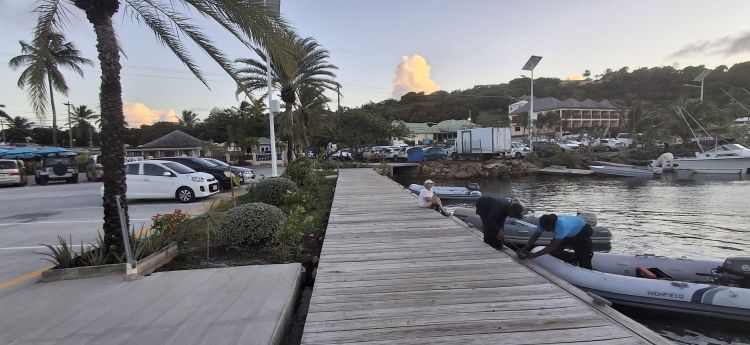


Well, I suppose a whole guidebook could be written about dinghy docks, where they are, their condition and usefulness and maybe someday there will be one. It is a subject that deserves some consideration. Of course, the business owners or authorities that construct and maintain these, seem to have little interest in the subject. Maybe if the customers, who need them and help support those businesses came into their stores in soaking wet bathing suits because that was the only way to get there, they might reconsider. Or maybe not.
 Kalunamoo
I really enjoy your writing 😊
LikeLike