
Woody Allen once said “You think God is dead? Try calling a plumber on the weekend.”
He was, of course, talking about people living on land, not on a boat. On land, at least during weekdays, you can call a plumber and probably your home wouldn’t sink and be underwater from basement to attic. On a boat, not so much.
That’s the thing about living on a boat, especially when the boat is not in a marina, tied securely to land with electricity, fresh water or professional help just a phone call (911?) away. Yes, with modern technology like StarLink and Sat Phones you can call anyone from anywhere in the world, including in the middle of the ocean. The issue though is that it is still impossible for the plumber to come and help you. Until Elon perfects teleportation, even he will have a long wait to get a plumber to his new home on Mars.
I bring this up as sailors generally know, that once untethered from land, they rely on their own devices for survival. Nobody is an expert in all the required subjects to survive on a boat at sea – navigation, electronics, seamanship, weather, health, first aid, invasive surgery, fish poisoning, interpersonal relations in confined spaces, firefighting, diesel-gasoline engine mechanics – to mention a few. Metallurgy is probably not on a list many would mention but is just as important, especially when sailing in salt water.
This brings me back to about 3500 BC when the Bronze Age was popular. Bronze statues and implements were all the rage. I guess it was like having an iPad at the time. As we all know, the upheaval around1000 BC drove the price of tin through the thatched roof of the Mediterranean smelters and by necessity the Iron Age sprang forth as a cheaper substitute for bronze. The rest, of course, is history.
But bronze never died out. Sailors worldwide, always on the trailing edge of technology, always had a thing for bronze and its flashier brother brass. Shiney brass is still found on the big oligarchs’ mega yachts as a cheap imitation of gold fittings.

I mention all this as we had a problem with one of our two dozen bronze fittings that, if gone unchecked, would have sunk Kalunamoo. Bronze is used to make and cast thru-hull fittings that allow controlled sea water to enter the vessel. The operative word is control. Uncontrolled sea water entry is also known as sinking – almost like Elon’s “premature disassembly by premature expansion of fuel”. This controlled salty sea water is used in a variety of ways. Toilets use it for obvious reasons. Engines use it for cooling, galleys use it to clean dishes, refrigerators use it to make things cold, and it is even possible to filter out the salt and use as drinking water. On Kalunamoo, there are actually 25 separate fittings to let sea water in or out of the hull for these reasons. They all have bronze fittings and valves to control the flow.

The other day, while checking the basement of Kalunamoo – called the bilge – I saw water where there should be none. Working back “up stream” I found it’s source at the top of a brass valve, actually the 90 degree brass elbow on the top of the valve, that seemed to have a lot of crusty corrosion on it. Wiping away the crusty stuff released a steady stream of seawater that sprouted forth. Not a good thing to see. It wasn’t a tremendous flood of water but it could not go unchecked. Close the valve and it should stop the flow. It didn’t. The valve handle moved in the right direction, but the internal ball didn’t. “Rescue Tape” was immediately applied to stop the flow, which by now was more than just a trickle. I also put a wooden plug in to stop the flow.
Long story short (too late), our cruiser friend Jason came over with his scuba tank, dived under the boat and plugged the intake from the outside with a wooden plug. We could not figure out how to fix it in the water. It became apparent that the whole thru hull had to be replaced which meant we had to be hauled out of the water to do that.
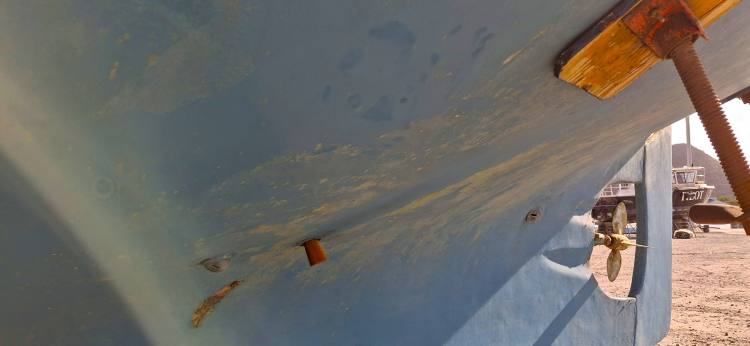
Fortunately, we were in Rodney Bay, St. Lucia which has a marina and good haul out facility. The only one on the island. A good marine chandlery, Island Water World, is there where new parts were had. The next day, after some delay we were hauled, and four hours later the new thru hull, valve and elbow were installed. The boat spent that night on the hard while we went to Bay Haven Hotel for the night. The next day, after some more delays, we splashed and sailed back to anchor in the bay. All’s well that ends well. No leaks with the new bronze fittings.

I mentioned metallurgy as an important subject for sailors. Bronze, being an alloy, mostly of the element of copper with small amounts of tin, zinc, aluminum, and nickel is a fascinating subject to those so inclined. And I’m sure electrolysis, noble metals, electrolytic properties of salt water, stray electric currents and other arcane subjects would surface in any sailor’s discussion of this incident. All play a part, but I will not go into the details or controversies here. The essential lesson learned was what our friend Mark has taught: “Everything on the boat is broken, you just don’t know it yet”. He might have added, “But you will eventually”.

This has kept us busy for a few days, allowed us to unload some “excess” funds, to give thanks to friends who helped, and to the luck we had finding that above mentioned “eventually” before a negative buoyancy issue put a damper on our home. The Age of Bronze lives on.
 Kalunamoo
Wow, glad you were able to fix quickly!
LikeLike