Adverse Currents

The Powers Clan

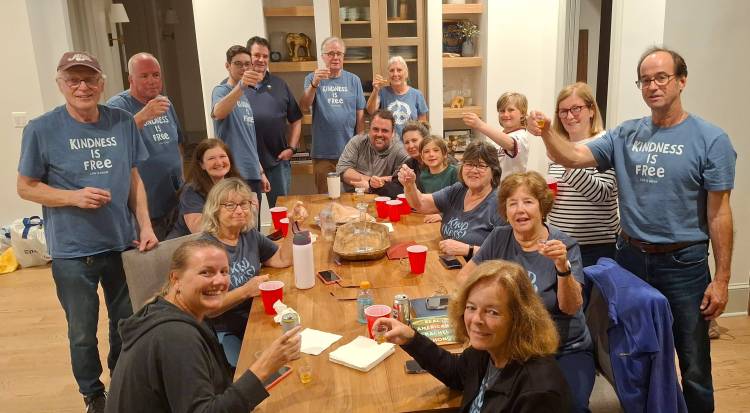
We were in St. Lucia for all of March and half of April. During that time, we did fly to the States for eight days to attend a gathering of Maureen’s siblings in Arlington VA. We gathered together to remember Michael Powers, Maureen’s younger brother, who passed away ten years ago. Ten years ago, we flew from Guadeloupe for his funeral although it doesn’t seem that long ago. It was a wonderful way to remember a very missed family member.

St. Lucia is our usual mid-season “break” when our daily routine of life aboard changes to include dentist appointments, maintenance or repair issues, and some time docked in a marina. In that respect, we consider St. Lucia an “easy island”. That was no different this time, as our last post described the thru hull issue. Besides crossing paths with cruisers we knew, we always meet new ones. So, our time there always includes many social gatherings, including the ubiquitous Mexican Train Dominoes, and a few beach BBQ’s and dinners. We finally left in Mid-April for the sail to Bequia.

That brings me to the topic of Adverse Currents. The sail south from Rodney Bay to Bequia is about 75 miles. For us, that is about a 12-hour run. We leave St. Lucia very early in the morning to ensure an arrival before sunset. So, at 4 am we set off going south. The weather window was good, with little chance of squalls and moderate winds of 17-20 knots from the east. Motoring the lee side of the islands is usually very calm as the strong winds only occur at the ends of the islands and provide good sailing between them.

We were surprised when going south from Rodney Bay, that in the lee of the island there was a bit of a lumpy sea. Not a short wind chop nor a long swell. I have not seen that before, but it was not that concerning. By sunrise we were past the Pitons and started crossing the St. Vincent Channel. As expected, the winds kicked in, at 20 plus knots due to the end of the island wind compression zone and we were off sailing. Well, actually motor sailing, as the winds were too far forward and there seemed to be a head current.

Sure enough, the current for the next three hours was at least 3 knots on the nose. Wind was on the port beam and seas were moderate. Boat speed through the water was almost a constant 8 knots while over ground speed was only 5. This is known as an Adverse Current!

The East Caribbean islands, the Lesser Antilles, running north and south lie mostly in the path of the westward flowing Equatorial current. This means that this northwest flowing current, which eventually feeds the Gulf Stream current off the U.S. East Coat, must pass between the islands. It is stronger the further south toward Trinidad. The strongest current is usually between Trinidad and Grenada and also between St. Lucia and St. Vincent. It can be locally stronger elsewhere as well. This told me that a head current should be expected. Bequia is the first island of the Grenadines just south of St. Vincent. I was surprised, however, at the strength and duration of the current. As we have crossed this many times, I had to figure out why it was different this time.

East Caribbean Ocean Currents

Ocean currents are long term conditions and don’t change quickly. There are eddies and fluctuations on the order of weeks and seasonal variations. Tidal currents, on the other hand, are daily, usually twice a day. They can add or subtract from the underlying ocean currents. These two currents are very evident in places like the Caribbean Islands. In addition, local weather conditions can also affect the surface conditions. Longer term trends may even play a part (salinity and density play a part in driving ocean currents).

It just so happened, that the full moon was only a day before our passage from St. Lucia. Also, there were consistent eastly trade winds for days. Full moons produce higher tides that “run” toward the moon. As we know, the full moon sets at sunrise which means the tidal current flows west and enhances the west flowing equatorial current. These three conditions and others must have  combined to result in the strong current we experienced. Three quarters of the way across to St. Vincent the current relented and we were doing 8 knots through the water and ground without the iron genny! We made up the time and made it to Bequia in under 12 hours. On talking to other sailors here in Bequia, they too noticed the strong current while sailing south.

Adverse currents certainly affect sailors. But aren’t we all, at one time or another, affected by adverse currents in our lives? The graphic of the ocean currents by Copernicus in the Windy weather site looks much like the Vincent Van Gogh painting The Starry Night. The swirls, twists, turns, and the unexpected of life flow through our lives much like the painting and the graphic. “Go with the flow”, so they say, when you can neither tell where it will lead, nor fathom the mystery director’s course. Van Gogh may have had a clue to sense this as an integral part of all our lives. Certainly, in the political world, adverse currents have surfaced and posed questions of where they lead and who will be affected. A loved one passes, circumstances change, the ocean moves mysteriously. Wouldn’t it be great to have a graphic? Or maybe an artist has already painted a picture for us that we just need to understand and appreciate?     
The Bronze Age

Woody Allen once said “You think God is dead? Try calling a plumber on the weekend.”
He was, of course, talking about people living on land, not on a boat. On land, at least during weekdays, you can call a plumber and probably your home wouldn’t sink and be underwater from basement to attic. On a boat, not so much.

That’s the thing about living on a boat, especially when the boat is not in a marina, tied securely to land with electricity, fresh water or professional help just a phone call (911?) away. Yes, with modern technology like StarLink and Sat Phones you can call anyone from anywhere in the world, including in the middle of the ocean. The issue though is that it is still impossible for the plumber to come and help you. Until Elon perfects teleportation, even he will have a long wait to get a plumber to his new home on Mars.

I bring this up as sailors generally know, that once untethered from land, they rely on their own devices for survival. Nobody is an expert in all the required subjects to survive on a boat at sea – navigation, electronics, seamanship, weather, health, first aid, invasive surgery, fish poisoning, interpersonal relations in confined spaces, firefighting, diesel-gasoline engine mechanics – to mention a few. Metallurgy is probably not on a list many would mention but is just as important, especially when sailing in salt water.

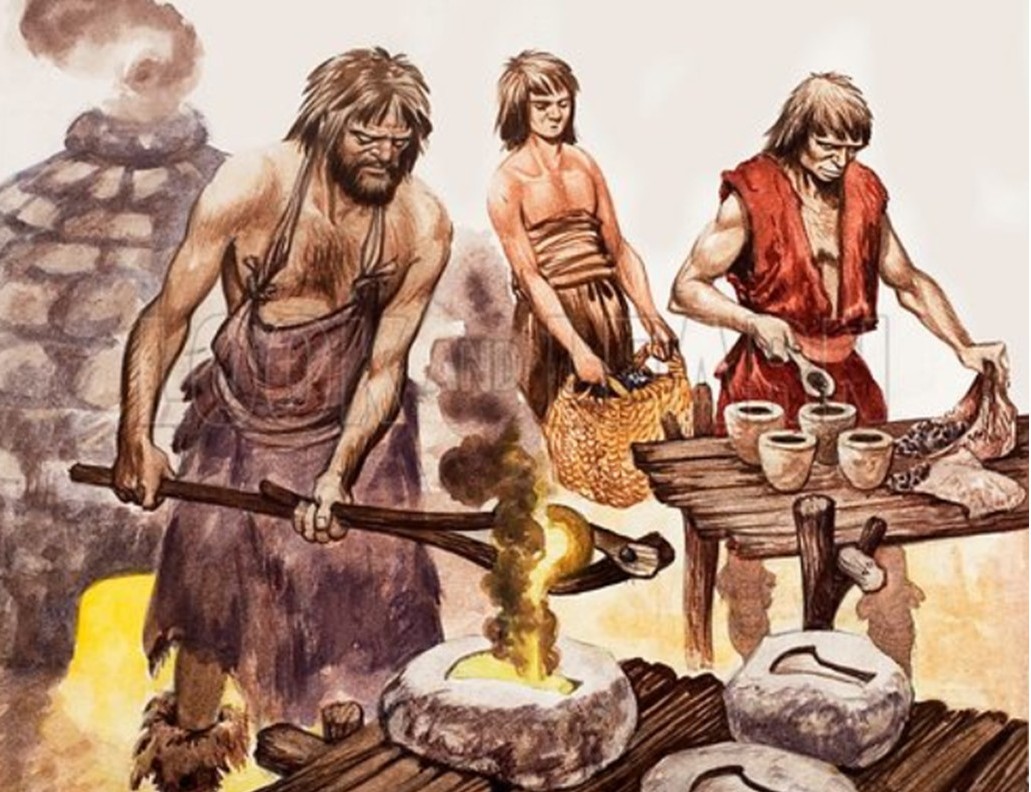
This brings me back to about 3500 BC when the Bronze Age was popular. Bronze statues and implements were all the rage. I guess it was like having an iPad at the time. As we all know, the upheaval around1000 BC drove the price of tin through the thatched roof of the Mediterranean smelters and by necessity the Iron Age sprang forth as a cheaper substitute for bronze. The rest, of course, is history.

But bronze never died out. Sailors worldwide, always on the trailing edge of technology, always had a thing for bronze and its flashier brother brass. Shiney brass is still found on the big oligarchs’ mega yachts as a cheap imitation of gold fittings.

I mention all this as we had a problem with one of our two dozen bronze fittings that, if gone unchecked, would have sunk Kalunamoo. Bronze is used to make and cast thru-hull fittings that allow controlled sea water to enter the vessel. The operative word is control. Uncontrolled sea water entry is also known as sinking – almost like Elon’s “premature disassembly by premature expansion of fuel”. This controlled salty sea water is used in a variety of ways. Toilets use it for obvious reasons. Engines use it for cooling, galleys use it to clean dishes, refrigerators use it to make things cold, and it is even possible to filter out the salt and use as drinking water. On Kalunamoo, there are actually 25 separate fittings to let sea water in or out of the hull for these reasons. They all have bronze fittings and valves to control the flow.

The Old Thru Hiull

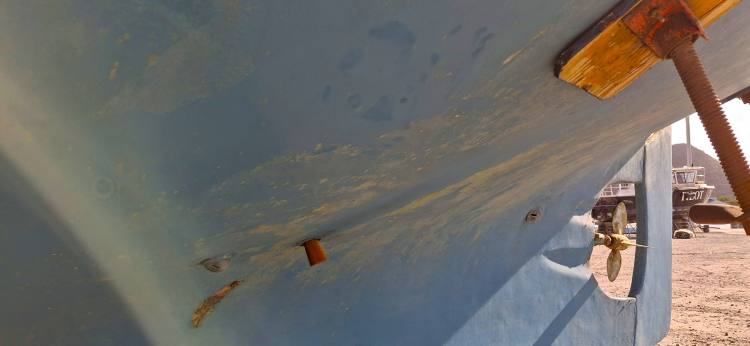
The other day, while checking the basement of Kalunamoo – called the bilge – I saw water where there should be none. Working back “up stream” I found it’s source at the top of a brass valve, actually the 90 degree brass elbow on the top of the valve, that seemed to have a lot of crusty corrosion on it. Wiping away the crusty stuff released a steady stream of seawater that sprouted forth. Not a good thing to see. It wasn’t a tremendous flood of water but it could not go unchecked. Close the valve and it should stop the flow. It didn’t. The valve handle moved in the right direction, but the internal ball didn’t. “Rescue Tape” was immediately applied to stop the flow, which by now was more than just a trickle. I also put a wooden plug in to stop the flow.

Long story short (too late), our cruiser friend Jason came over with his scuba tank, dived under the boat and plugged the intake from the outside with a wooden plug. We could not figure out how to fix it in the water. It became apparent that the whole thru hull had to be replaced which meant we had to be hauled out of the water to do that.

The Plug

Fortunately, we were in Rodney Bay, St. Lucia which has a marina and good haul out facility. The only one on the island. A good marine chandlery, Island Water World, is there where new parts were had. The next day, after some delay we were hauled, and four hours later the new thru hull, valve and elbow were installed. The boat spent that night on the hard while we went to Bay Haven Hotel for the night. The next day, after some more delays, we splashed and sailed back to anchor in the bay. All’s well that ends well. No leaks with the new bronze fittings.

I mentioned metallurgy as an important subject for sailors. Bronze, being an alloy, mostly of the element of copper with small amounts of tin, zinc, aluminum, and nickel is a fascinating subject to those so inclined. And I’m sure electrolysis, noble metals, electrolytic properties of salt water, stray electric currents and other arcane subjects would surface in any sailor’s discussion of this incident.  All play a part, but I will not go into the details or controversies here. The essential lesson learned was what our friend Mark has taught: “Everything on the boat is broken, you just don’t know it yet”. He might have added, “But you will eventually”. 

The New Thru Hull

This has kept us busy for a few days, allowed us to unload some “excess” funds, to give thanks to friends who helped, and to the luck we had finding that above mentioned “eventually” before a negative buoyancy issue put a damper on our home. The Age of Bronze lives on. 

On Turning 77

By this time, I thought, I would have had the answers. Given enough time, and 77 years seems long enough, not only for the answers but the persuasive abilities to convince others. The knowledge and experience, layered upon circumstances, endlessly repeated, should have given me the ability to judge the proper course that should be set. And yet the world moves on, regardless of what I think or do. 

“The spiritual meaning of the number 77 holds a profound significance in our lives, inviting us to delve deeper into self-awareness, introspection, and personal growth. By embracing this energy and incorporating it into our daily routines, we can unlock new dimensions of understanding and wisdom.”

Easy for them to say. The physical body, far from personal growth, seems to lose functionality at an alarming rate. Self-awareness and introspection, combined with hard of hearing, and short-term memory loss, renders such efforts ineffective in even finding the car keys (oh, I forgot, I don’t have a car).

“In Christian tradition, the number 7 represents completion or perfection. The number 77 may symbolize an important turning point or moment of spiritual awakening in one’s life journey.”

Sister Mary Slap-on-the-Wrist did her best when I was 7. At 77 it only now kicks in? I hope I was not sleepwalking for the last 70 years.

“Judaism and Islam place significant importance on the number 7 as well, particularly in their sacred texts. The number 77 could represent a call to deeper understanding or connection with spiritual truths. In Chinese culture, the number 7 is considered lucky due to its resemblance to the word for “life” in Mandarin. Similarly, in Hinduism and Buddhism, the number 7 is associated with chakras – energy centers within the body – suggesting that the number 77 may be linked to our spiritual growth and development.”

Well that is a little more positive. I could use a little more of the “energy centers within the body”. Especially after a big lunch and a few rhums. I fear I am becoming a Mexican with a love of siesta

But answers to life’s questions, if one believes life asks them, are as elusive as ever. It seems we must look inside one’s self to find any answers. Now they tell me! Socrates was right all along. It is not the answers we seek, but only the questions we ask that are important.

 So, what questions do I have after kicking around for 77 years? I know why the sky is blue, why ego causes war, why man is the only animal that blushes, or needs to (thanks Mark Twain). I know that

77  Sunset Strip was a TV show 1958-1964, that 77 is the only number that can be expressed as the sum of the first eight prime numbers: 2 + 3 + 5 + 7 + 11 + 13 + 17 + 19; that James Bond climbing the Hills of Genoa could be called 0077.

What Agnes Collard called, “untimely questions”, should I ask? Questions that are difficult to answer because they rely on our own experiences to frame. Songwriters Lymon, Santiago and Merchant asked “Why do fools fall in love”. We all fall in love with people, places or things, so I guess we are all fools at some point in our lives. What is the answer to that?

So, we are in St. Lucia (ala- looking for a shaker of salt?) and asking questions with infrequent, conflicting, reflexive and sometimes perplexing answers. And yet the world goes on, despite our explicit opinions and advice. Well, at least the weather is warm and sunny, but where are those dam car keys?

How’s the Parking?

We spent three weeks in Martinique. Maureen and I managed to remember a few words in French which didn’t carry us much beyond “Good day”, or “2 chocolate croissants”.  Our friends Polda and Nada, staying at an Airbnb in St. Anne, graciously drove us to the Pottery Village (last blog), the Decathlon for some sporting goods and a few restaurants. We also spent time with other cruisers we knew who passed thru St. Anne including two jam sessions aboard Kalunamoo. One thing about staying in one place for an extended period is that eventually cruisers that you know will stop by and say hello.

Just don’t stop and stare, say hello in there, Hello”. Thanks John Prine, we’re almost at that age.

By the end of February, we were ready to move south. “February made me shiver, with every forecast I predicted…” Thanks Don Mclean.

The weather, since the end of January through most of February was not the best for island passages. The Trade winds were roaring almost constantly, and rain squalls were a virtual daily occurrence. Wind 25 knots plus with higher gusts in squalls and seas over 10 feet kept us in port. We recorded 30 knot gusts at anchor in St Anne. The total rainfall we measured (yes, we have a rain gauge) for February was 5.46 inches. For comparison, the average February rainfall in Martinique is 2.17 inches. The average wettest month in Martinique is October with a total of 9.4 inches. Their yearly total is 81 inches. No need for a water maker last month!

The weather window on the last day of February was predicted to be fair to sail south. St Lucia is only a 4-hour sail, and conditions were good until the north end of the island. Of course, as luck would have it, just as the compressed winds at the end of the island kick in and boost winds 5-10 knots, a squall was also coming off the island. Rain, wind and waves made the last hour into Rodney Bay “salty” but all ended well in the calm water of the bay. We dropped the hook, lowered the dink, went ashore, entered Customs and had and wonderful lunch at Sea Salt.

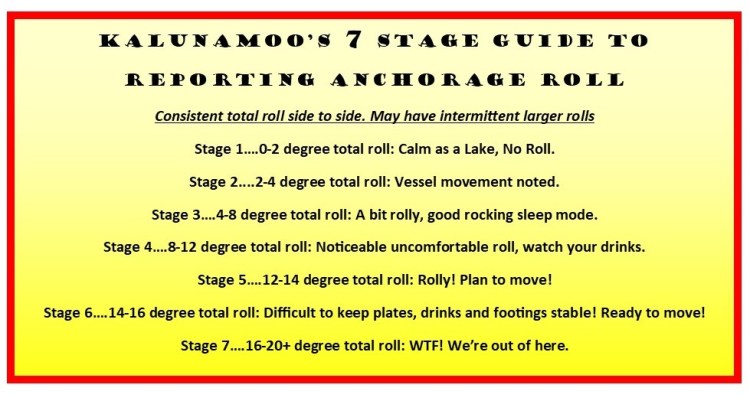
That brings me to the topic of this blog. Among the many concerns cruisers have when discussing ports and sailing are two that are ubiquitous. The first is the question of how rolly the anchorage is in the chosen port. I wrote about this before and quantified the answer in Kalunamoo’s 7 Stage Roll Guide. From 1, which is “Calm as a lake” to 7 which is “WTF? We’re out of here”. We have experienced all seven stages over the last number of years. Of course, conditions are not static and so all anchorages could experience different stages at any time. Hence the question of “How’s the Parking” is germane to specific time and place.

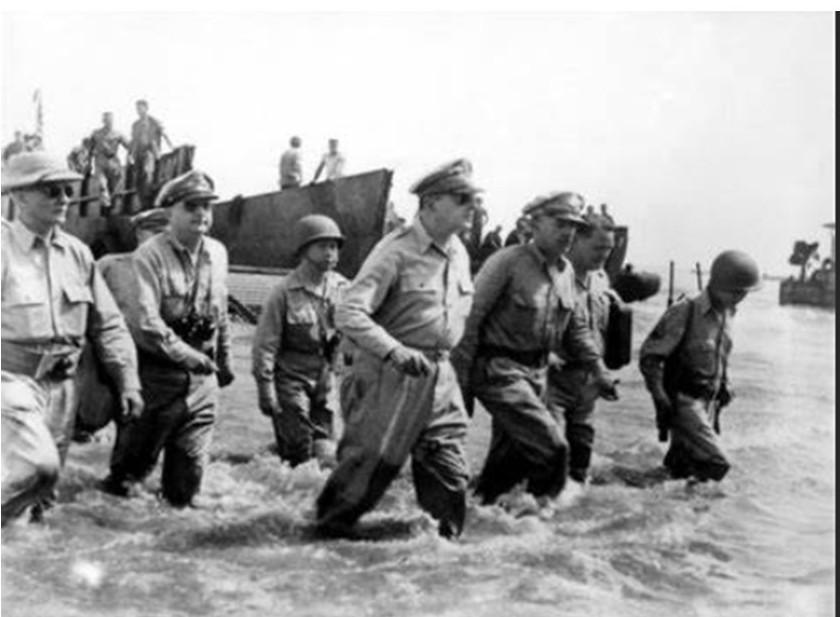
Going ashore in Normandy

The second concern asks the question of “How’s the Parking” in regard to the anchorage and also to the vessel’s car, (i.e – the dinghy). This entails wanting to know the location, condition, size, safety, and popularity of the “parking spot” for the car when going ashore. It is true that most dinghies can be landed ashore on a beach. Provided that is where you want to be, maybe to go swimming or have a brie on the beach, and that is fine. You do have to consider the surf conditions at the shoreline as most dinghys and passengers prefer to stay dry while aboard the craft and expect to walk off on dry land. It is rather embarrassing to land on a beach after a wave fills it with sand and water because your timing was off, judging the surf. Remember pictures of the Normandy landing? For those who have never experienced this type of adventure, they haven’t cruised enough. We have cruised enough.

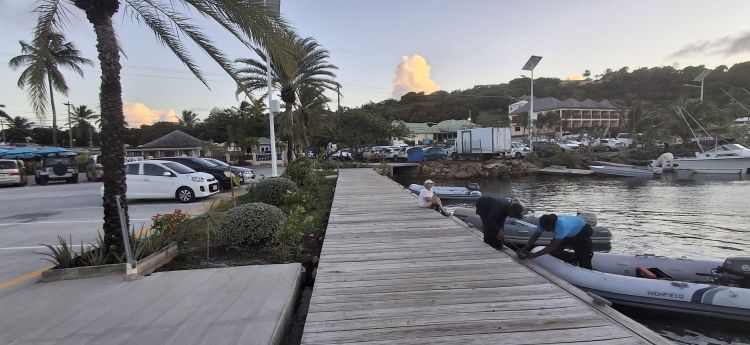
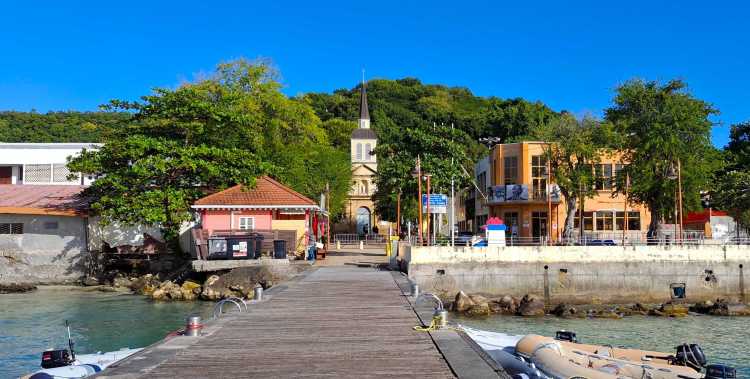
The other option is to park the car at a specified “dingy dock”. I’m not too sure if that term is meant to describe the dock itself or the craft it is meant to serve. We have seen, and used, many that must refer to the former as one can almost experience the Normandy Beach Landing on such “dinghy docks”.

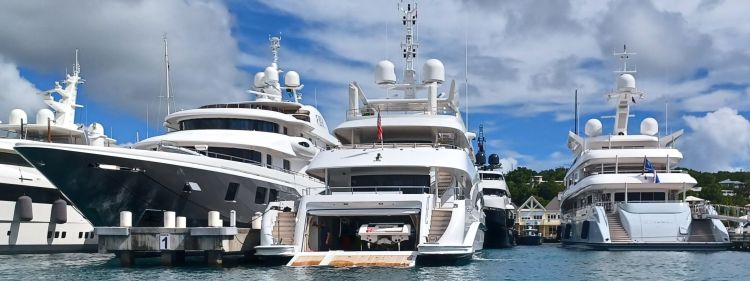
Two of the above described “docks” come to mind. The floating pontoon dock at Pirates Beach, St Anne and the “walk the plank” dock in English Harbor. I can accept the Pirates Beach situation more than the English Harbor one (which is literally in the shadow of the mega-yachts there). There are others which I will not mention, that fit the same bill. All I can say is that good coordination and balance is required when using these docks or proper swimsuits are recommended. (Note to self – get pictures of these!)

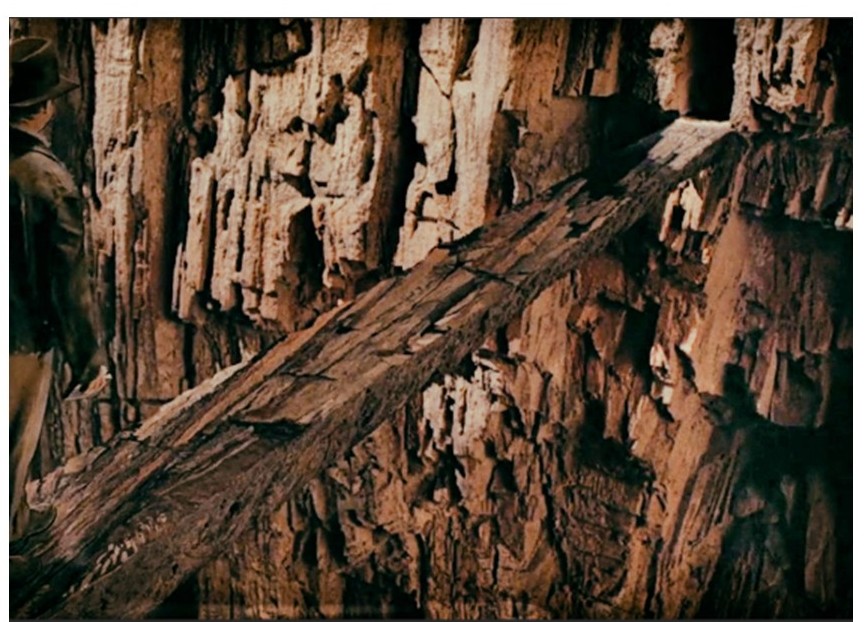
Leap of Faith, Jones!

As mentioned above, finding a suitable place to park one’s car (see cruiser’s definitions above) extends to other concerns. Many docks are specific to businesses that maintain them (like a parking lot for their customers). These don’t always mean they are maintained as well as their shore based parking lots. The one for Budget Marine in Falmouth Harbor, Antigua requires a certain agility and a “leap of Faith”. Some require rock climbing experience, especially at low tide (I’m thinking of you, St. Anne, Martinique). Some require expertise in short distance sprints when ocean swells gush up from under your feet if you’re not fast enough to outrun them (I’m thinking of you Deshaies, Guadeloupe).

To be fair there are some very good docks to be found: Jolly Harbor Marina, and the Falmouth town dinghy dock in Antigua. Bequia, Le Marin, and others, if sometimes too small are really good. (I’m thinking of the very small one at Marina Bas-du-Fort, Guadeloupe). Most marinas have decent dinghy docks although some restrict who can use them to go ashore outside the marina.

Rodney Bay Marina Dinghy Dock

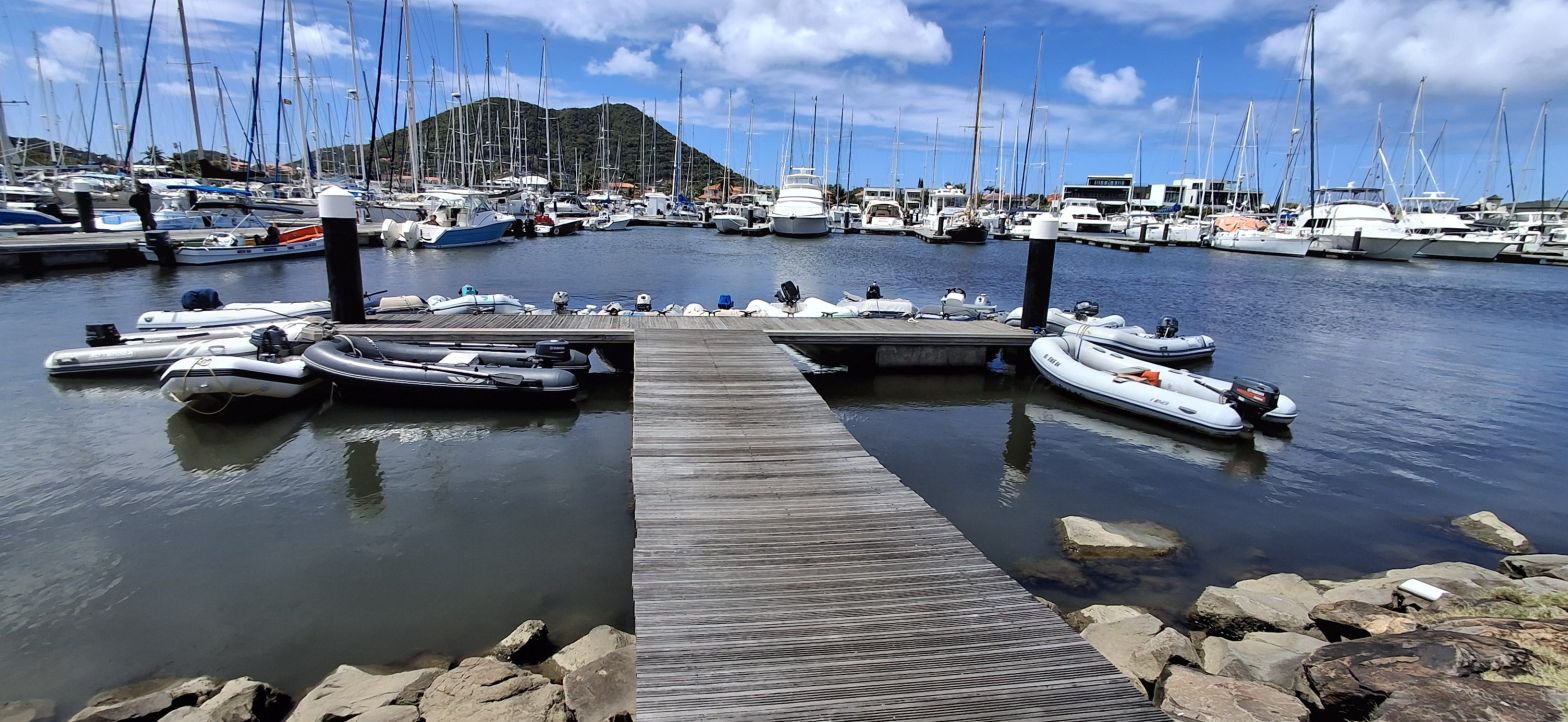
Other issues concern the safety of leaving your car and expecting it be there when you return to it. I guess it is like a convertible car ashore with the top down. It is easy to get in and hot wire it away. Our defense against such occurrences relies onheavy chain. Notice too, in the picture, how tight the parking is. The car is just one big rubber inflatable fender. No worries about door dings from cars parked too close together. On the other hand, it is common curtsey not to tie up tight to the dock. This way others can squeeze in, something the driver on the right doesn’t understand. Also, the dock itself could be classified as a “porcupine” dock. Nails, spikes, and other implements of dinghy destruction are embedded into the dock ready to deflate the unaware. Don’t ask why I know this.

St Anne, Martinique
Falmouth Town Dinghy Dock
Portsmouth PAYS dock, which has since been repaired
Deshaies, Guadeloupe
Le Marin, Martinique

Well, I suppose a whole guidebook could be written about dinghy docks, where they are, their condition and usefulness and maybe someday there will be one. It is a subject that deserves some consideration. Of course, the business owners or authorities that construct and maintain these, seem to have little interest in the subject. Maybe if the customers, who need them and help support those businesses came into their stores in soaking wet bathing suits because that was the only way to get there, they might reconsider. Or maybe not.

The Voyage South and Neg Marons

This from the Captain’s Log

“It is the second week of the second month and as I last penned in this sea journal, the Windman Cometh had cometh and has yet to depart. In the clutches of this adversary, we make our plans. This captain and his mate resolve to sail south with full knowledge of the prevailing conditions bestowed upon the winds and seas, trusting their stout vessel will see and carry them thru.  “Set course and make for way to Ilet a Kahouanne”. That little speck of rock northwest off the rugged Guadeloupe coast was our north star. From there, head downwind to Pte. Du Gros Morne and Anse Deshaies. That deep water harbor will shelter us for the night, out of the eastly swell and winds. But it is well known that the little harbor serves up some might gusts flowing down the valley and out to all vessels hooked into its deep seabed. Dragging their anchors in the gusty nights is a most common occurrence to those luckless sailors in that lovely harbor, one that this captain is well aware of.  We set sail with reefed main and flew only the Yankee stay and made good our southerly course. The seas were up but not overpowering as we sailed into the early afternoon. We fetched up and dropped the hook in 5 fathoms. It set well, but the anchorage was full and our swing took our vessel uncomfortably close to a nearby sloop. In less than an hour, orders we given to weigh anchor and to make for Malendure before dark.”

The open roadstead at Malendure has ample space to anchor. Being half way down the west coast of the big island, it is immune, mostly, of any swell but the dreaded northerlies. None were forecast, and so it was the safe harbor that we sought. 

Le Rocher de Malendure

Arriving near sunset we dropped the hook close to shore. A few light showers passed by, but the evening grew still, and a restful night lay ahead without the concern of dragging anchors.

We stayed another day and lunched at the headland restaurant Le Rocher de Malendure. A very pleasant eatery. Before retiring for another peaceful night, we contacted a fellow cruiser, s/v BeBe anchored in the next Anse south, Bouillante. Bouillante is known for its geothermal power plant. The hot springs supply the energy for the town and surrounding area. The discharge of the warm water supplies a hot tub experience in the bay.

Arrangements were made to play Mexican Train Dominoes the next afternoon, which we did, and then made plans to sail to Le Saints at sunrise. That evening, the population of Bouillante, held a celebration ashore. It must have been a warmup to the French Carnaval in Forte de France. Drums boomed, voices in the night, a cacophony of competing bands echoed in the anchorage. Fortunately by 2100, they closed down and peace prevailed.

At Anchore in The Saints

The sail to the Le Saints was not as difficult as anticipated. Despite strong winds and moderate seas, we crossed over from Vieux Fort without too much discomfort. Arriving in the Saints by noon, all moorings were occupied, and so we dropped the hook off Tete Rouge. This would only be an overnight stay, so no shore leave was granted. The next day we were off to Dominica. We were on a mission to get to Martinique before the winds and seas kicked up again. The sail to Dominica was not terrible and again spent one night in Portsmouth before continuing south to Martinique.

It is at the ends of these islands that the winds and seas build above the prevailing conditions that makes passages “sporty”. This is due to the “compression zone” where the easterly winds whip around the ends of the island, think of the amusement park ride – the Whip. Sailing off the southern tip of Dominica we were faced with 25 kts and short steep waves. Ugh! But an hour or so later, thrashing thru it all, the seas settled down somewhat for the remainder of the sail to St. Pierre in Martinique.

It would be another overnight in St. Pierre and then the final leg to St. Anne. The last 10 miles of that leg is a bear.

St Anne is ten miles due east of Diamond Rock. We got to Diamond Rock with favorable current but that meant it was wind against current. This builds short steep seas. Rounding Diamond was a challenge and passing close by nerve racking. Then we faced ten miles directly up wind to St Anne. The other option was to continue past Diamond and sail halfway to St Lucia and then tack back to Martinique. We opted to motor sail, close hauled, directly to St Anne.

St. Anne

By afternoon we dropped the hook in 3 fathoms in the Mouillage de Ste Anne. I made sure our hook was well dug into the sandy bottom and declared our 200 mile trek from Antigua was completed. The anchorage is choppy but not rolly and as expected, the Trade Winds are up again for another week. We will be here for a while! Time to enjoy French cuisine and a bit of “out and about” excursions. The first of which was to Le Village de la Poterie.

Ex-cruising friends , Nada and Polde(s/v NADA) are in St Anne for a month and they invited us to go with them to the Pottery Village near Trois Islets. Nada drove and despite some misdirection and a long traffic delay because of road repair, we had a lovely time and a great lunch at Le Jardin des Envies.

Le Village was a late 1600’s Jesuit cite and then a building materials facility in the 1700’s. Terracotta bricks are still made there. But today it is mostly an enclave for local artists, craftsmen, cafes, restaurants and yes, t-shirt vendors, including a go-cart track! I believe it is also home of The Men of Clay.

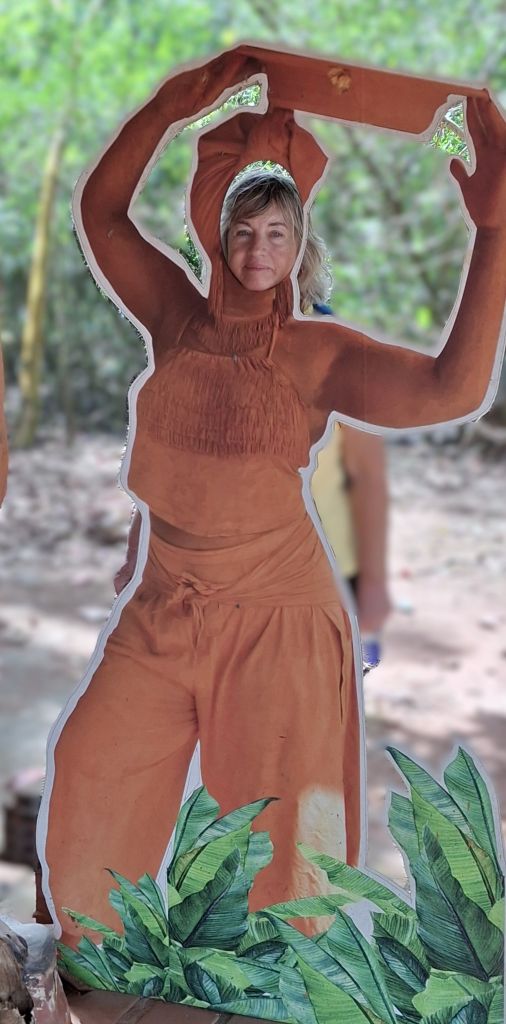
We have seen these “claymen” in the Fort de France carnival a few times. They paint  themselves in terracotta like makeup and parade in the carnival. They then freeze in the posture of clay statues in the style of the Neg Marons (runaway slaves and freemen of the Caribbean). It is really something to see.

We’ll be here for a few weeks before heading south to St. Lucia and hope the winds and seas become more amendable to moving about. Are we the Neg Maron’s escaping the clutches of the weather? Until then, viva la France!

The Windman Cometh

When I was younger (not all that long ago), I used to windsurf or sailboard. That was before kiteboarding and wing foiling came around. It was fun and didn’t require too much equipment, although carbon fiber masts and multiple sails could always be added to my inventory. Sailboarding wasn’t particularly difficult and didn’t require extraordinary strength. It was like learning to ride a bicycle. It required a good ability to balance, and a good ability to swim! But the most important thing was that you had to learn to be “one with the wind”.

When the wind was “up”, up came the board, the sail was rigged and off I was scooting around the marina. To be “one with the wind” meant that you had to feel the wind pressure on the sail thru your arms, the minute wind angle changes thru the hair on your back, and shifting your body posture to capture the energy to propel you forward.

This is also true while sailing small boats. But the larger the boat the less you have that connection. When you get to heavy cruising boats like Kalunamoo, these subtle wind changes have little effect and the sense of being with the wind almost vanishes. But not totally.

Living on a boat always involves “being one with the wind and weather”. I write this as we are anchored in Falmouth Harbor, Antigua and the start of a week or two of strong trade winds. It will be quite different than the last few weeks of gentle, if not calm, winds.

This was fortunate as our daughter Melanie and son-in-law Dave flew down and stayed with us for a week. The winds were very calm for a few days which made for an easy ride up to Nonsuch Bay and Green Island. This is usually a slog upwind with large seas and not something to look forward to. But the wind cooperated, and we had a great time behind the reefs. Snorkeling and swimming were very pleasant in those conditions.

In fact, the wind really didn’t pick up much for the entire week, so sailing was not really in the cards The downwind run back to Falmouth was another motor sail but at least we caught a barracuda to make an interesting run.

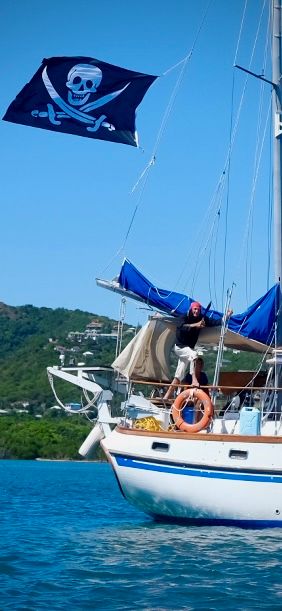
Dinners aboard and ashore were wonderful, fresh lobsters and French cuisine despite some pirate activity.

But weather changes, and it looks like the “Christmas Winds” came late this year as strong trade winds are forecast until the end of the month. Melanie and Dave departed, a day of cloudy rainy weather arrived, and the Windman Cometh.

Winds out of the east at 25 knots plus, gusts to near 30 for two weeks will build seas to 10 feet between islands. In other words, we will hunker down here for the duration. Falmouth is well protected so there is no danger, but we will have to get used to the wind whistling in the rigging again. There is enough to do here in Falmouth so that is not a problem. We could also go around to the west side of the island: Jolly Harbor or Deep Bay if we want.

The technical explanation for this weather pattern is complex but can be simplified. The relatively light winds were the result of cold fronts coming down from the States to around Puerto Rico. They eliminated the pressure differential between the tropics and the central Atlantic that powers the eastly trade winds. That pattern persisted for a few weeks. That pattern has changed and so typical pressures return and strong winter trades blow!

When the cold fronts come to the States, the winds react in the Caribbean. Fires rage in the west, the new President huddles indoors for his inauguration, kids play in the snow while we hear the rigging blow. When the Windman Cometh, we are one with the wind but with the realization that we can only acquiesce to its effects. It is a reality check. Is that a similarity with those delusional characters and their eventual reality check, Eugene O’Neill wrote about in the play, The Iceman Cometh? Some could say that the flow of Caribbean rum and the perception of living in paradise makes the comparison valid. When the character Hickey arrived on the stage, the parties began, reality faded. But by the end of the play, O’Neill wrote that reality catches up to all.

KORU has arrived here. The impressive, although not that pretty KORU, sits in Falmouth Harbor. Jeff Bezos’s 417 foot mega yacht shares the waters we both float in. That yacht itself can be considered a delusional idea of reality. A constant party in Paradise. Who lives on such a thing?

Yes, in the end we become one with the wind, and reality does catch up with all of us when the Windman Cometh. We acquiesce to its dictates and wait for calmer seas. Reality will not be

refused.

And Just Like That it Became 2025

Bang! Boom! Flash! Really? In the middle of the night? “Oh, its only New Year’s midnight, go back too sleep” And just like that it became 2025.

Buried in a plastic storage bin in our daughter’s house is a 1968 reel to reel audio tape I recorded in my parent’s Brooklyn home. It was New Year’s Eve. Mom, dad, brother, sister (with her year and half old daughter) and I were watching Guy Lombardo and his Royal Canadians play Auld Lang Syne on live TV from the Waldorf Astoria Hotel in New York City. It was another typical New Year’s Eve at home. “House parties”, banging on pots and pans at midnight, making eggnog, wearing silly hats and of course, watching the ball drop in Times Square was a yearly ritual. Actually, for many that has not changed much.

Guy Lombardo, Dick Clark, Brian Seaquest, and countless other performers I have no clue of, filled and continues to fill the airways on this one night a year event. Airways, however, are now complemented with cell towers, WiFi, and direct satellite transmissions. Emails, video messages, text’s, Tik Tok, X, explode with greetings from all over the world at the stroke of midnight. Influencers, pundits, historians, commentators, sober or not, each give their considered opinion on the past year and the coming year. I write sober or not as professional drinkers may shun the night but I think it is still the number one day for alcohol sales and use. Some things never change.

The New Year of 1969 was a turning point for me. I graduated from college that June, started sailing in the merchant marine and became serious with Maureen. Turning 21 three months after new year’s was the start of a new life. Maybe that is why I turned that recorder on that night. It was a night and a time, that I could never repeat but only remember.

Maureen and I flew back to Antigua and Kalunamoo on this New Year’s Eve, had dinner on the waterfront and retired well before midnight. And just like that, it became a new year as I drifted back to sleep hearing Auld Lang Syne off in the distance while fireworks exploded over the palm trees of the Caribbean. Just another night in paradise. Nothing wrong with that.

Well, does that sound like the same old same old? We have been in the Lesser Antilles for 12 years now, island hoping with jaunts back to the “old country”. The people we meet who travel the same way are literal float in and out acquaintances. It is true that we have the capability of sailing to distance shores as that seems to be the main motivating force in most of the cruisers we meet. “Going across the pond”, “Will walk the trail of Ulysses”, “Made canal reservation, down-wind to Tahiti”, “Loved our time in Singapore”, “Cape Town is a must”.

Yes, we heard them all. As Jimmy Buffet sang, many have heard mother ocean call. Maybe if we were 15 years younger, when our bones didn’t creak as much, when being carefree didn’t have as many restrictions as it does now, we too could move on to distance shores. I’ll admit to being a little jealous at times, but we always send them off with good wishes and hopes that we will see them again.

There is good reason to believe that the world is at a turning point that will test our understanding, or even our acceptance, of it. Someone just caught a fish and sold it in Japan for 1.3 million dollars. A guy in New York hasn’t cut his hair in 50 years (its not me). Drones may fill the sky and blot out the stars while information continues to spread like wildfire. Soldiers will continue to be sent off to war, as if that solves anything. I read that a Rabbi has used AI to write a sermon.    

So what will this new year bring us?  We hope for warm breezes and sunshine; clear waters and fine wine; sweet rhums and better puns; good news and infrequent blues. We’ll sail when the time seems right and even travel by air when the time is tight. We are still open for new adventures, large or small, and hope our body parts accept them all.

Island hopping will continue, maybe at a slower pace. As we watch the weather, and asses the seas, trim the sails and stop the leaks, repair what fails and watch for whales, and just like that, another year will pass, AAGWWP (Always Afloat, God Willing, Weather Permitting).

The Social Pause

The weeks-long social events that we participated in, organized by the Salty Dawgs, came to an end after Thanksgiving. Dinners, games, gatherings and fun were all good. Cruising is definitely a social occupation. It was great to catch up with old friends and meet new ones, but it is also good to take a pause and not be so socially organized! With that in mind, we moved from Falmouth Harbor to Deep Bay to do so. Before we left Falmouth, the Charter Boat Show began. This is the place to be if you wish to charter one of these mega yachts for a week or so. Now that would be a social event! I can just imagine a bunch of these mega yachts getting together and having a dinghy drift with their tenders like we had! All this may set you back an inheritance or two but it would definitely impress your friends when posting photos on Facebook.

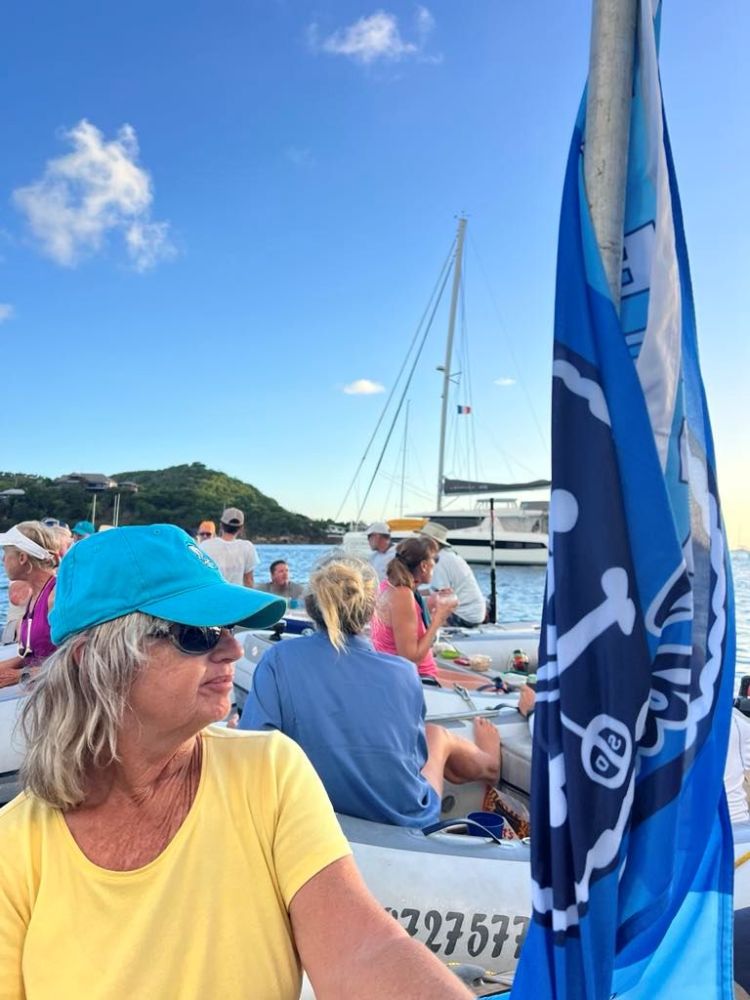
The Salty Dawg Raft-Up

We haven’t been to Deep Bay for a few years. This little bay, on the west coast of Antigua, featured a good beach, protected anchorage, a sunken ship to snorkel and nothing ashore. But developments progress and the resort

ashore, The Royalton, that started to expand when last we were here, has become very popular. Actually, when we were here, jet ski mosquitoes were also a bother. Well, the good features still exist, despite the expanded resort, and the mosquitoes are fewer.

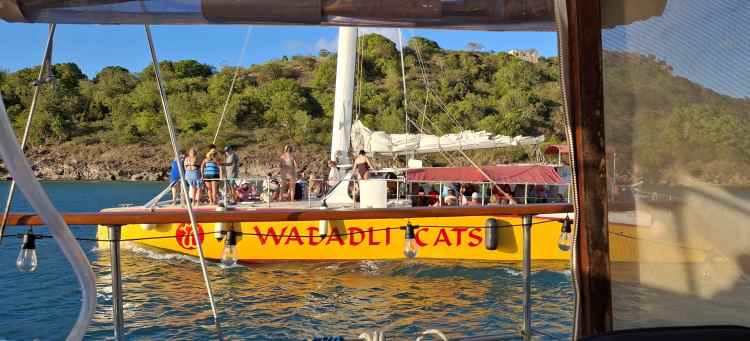
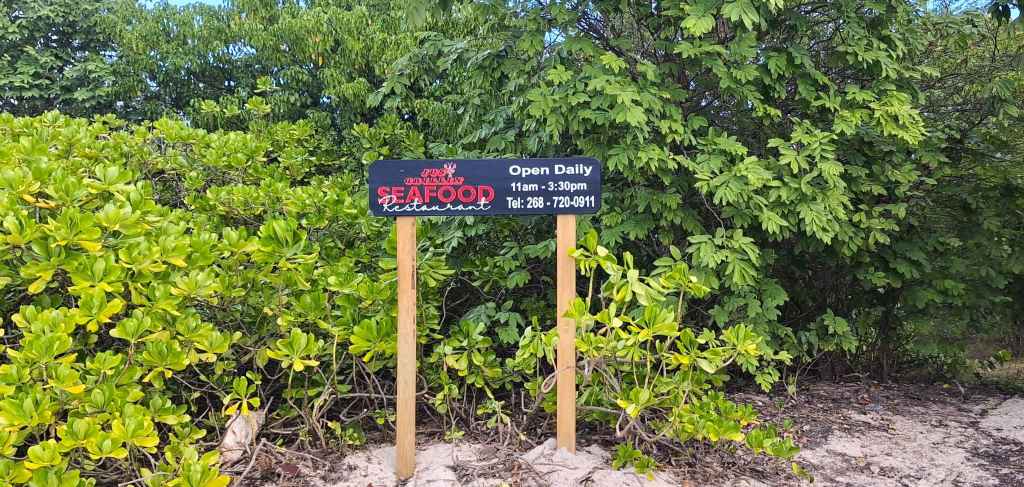
The daily Wadali “cattelmarans” of tourists still arrive for a few hours a day and there is a new very informal beach side restaurant, “Jus Grillin’ Seafood”. Otherwise, it still is a great little bay to chill out and not be socially organized.

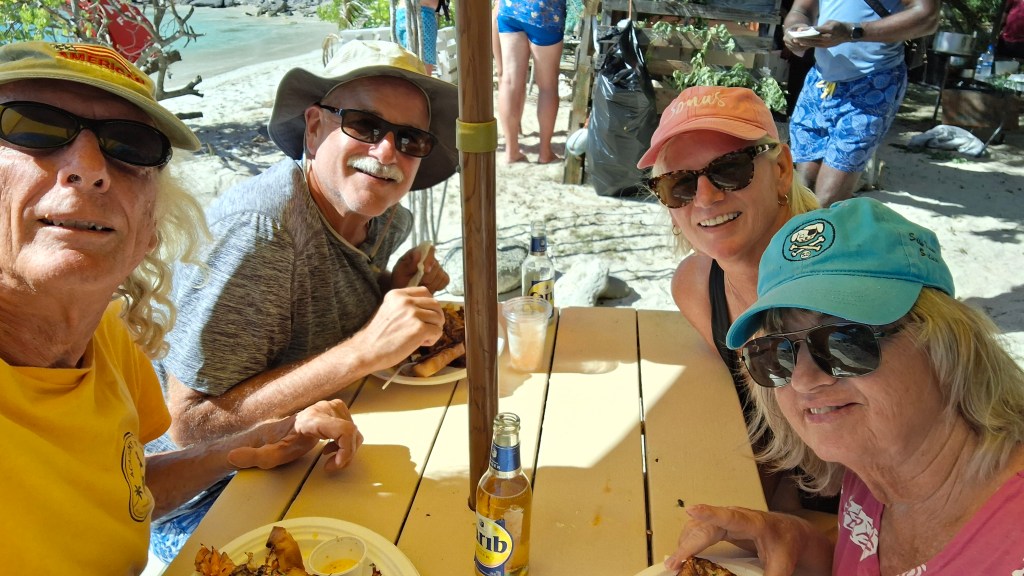
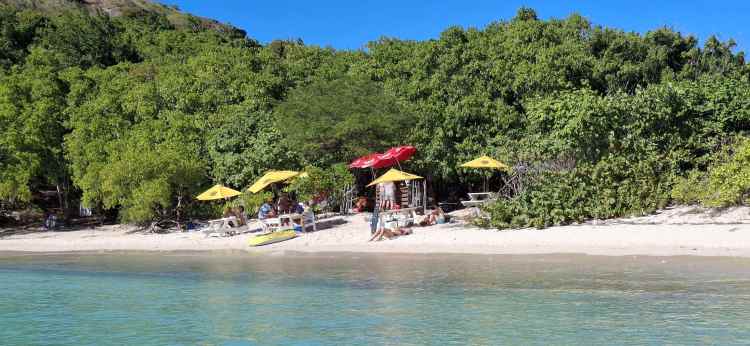
We did, however, meet one other Salty Dawg boat here (of the 2-3 other cruiser boats here) and had sundowners and lunch (lobster) at Jus Grillin.  Diane and Carl (s/v SONAS). This is also the beach we can do a brie – a South African beach BBQ – but don’t think we will do it this time around.  

So, in a day or so, we will be moving over to Jolly Harbor and then flying to New York next week to start the Christmas Holidays Social Schedule!  We are looking forward to being with family and friends but hope the weather cooperates. Coming from air temperatures in the mid 80’s, with the water temps also in the mid 80s, it is going to be a bit of a shock walking around with temps in the 30’s. That is not something we look forward to. A White Christmas looks great in photos but the Deep Bay colors are more to our style. And yes, there are Christmas trees around, despite the lack of snow.

Have a Merry Christmas and Happy New Year!

Sailin’ N Cruisin’

We sailed from Trinidad on November 2. At one time that was considered the end of the hurricane season. It was assumed, therefore, safe to venture after that date into the wilds of the Caribbean where ,hurricanes swirl, whirl and prevail. That was a major concern because most boat insurance policies excluded coverage while in the “hurricane season in the Caribbean”.  Since then, the good folks at the marine insurance business extended that date until the end of November. Lately those folks gave up the date and location issue entirely. Many boat insurance policies, including ours, excludes coverage for any “named storm, any location, any time” unless you pay more. Seems, some really believe in climate change when money is involved.

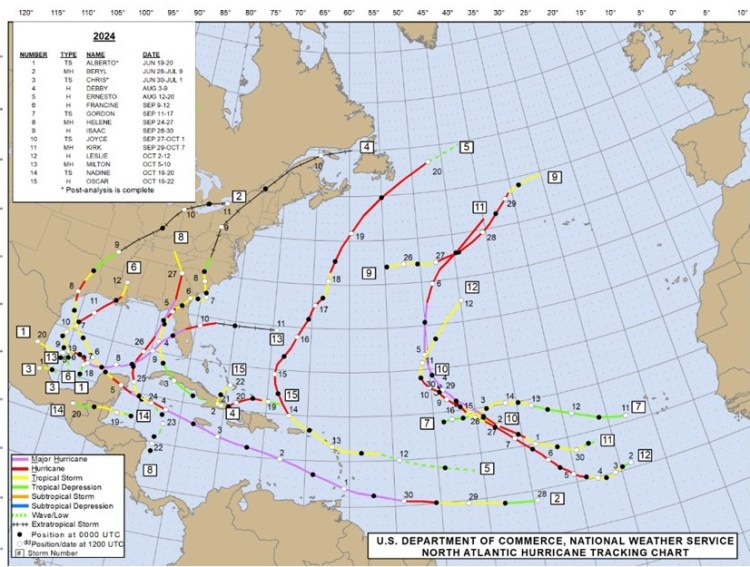
For the record, there were two named storms in the Lesser Antilles this year which is the average number for the last 30 years. Of course, Major Hurricane Beryl destroyed Carriacou but they are slowly recovering.

We sailed north from Trinidad in wonderful weather, picking our way between islands to avoid the squalls and adverse winds. We overnighted in Bequia and then sailed on to St. Lucia. There we spent five days visiting friends and cruisers. The strange thing, while in St. Lucia was that Customs and immigration was closed for almost a week. The problem with that is if you don’t get Customs clearance in and out of an island, you don’t have the right paperwork to enter your next port of call. Fortunately, our next port of call was Martinique. This French Island is not as demanding regarding the paperwork and so we cleared in and out and then had the proper papers to enter Antigua, our final destination.

In the interim, we overnighted in Dominica and Guadeloupe before Antigua. This island hopping for 536 miles brought us to Antigua just in time to gather with the arriving 80 boats of the Salty Dawg Rally from the U.S. Since then, there has been the daily social events they organized that keeps us busy. Lynn and Mark have stayed with us for a five days as their boat ROXY is in Annapolis on the block to be sold. Lynn is the social director for the Dawgs and did a great job, along with Bob (PANDORA), in setting up all the events. Things wind down after Thanksgiving as we plan to spend two weeks in New York for Christmas Holidays.

We have managed multiple dinners, played Mexican Train Dominoes and even had a private Jam on Kalunamoo with young Victor from Spice of Life.

This short video shows, we do actually sail at times. True most time is spent at anchor but as Christopher Cross sang:

Well, it’s not far down to paradise

At least it’s not for me

And if the wind is right you can sail away

And find tranquility

Oh, the canvas can do miracles

Just you wait and see

Believe me

Sailing 2024

Our current “neighborhood” is about 500 miles long and so when the wind is right we move. And when it is not, we stay. Believe me!

What a Way to Start a Vacation!

Before launching from Power Boats Boat Yard and moving to Crews Inn for a “vacation” we took a tour with Jesse James and four other cruising couples to the Pitch Lake in southern Trinidad. There are only two other places like this: one in Venezuela and the other in Los Angeles. The one here is the only one mined commercially for pitch and asphalt. It may not seem like a great tourist spot but it is an interesting place and worth the trip. And yes, we did walk in and on the lake and you could actual swim in it but we didn’t. No, it didn’t smell like tar nor did you get stuck in it if you watched your step. For some reason I kept thinking of Br’er Rabbit. However, standing in one place for a short while left an impression of your foot in the asphalt ground. Jesse also took us to the Hindu Temple on the Sea and a Hindu school and events center. Were we in Trinidad or India? As always, Jesse’s tours and commentary while exploring Trinidad are well worth it.

Walking in the Pitch Lake
Temple in the Sea
Hindu School and Events Center

Friday, October 18 was Splash Day. It is always those last minute tasks that need completing before the boat hits the water for the new voyage that creeps up on you. “Hit” is the operative word which you will read about below.

Kalunamoo had been on the hard since May 1, a long time; 4 ½ months to be exact. It has to be remembered that boat parts continually deteriorate regardless of their being actively used on the water or laying dormant in a boat yard. I think, it is a fallacy, to believe that a boat in storage will emerge in the same condition it was when it was laid up. It seems more things break when not used “in storage” than when actually being used. Therefore, it is with a certain amount of trepidation on the day of relaunching in seeing which boat part falls apart, doesn’t work, or falls overboard.

With the shrink wrap removed from the boat, we were able to lower the dinghy and get the dinghy chaps back from Sean at Superb Canvas. They needed some repair and a bag for the security chain. Also, with the shrink wrap off, it was time to see if the new hatch gaskets were water tight. They were. But other drips were found including a major leak by the power cord plugs. Not all were fixed but they don’t call these boats “Leak Teaky” for nothing. As I always say, all bleeding stops, eventually. So to, all leaks stop when the rain stops.

A week before launching, the bow thruster zinc was being replaced. Not a big deal until one of the two tiny metric flat head Allen screws dropped 4 feet onto the gravel and disappeared. Two days of searching for the 6mm long screw was to no avail. It may have gone to the center of the earth for all I knew. Just because the boat is on land does not mean when things go overboard they can be found. There must be a law that states “All things passing over the toe rail shall hence force be ceded to King Neptune for Eternity”.

Fortunately, there is a well-stocked marine hardware shop close by that had the little buggers. With quick dispatch I bought a few, King Neptune may never get them all. Upon tightening the missing screw the zinc split in half. I could almost hear King Neptune’s roaring laugh as I pondered the reality of the situation. The situation is that the Vetus zinc, made in Europe, is not an off the shelf item here. No zinc, no bow thruster. No bow thruster, more difficult to dock. Long story, short (too late?). Our cruising friend, Kevin, just happened to be in Florida and would return the night before the boat launch and could bring two down for me. First thing in the morning I mounted the zinc (after modifications) and we were good to go.

We do get the engine running a day or two before launch. This avoids the embarrassment of the dock workers standing around as you and the boat are in the slings afloat, in the well, ready to depart but either engine or batteries are dead. This never happened to us. A gushing packing gland is a story for another time.

The last touch up of the bottom paint, where the keel was blocked off was brushed on as the marina crew lifted the boat in the travel lift. It was then off to the well and into the water. All was good, the engine started, no gushing water by the shaft seal, we were safely afloat again. As we powered out of the well, we waved and thanked the dock crew and did a short run out into the bay and then returned and headed for the fuel dock. I wanted to top off the diesel tanks, get gas for the dinghy.

The new fuel dock at Power Boats was rebuilt recently. It is a very sturdy, cement deck, steel framed affair. Unfortunately, it does not (as of now) have much of a fender system. Especially at the corners. And that is where Kalunamoo met the dock. As the saying goes, “It doesn’t matter if the water pitcher fell to the floor or the floor hit the pitcher, it is never ends well for the water pitcher”.

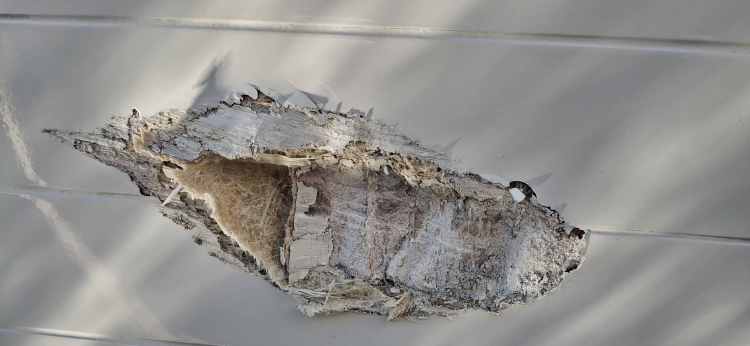
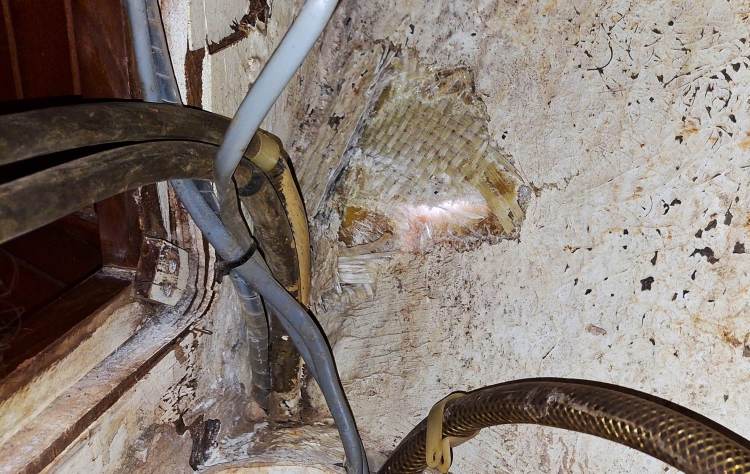
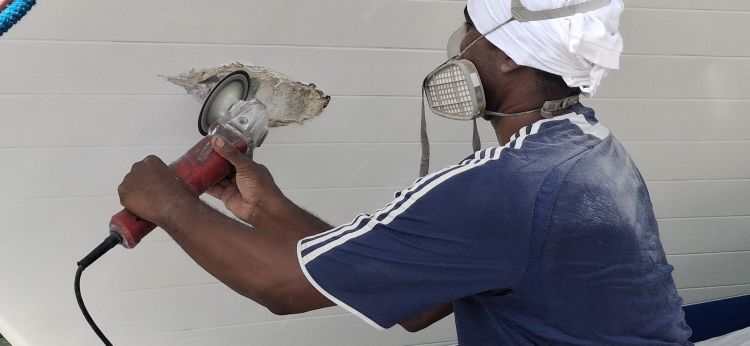
A cross current, a light wind, and perhaps a misjudgment, but in any case, the concrete corner of the fuel dock penetrated the hull two feet above the water line. The boat is heavily built but it is also very heavy. We could have returned to Power Boats and be hauled for repairs or continue to Crews Inn for our “vacation”. After discussing with Ali, the contractor who does most of our hull repairs, we brought the boat To Crews Inn. Ali was willing to repair the hull in the water. First thing Monday, Ali came down to the boat and Quincy came aboard and went to work grinding the inside of the hull. After that, he glassed the inside and ground the outside. It actually was not a big hole, only about 8×10 inches of damage. The hole was inside the chain locker so no inside woodwork was touched. More glass and filler on the outside. Then fairing and finally priming and painting.

Original Outside Damage
Original Inside Damage
Final Inside Repair
Final Outside Reair

In two days, the job was complete. We agreed before starting to use the “off white” deck paint we had on board. It is slightly different than the hull color of “fleet white” but it will do for now. Next year in Trinidad a better match with blending and buffing will be done along with the other dings and scratches that we will accumulate. Even so, the final job looks good.

For the next week or so, we will get Kalunamoo back in cruising shape, provision and watch for a weather window to head up island. We should make Antigua by the second week of November barring any tropical storm developments. That season is winding down but November or December storms are not unheard of.  Until then, we are on vacation.