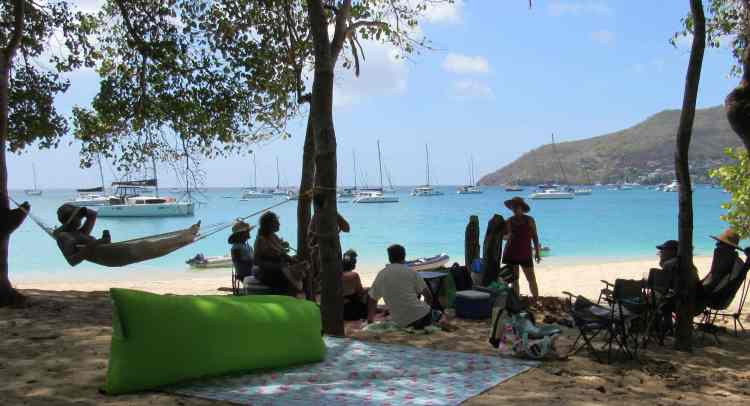
We spent almost a month in Bequia which seemed like only a few days. It is a little island that is hard to depart, not physically but mentally. It is also the first steppingstone down the Grenadines; each a small gem on the azure sea to Grenada. But this time we didn’t stop along the way and sailed directly to Carriacou. We haven’t been there since 2019 and decided to spend our last weeks this season there. This is the last island in the Grenadines but is part of Grenada. Our cruiser friends on Roxy sailed to Tobago from Bequia and we were going to sail with them, but it is a bit of a slog getting there. It is southeast of Bequia, hard on the wind against a strong current and so it is mostly “uphill”. I guess we just were not up to it!
Not that is not worth it. We have been to Tobago, a few years ago, on a “vacation” from Trinidad. A fast ferry from Port of Spain, Trinidad and a few days in a small inn was well worth it. Perhaps in the future we’ll return with the boat but for this year we elected to go to Carriacou.
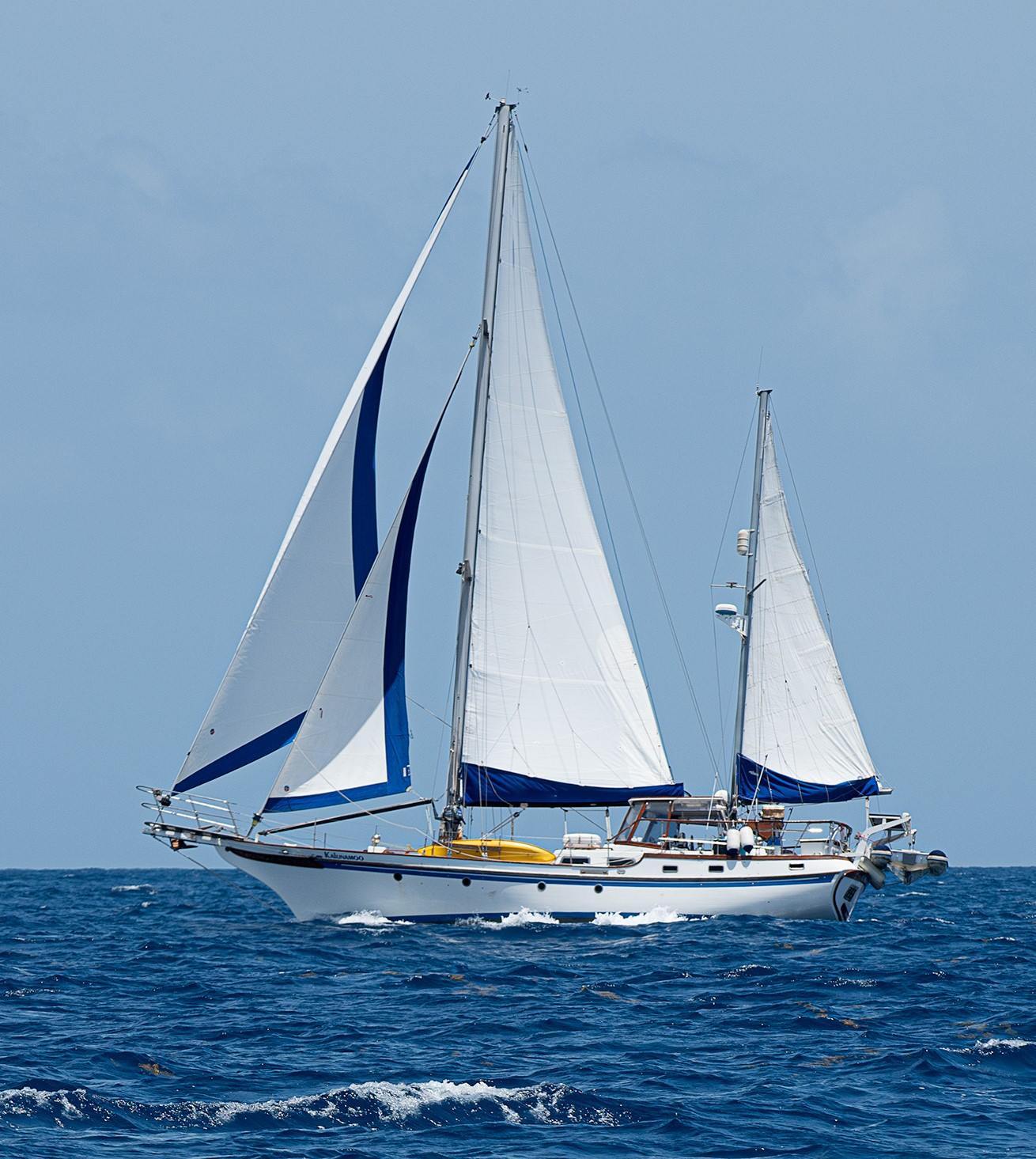
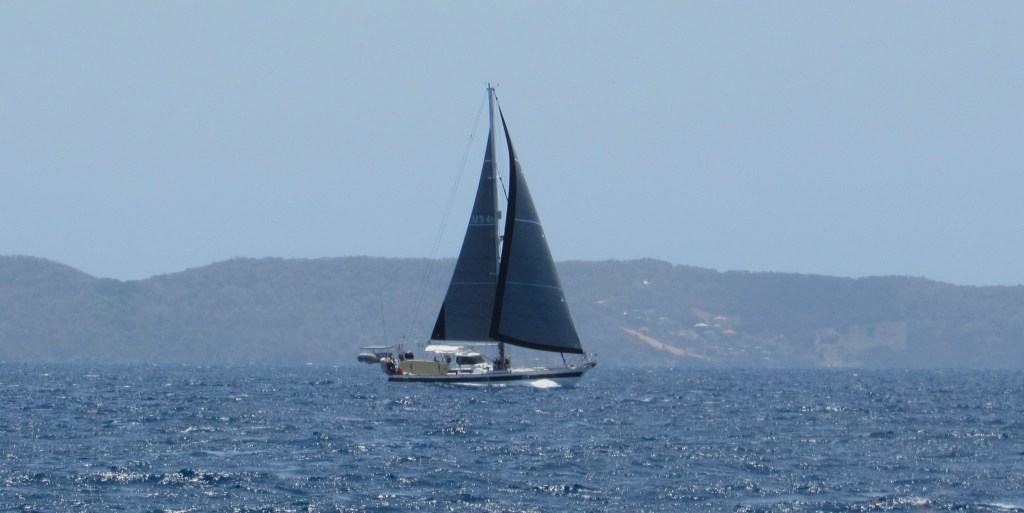
It was a great sail down from Bequia. I have found that you pay for a great sail by paying for it on other days when “unpleasant” sailing is the order of the day. We have only one more leg to sail to Trinidad, and hope to arrange another great sail. We have a few weeks to pick the right day! Another cruiser friend on Miclo 3, sailed along with us. We exchanged pictures.
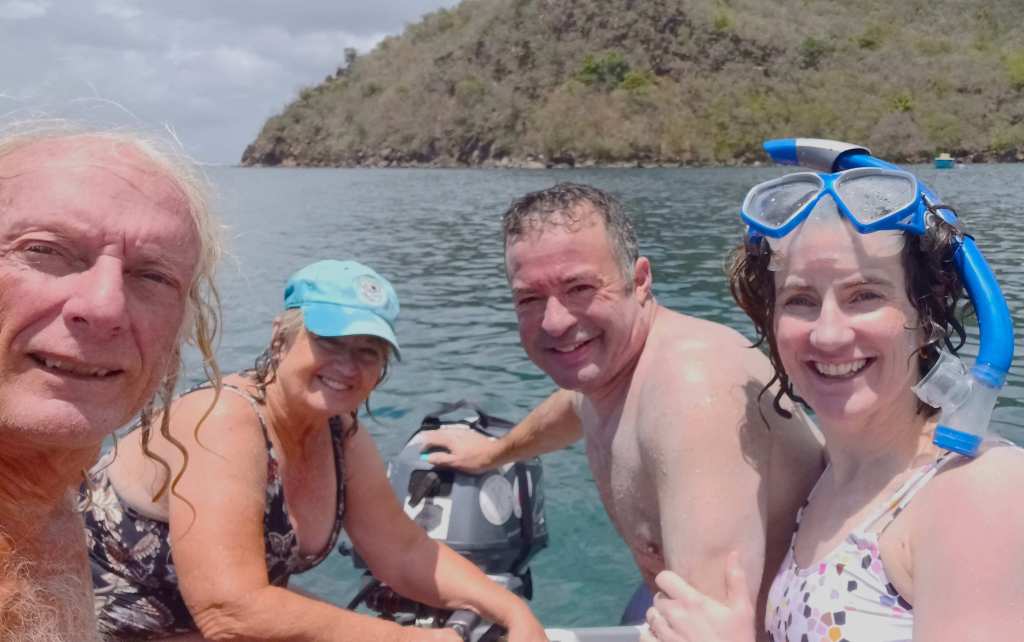
Miclo 3
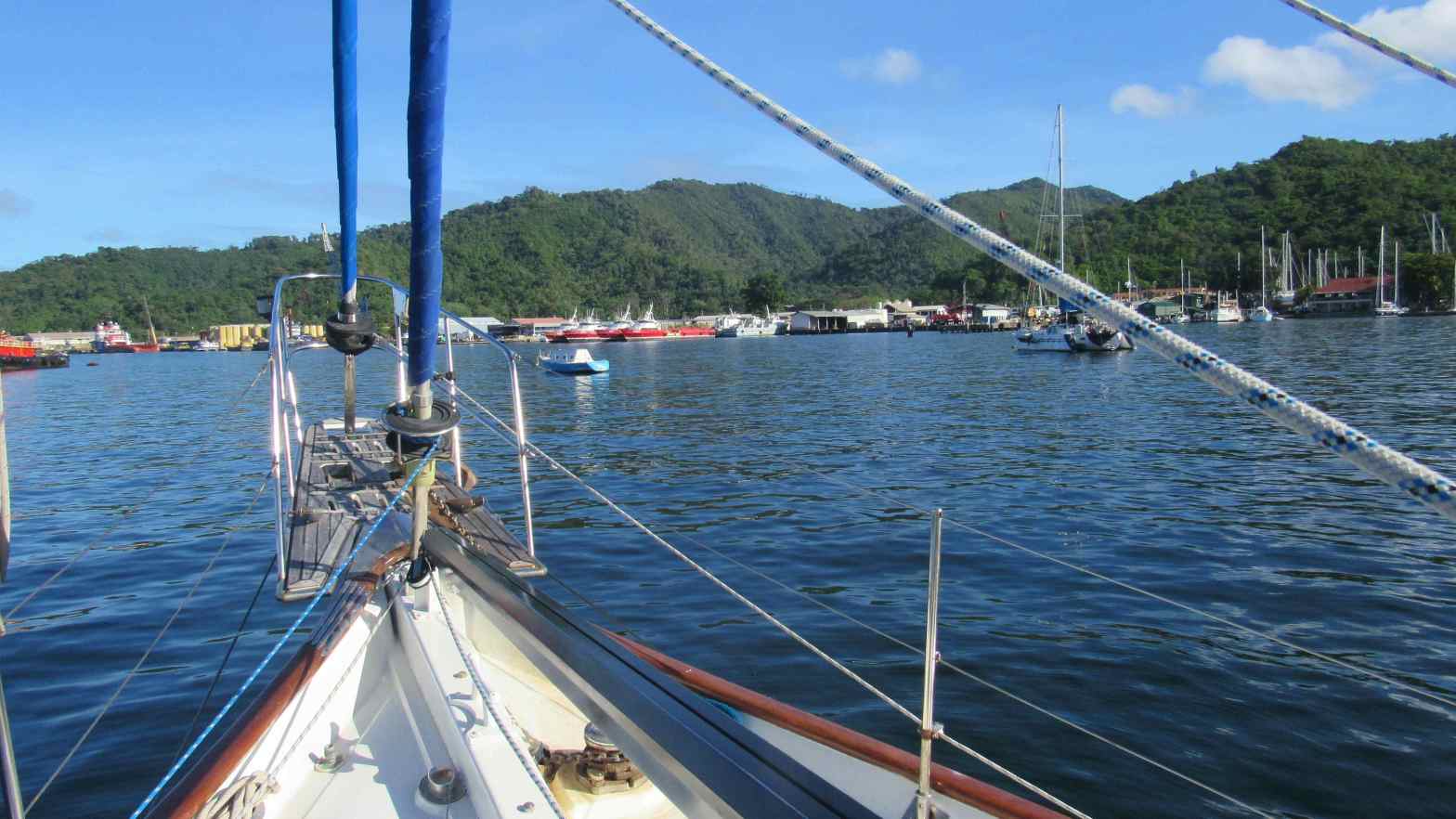
We are now anchored in Tyrrel Bay. One of the things that disturbed James Mitchell, was the trend that public music took on the Islands in the last 20 years or so. Mitchell was St. Vincent and the Grenadines PM in the late 1980’s to 2000 or so. He commented on the volume of the music whenever a party, bar, or parade was organized to socialize. That became endemic in most islands now as the sounds of party nights go for hours at a time. Any holiday is celebrated by day-long, into the night non-stop music blasting away. In Rodney Bay St Lucia, Bequia, and now here in Tyrrel Bay, we have been subjected to this. Tomorrow is Mother’s Day, and so the celebration with ear splitting music started at noon today. We are anchored a quarter of a mile off-shore and can clearly hear the sound inside the boat. The video does not do the sound justice as the base beat pulses can’t be captured on a cell phone. But even with poor hearing, there is no mistaking the 120 beat base line of the music.
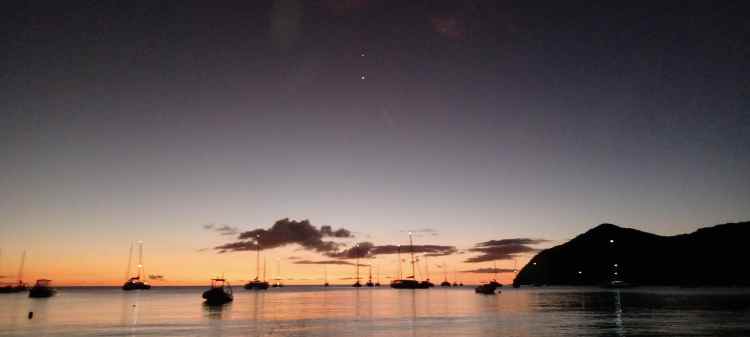
At anchor in Tyrrel Bay
The beat is almost always 120 beats per minute – just enough to raise your pulse below critical. I wouldn’t comment on the actual music as that is a matter of taste. Regardless of musical style, the volume itself is indefensible. And I have bad hearing. My theory of why this occurs is as follows. Not everyone has the equipment to properly hear the nuances of this music. In order to compensate for this, when music is played, it is shared by the whole island at the same time. This necessitates, a volume sufficient to cover the whole island. Apparently, radio stations are too old school to serve this purpose. I don’t doubt that the equipment used for this purpose was the same ones used by the band Spinal Tap: amplifiers that went to 11 and 12.
Tyrrel Bay is lovely. We will spend much time here and plan to go to Sandy Island, Paradise Beach and maybe other west coast anchorages.
By June we will be off to Trinidad. They too have the music turned up but fortunately not in the boat yards! They did have Party Boats with this sound that go out at night. I think the Venezuelan’s at the time, 12 miles away, enjoyed the music. A few years ago, we attended a night of The Battle of the Pan Bands in Port of Spain. I described it as a hurricane of sound in intensity and nearly the same in effect. Our jam sessions on board Kalunamoo are not nearly as boisterous. My amp only goes to 10.
Over the last number of years, we have sailed past St. Vincent numerous times. This large islands always looks green and rugged with few settlements or towns along the west coast. Few beaches are evident, and no natural harbors exist except for one or two at the southern end. In addition, a reputation of not being safe in some anchorages discouraged us from landing on the island. We therefore have sailed passed and anchored in Bequia, the first island of the Grenadines. These small islands are wonderful although they also had a history of “safety concerns”. As with most places, however, reputations are hard to live down and St. Vincent and the Grenadines (yes, that is the official name of the country) are probably no worse than many other islands.
After helping with the demasted sailboat (see last post) and which we assume made it to port, we anchored in Bequia. A number of cruising and Salty Dawg boats were here, some coming and going using Bequia as a jumping off point to the smaller Grenadines. Sundowners, beach BBQ, dominoes, restaurants, and gatherings have occupied our time but the lure of St. Vincent was always on my mind.
We decided the best way, at least for now, would be to take the ferry from Bequia over to St. Vincent and tour the island. Cruiser friends recently did just that and recommended a tour guide (Hazeco Tours). We would take the one-hour ferry at 6:30AM and land in Kingstown, have breakfast, then tour with a guide for the day. The last ferry back is at 6PM so there is no rush to leave the island.
We made arrangements for last Monday but knew the weather was not looking too good. It turned out that a week of showery weather was in store for us. Sunday night, Millie, the tour operator called and said the forecast was really not good to drive up the mountains and so we decided to wait until Friday when the weather returned to more “normal” conditions. That was a good call as we saw later mudslides can easily block roads.
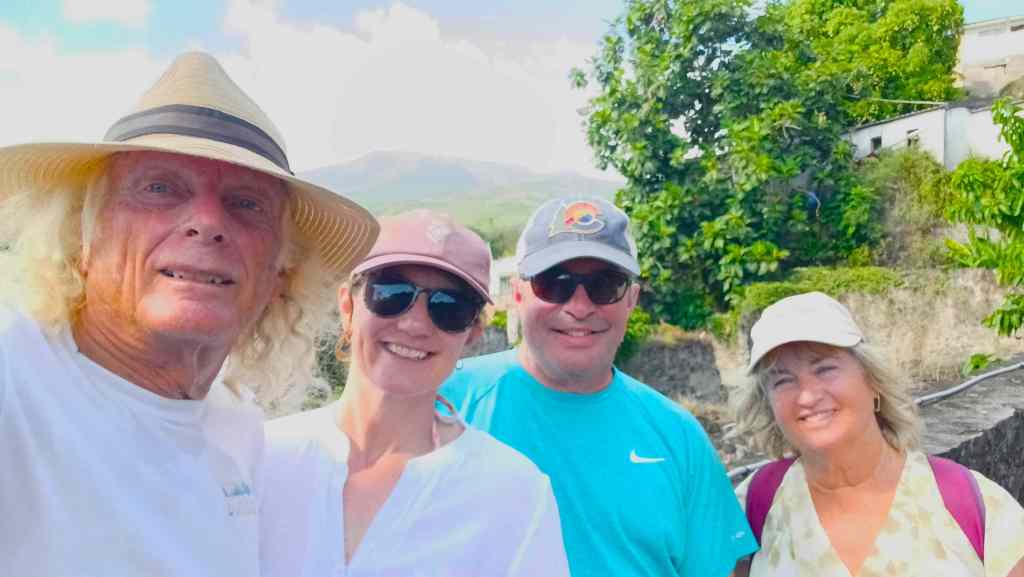
Mark and Lynn on ROXY joined us, and we took the 6:30 AM ferry to Kingstown. We ate breakfast at the oldest hotel on the island – The Cobblestone Hotel – and awaited on our guide. We met Fiona waiting for us outside the hotel, but the driver of the van was stuck in traffic. As small as these islands are, traffic jams can be as bad as mid-town Manhattan in rush hour. A bit of a wait, but we all piled into the van and off we went. Of course, we were still in traffic, but eventually made it out of town.
Fiona and our driver
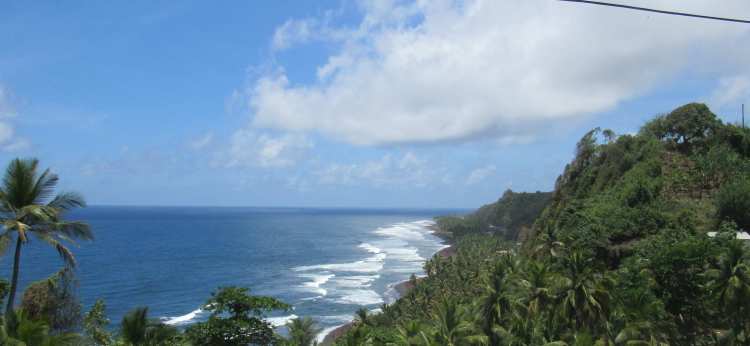
We had a few suggestions as to what to see but generally left it up to Fiona as this was our first time on the island. There really is only two main roads from the southern end of St Vincent where the capital and main town, Kingston, is located. One up the west coast, one up the east coast. Neither run all the way to the north end. La Soufriere, the volcano that erupted in 2021, is at the north end of the island.
About 20 minutes into the trip, we heard a bang and thought the van had a tire blow out. The roads are full of potholes, so that is not unusual. Unfortunately, it was much worse as the ball joints broke and the wheel was essentially off the vehicle. We could only thank God that it didn’t happen on any of the steep roads. Not many have guardrails!
It took about a half hour for a car replacement and Fiona and the four of us climbed into the van and we were off again. Unfortunately, the traffic delay and the broken van meant we wouldn’t get to the Montreal Gardens. Well, maybe next time. We did continue on the east coast heading north.
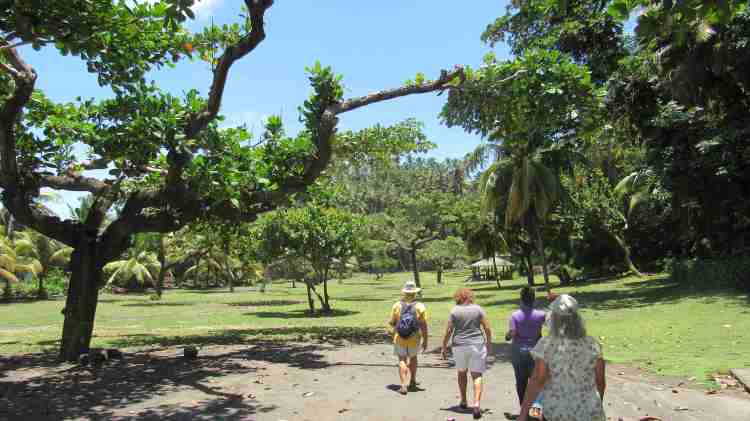
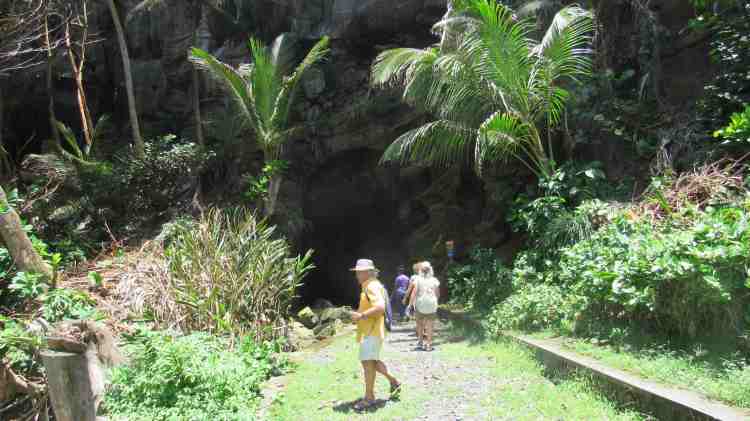
We stopped at Black Point, which is a National Park and the sight of the Black Point Tunnel. This is a man made (by slaves) tunnel through a headland. It was used to transport sugar from the surrounding plantations to ships in the bay on the other side of the headland. It also included small storage rooms (caves). The bats and crawling creatures in the tunnel was an added attraction!
Continuing further north we entered the Red Zone. This area, about 1/3 of the island, is where La Soufriere is located and was very much impacted by the eruption in April 2021. That same volcano erupted in 1902 and 1979. In April of 2021, we were in Antigua but sailed to St Lucia in early May. This was during the height of the pandemic lockdowns with not many islands “open” for cruisers, however, St Lucia was one of them. We were concerned, however, how it would affect St Lucia, but the prevailing winds carried the ash east and west and little to the north.
The Eruption in 2021
La Soufriere today
On St Vincent, the situation was very different. The Red Zone had to be evacuated due to the volcanic fall out of ash and “fire balls”. Electricity and water were cut off and mud flows cut off the roads. The ash eventually covered the entire island and contaminated the water supply and severely affected agriculture. Our guide, Fiona, lived in the south by Kingstown and said she couldn’t breath outside and had to seal up all windows to keep the air breathable. Airports were closed for weeks as the ash disrupted normal air traffic. Over 16,000 people were evacuated from the red zone. The government eventually build new housing for them in the zone.
One of the lasting effects we saw were the numerous dry rivers. As in most of these islands, inland rains may make small streams into “flash flood” zones at times and it was no different here. But there is a difference. These streams carry ash and boulders released from the volcano. This makes the flood water almost like a surrey with a much more destructive force than just water. House were destroyed and burned. Bridges have been rebuilt but when flash floods occur they make it almost impossible to cross.
One good thing that these have brought is a new source of income. The ash aggregate was found to be a very good base material to make cement. The dry riverbeds provide an easy source of this material and is used and exported as all new construction is cement block and concrete.
Dry river bed
We then went to Owia Salt Pond Recreational park. At this picturesque point, a home cooked lunch of chicken and rice and rhum punch was provided by the tour company and eaten overlooking the tidal pools of Salt Pond. The beaches in this area have the black sand of the volcano but are still very “Caribbean”.
The drive back to Kingston covered the same territory while Fiona commented on life in St. Vincent. As in all these islands, their economies are trying to expand from just a tourist destination. St Vincent, is actively expanding its tourist attractions and visitors, is also supporting local agriculture and products to help diversify their income. They may be late to the game regarding tourists; they only recently opened their international airport. This may go back to James Mitchell’s ideas after St. Vincent became independent in 1979. Born in Bequia, he was their Prime Minister, 1984-2002 and saw the future as including tourism but wanted St. Vincent to be unique in that regard. Large international resorts were not envisioned. He may have gotten his wish until now, but it is hard for any government to turn down multi-million development plans. But as Fiona pointed out, construction jobs, materials, and ownership profits are very rarely beneficial to the local population.
The ferry dock in Kingstown
We got back to Kingston in time for the 6PM ferry back to Bequia. It was a good tour and would recommend doing the same to anyone to get an overview of the island. In the future, we are sure we will anchor in some of the anchorages on St. Vincent and take advantage of other sights.
It’s a word that is easy to say. That is what Fredrick Mockford thought in the early 1920’s. He wanted a word that was easily understood by pilots (English and French) to indicate an emergency over voice radio. At the time, he was the officer in charge at Croydon Airport in England. It was a good choice because m’aidez in French means Help Me. SOS was the recognized telegraph signal but was not suitable for voice radio – ESOHES – which was the new tech on the scene. All this is background to our recent experience when sailing from St. Lucia to Bequia.
After Melanie and Dave flew home from Martinique, we sailed to St Lucia for a few days. Then we were off to Bequia and south. The sailing weather was great, with winds 15-20 knots on the beam although the seas were running 6-7 feet. We left Rodney Bay around 4 AM to be in Bequia way before sunset. Light winds and calm seas in the lee of the islands is balanced with high winds and seas between islands. This trip was no different. Sailing southbound, just after passing the Pitons in St Lucia, the wind picks up as you make for the north west corner of St. Vincent. Since the winds were moderate, and actually slightly north of east, I gave thought about sailing on the east side of St. Vincent down to Bequia, an island just south of St. Vincent. This might save time and miles and avoid the wind shadow of St Vincent. The down-side of that is that you are sailing along a lee shore with no place to land if something happens. And things happen at the most inconvenient time. A recent experience of our cruising friends also played on my mind. Their rudder got stuck hard over when sailing to Martinique and they circled an hour freeing it, all the while drifting toward Diamond Rock. They managed to disconnect the cabling and used the autopilot to steer, arriving safely in Ste Anne.
No, we will sail on the west side to Bequia and made a course to the lee of St Vincent. We would be in the lee of the island for lunch! All was going well until a pop and bang shook the boom and mainsail. We heard that before – when the boom broke, when the vang broke, when the stay sail tack broke, ect. But this was a broken cam cleat on the boom vang. Not a terrible thing and an easy jury rig fix. We continued on.
We were about 5 miles off the northwest corner of St Vincent when we though we heard “mayday, mayday, mayday” on channel 16 on the VHF (the emergency channel). Nothing was heard after that until about 5 minutes later we heard it again. Yes, it was definitely a mayday. There were a few other sailboats in the area but we saw nothing unusual. This time I responded and ask who was calling a mayday. Again, no response for a few minutes and then someone said they had a broken mast. This started a very tortured conversation first with a man and then a woman. Apparently, they did not speak English very well and couldn’t understand our questions. Maureen was manning the VHF at this time as I searched for the boat. I spotted a boat that was about 2 miles away but it looked like it had a mast and sail up but not moving. I altered course to get closer and saw that the mast above the spreader was bent down to the waterline. Needless to say, their VHF antenna was probably down and they were on a hand held radio.
The area this took place in is known as a “compression zone”. It occurs at the end of the high mountainous islands where the wind is forced to whip around the island. This increases both wind and waves for a few miles. But the tradition of the sea, and common curtesy, requires an “all hands” response when another boat calls for help, and so we altered course to come up close. Over the next 30 minutes or so we circled around them and with radio relay help of two other sailboats closer to shore, got word to the local Coast Guard of the situation. It was a French sailboat about 40’ long with a man, woman and child aboard. Apparently no injures or sinking. We could do nothing else but assure them that the authorities were called, and help was on its way. In the meantime, the man was cutting away the rigging as you can’t use the engine until you make sure there is nothing in the water to foul the prop. We got word that the Coast Guard would be there in about a half hour (or was it an hour and a half?). They had to come from the other end of the island. Satisfied that they were on their way with the accurate GPS position we gave, we couldn’t do anything more (circling with main and stay sail in large seas is not pleasant!). We resumed our course south. In short order we saw the Coast Guard boat speeding up the island and turn out to sea toward them. We heard that they got to the scene and were proving assistance. We don’t know if they went aboard or not but we are sure they were well assisted.
No pictures on this post as in haste, “technical errors” ensued during the events described.
Just another day on the water? Perhaps, but as I wrote above, things happen. A simple word, thought about 100 years ago, saved the day for a French couple and a child.
We have a sign in our salon that reads “Friends welcome, Relatives by APPT”. Cruiser friends laugh when they read it as most assume we discourage, or at least put obstacles in the path of visiting relatives. This is completely not true. The fact is that “friends”, specifically “cruiser friends”, can and do drop by any time they drop anchor in the same harbor where we are. The longer we are down here, the more we run across these fellow cruisers no matter what harbor or anchorage we are in. No APPT needed to share sundowners, just dinghy on over!
Relatives are equally welcomed. However, the difference is that they live thousands of miles away, book air tickets weeks in advance and have to know when and where, we will be. The latter is not easily discernable far in advance. This is not by design, but it does depend on air currents, weather and sea conditions, and in the general direction we are traveling. So APPT’s are definitely needed, so that we both arrive on the same island at the same time.
Dave and Melanie at Ste Anne
Our oldest daughter Melanie and son-in-law Dave flew to Martinique just on schedule. We sailed up from St. Lucia as mentioned previously and we were at the right place at the right time to greet them. It so happened that the week before, when we were at a beach BBQ, a fellow cruiser had his daughter and boyfriend on board. They happened to be flying back to Montreal the day our daughter was flying in from Montreal. He was also expecting his brother on that same flight from Canada. That made arranging one taxi to the airport to transport family to and from convenient. All went well and nobody got lost in the shuffle.
We stayed in Ste. Anne a day so that Melanie and Dave could get their feet wet and hike around to Salines Beach. The next day we sailed around Diamond Rock up to Anse Chadiere. We did encounter a good 30 knot squall just before Diamond Rock that tested their commitment to sail but other than some black and blue marks, we survived and carried on.
Chadiere is just south of Les Anses D’Arlet and is a good snorkeling spot. The weather was fine for that and then we had a late lunch at one of the many beach front restaurants. Back on board we looked forward to showing them a Green Flash sunset. This was not to be, as “feather canyons everywhere…got in the way”. A minute fine green flash may have occurred, but it was not convincing. Well, we had four sunsets to go.
The next day we sailed up to St. Pierre. Melanie and Dave are hikers and so they set their sights on Mt. Pelle. The night before we had dinner at L’Alsace a Kay, a great French/German restaurant with a great view of the setting sun. The dinner was great but, again, clouds got in the way of a Green Flash.
On Wednesday they set off by bus to the trail for the climb up to the top of Mt. Pelle. Actually, the bus stop is a considerable distance from the trail head, but they managed to hitched a ride for part of the way and then they hiked the trail to the caldera. The weather was great for the hike, no squalls and good visibility at the summit. They did admit it was not a walk in the woods. More like a Goat Trail and more of a challenge than expected but they had a great time. The view from the top was clear all the way down to St. Pierre.
Mt Pelee in the background
That night after another disappointing No Green Flash Sunset, Mexican Train dominoes and Rhum samplings were had. No, the rhum does not enhance the sighting of the Green Flash. The next day we went to the Depaz Distillery to resume the sampling.
Waiting for the Green Flash
By Friday we sailed (motored) back to Fort de France. Since it was Good Friday, the town was deserted, and everything was closed. Clouds descended and no Green Flash would be seen that night either. But a JAM and Train session was had on our final night together.
Saturday, breakfast ashore, which took an exceeding long time at a small kiosk by La Savanne, completed the visit from Melanie and Dave. A taxi arrived and they were off to the airport and on the way home.
It was a great week that we all enjoyed and hope that we can continue to arrange these APPTs for relatives. Now only if we can arrange a Green Flash APPT!
Maureen announced “I made a dentist appointment”. It was an announcement that many people make, usually for a cleaning or other routine checkups. A few months ago, I lost two fillings and needed some “repairs”. The fillings are at least 50 years old, if not longer. When you think about that it is really amazing they last that long. What other things did you buy 50 years ago, used heavily every day, and didn’t need repair? Soon after another filling came out and it sems like a chunk of the tooth came with it. Ok, too much detail but Maureen had a good experience with a dentist in St. Lucia – an implant – so off to see the dentist.
Dr. Glace in Rodney Bay is only about 25 miles away. But since we were in Martinique and he is in St. Lucia, that is about a 4 hour ocean sail. But that depends on wind and sea conditions. It also means customs clearance in Martinique and Customs, Immigration, Health and Port Authority clearance in St. Lucia. In other words, it’s not a hop in the car for a 15 min ride to the dentist.
It was an easy sail south to St. Lucia in northeast winds and typical trade wind seas. We sailed on a Friday to avoid over time charges when clearing in and anchored in Rodney Bay. We tend to ignore the old sailors dictum to “never sail on a Friday”. I don’t think old sailors worried about overtime charges. We also came to St. Lucia for a quick “shuttle” trip to New York (by air) for a week. I had some tax work to do, and we promised our daughter to do some babysitting for a few days.
Monday morning, I saw Dr. Glace who quickly filled the cavities and we decided to have a cap done for the third. On Wednesday I was back to be “fitted” with a cap which will be ready in about 3 weeks. Later in the week we brought the boat into Rodney Bay Marina and prepared to fly back to New York for a week. Seeing cruiser friends and others in Rodney Bay made us feel like being in a “home base”. It seems like Antigua, St. Lucia and Trinidad are becoming our “home base” islands or nexus islands to conduct boat repairs, doctor visits and air travel arrangements.
Rodney Bay, St Lucia
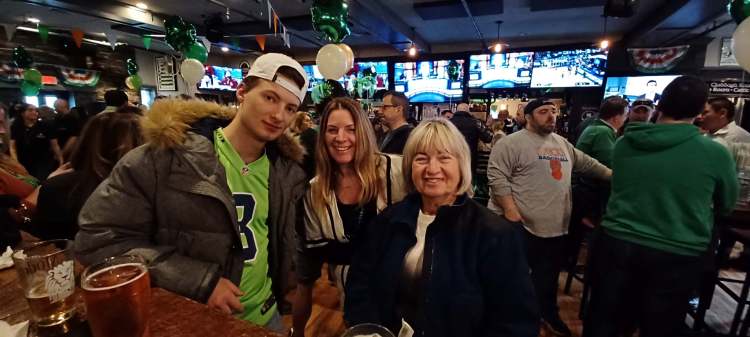
St. Pat’s Day, with Michael and Laurs
We did fly to NY for a week, completed the tax work, babysat for a few days, saw family and friends, celebrated St. Patrick’s day and then flew back to St. Lucia. The weather was ok but considerably colder than the 80 degrees in St Lucia. A few snow flurries and cold winds greeted us but we survived! The only problem flying off island in St Lucia is that it is at least an hour and half taxi ride to the airport. This time it took two hours and as we arrived at the airport just as they started to board. The one flight a day cannot be missed!
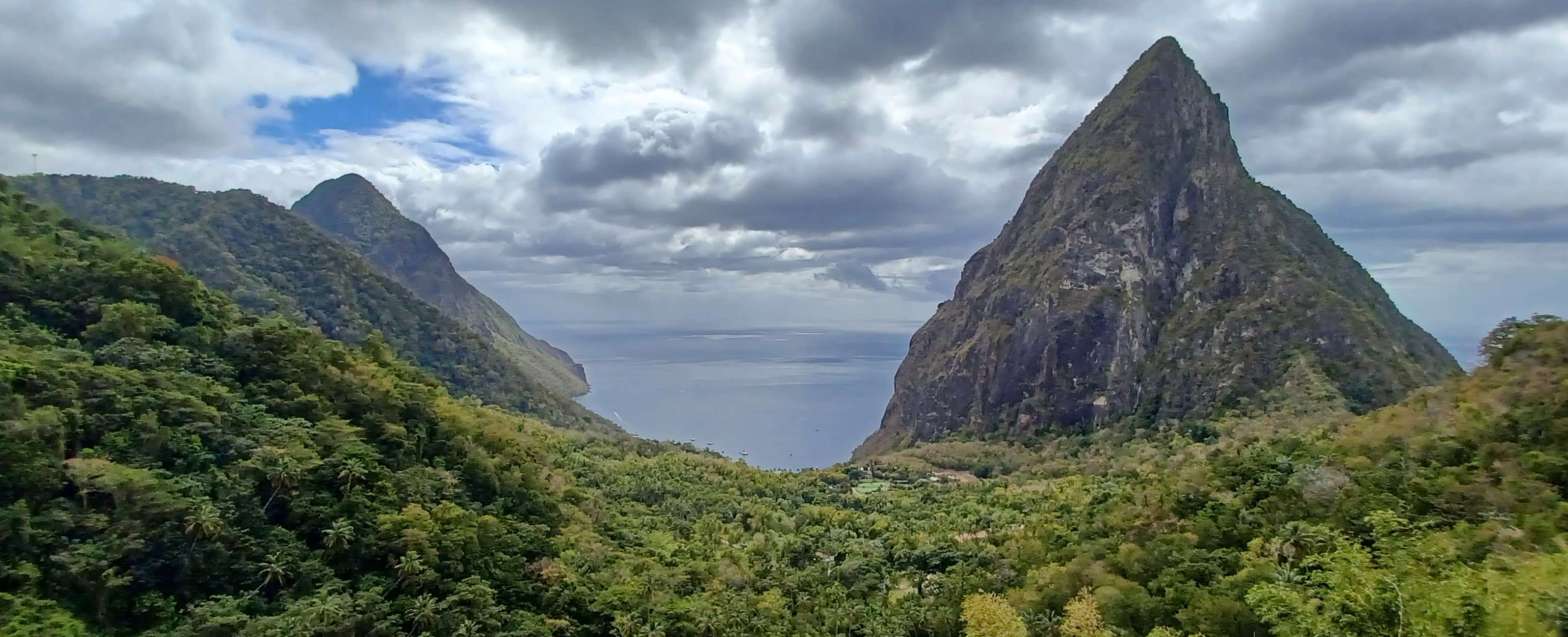
We few back to St Lucia with another couple that were going to sail with our cruiser friends Bob and Brenda on PANDORA who were also in St. Lucia. The six of us took a road trip the day after we arrived and had a great lunch at Ladera’s. Ladera is a high-end resort overlooking the Pitons. St Lucia is one of the most beautiful islands in the Caribbean and the Pitons are two of the very impressive “pointy” mountains of the island.
After the short visit to St Lucia is was time to sail back to Martinique as our daughter Melanie and husband Dave will visit and stay with us for a week. The sail back on Friday was not as good as the sail down as it was an upwind sail and head seas. Maybe those old sailors knew something. But now we are back in St. Anne planning a week with our daughter and son-in-law. We are looking forward to that. Besides beaches and sun, sailing and restaurants, they want to climb the volcanic Mt. Pelee. Well, they are young enough. This three-quarters of a century body is not up to that task. I’m just grateful my teeth are still in my mouth. We sail to St. Lucia after a week with Melanie and Dave to get a cap.
Around 130 AD the Arawaks arrived from South America and settled in Martinique. There was no custom or immigration forms to complete, they just came and set up shop near Mt. Pelee. Maybe that was a mistake. Mt. Pelee erupted (didn’t like the immigrants?) around 295 AD and nearly wiped out the Arawaks. The Arawak’s luck wasn’t any better when the Caribs landed on the island around 600 AD. They nearly wiped out the Arawaks also. Christopher Columbus charted the island in 1493 but didn’t land on it until his 4th voyage in 1502. He came, he saw, and left some pigs and goats and then left. Apparently, the Spanish were not impressed with what they found. One hundred and thirty-five years later, 1635, French citizens from St. Kitts arrived and set up shop near Mt. Pelee. They liked what they saw and expanded their agricultural products while pushing the native Caribs to the east side of the island. By 1660 the pesky Caribs were no more. Twenty-five years later, 1685, the local crop was sugar and it was so profitable they brought in slaves (nothing like cheap labor to make it profitable) to “help” with the harvest. Sugar was more valuable than gold (or diamonds). This attracted the attention of the Dutch and English like bears to a honey pot. Needless to say, this resulted in typical human actions, namely multiple military actions.
In 1672, Louis XIV built a fort, Fort St Louis, at Fort Royal Bay (it’s good to be king and name a fort after yourself). The town, Fort Royal, was built in a malaria swamp. At least it wasn’t near Mt. Pelee. In any case, the next 200 years saw military actions, multiple Anglo-Dutch wars, the Seven Years Wars, revolutions, the Napoleonic Wars, slave revolts, hurricanes, rhum, pirates, yellow fever epidemics, and the birth of Josephine in Les Trois-Ilets. By 1848 Fort Royal became Fort de France, slavery was abolished the malaria swamp was filled in and the town competed with St. Pierre (in the shadow of Mt. Pelee) for commerce and population. Paul Gaugain came and painted some great works. The great iron and glass Schoelcher Library building was disassembled in France and reconstructed in Fort de France. It is still there despite a fire in 1890 that destroyed much of city. The balance was done in by a hurricane the next year.
Mt Pelee in the clouds, PANDORA at anchor
Not to be outdone, Mt. Pelee erupted in 1902 killing 29,000 people. The island survived, hurricanes came and reshaped the land, World Wars occurred (the movie “To Have and Have Not” was based on Hemingway’s story of a fisherman in Fort de France) and today, as a French Department, it is subsidized by the national government and developed into a great French tourist destination. Some regard this French subsidy as reparations for its involvement over the last 500 years. Others thank retired French chefs for the restaurants they open here.
All this is to say we first landed in Martinique in March of 2015 at St. Pierre and find the history of this island very interesting. The specific history of the islands explains a lot about their current affairs and circumstances. This year we stopped at St. Pierre, Trois-Ilets, Grand Anse, and St Anne. We will return in April when our daughter and son-in-law visit us. I only wish I could speak French, although buddy boating with ROXY has been a great help. Lynn has perfected her French to the point that we know what to eat, where to find things and, in general, don’t act like ugly Americans. Thanks Lynn!
Kalunamoo and the Mats, photo by Mark on ROXY
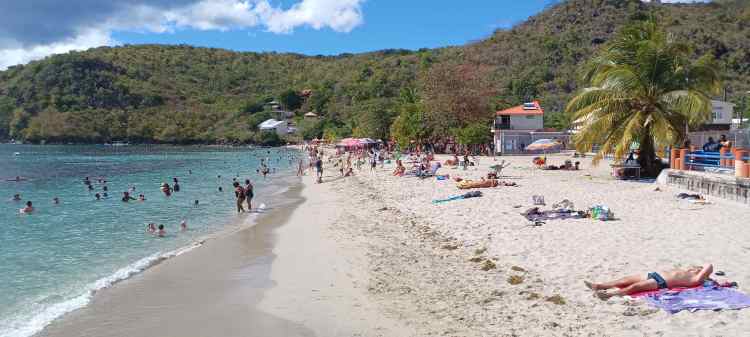
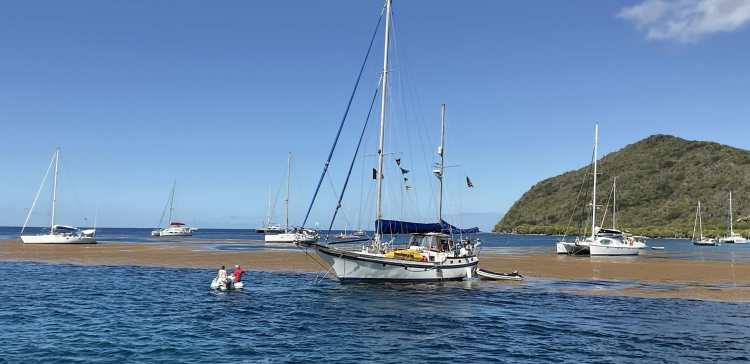
After we went to the Carnaval in Fort de France and sailed from Trois-Ilets, we spent a few days in Grand Anse D’Arlet, a small picturesque sea-side French village. Beautiful Les Anses-D’Arlet is just a dinghy ride around the headlands away. Both feature beach front restaurants, good swimming, snorkeling and great sunsets. The day before we sailed out, light winds and currents brought in mats of Sargassum seaweed. The last time this happened to us was in Joist Van Dyke in the BVI’s. Fortunately, the mats do move on but eventually come ashore and present a real problem for beaches. Presently there is no solution to this problem.
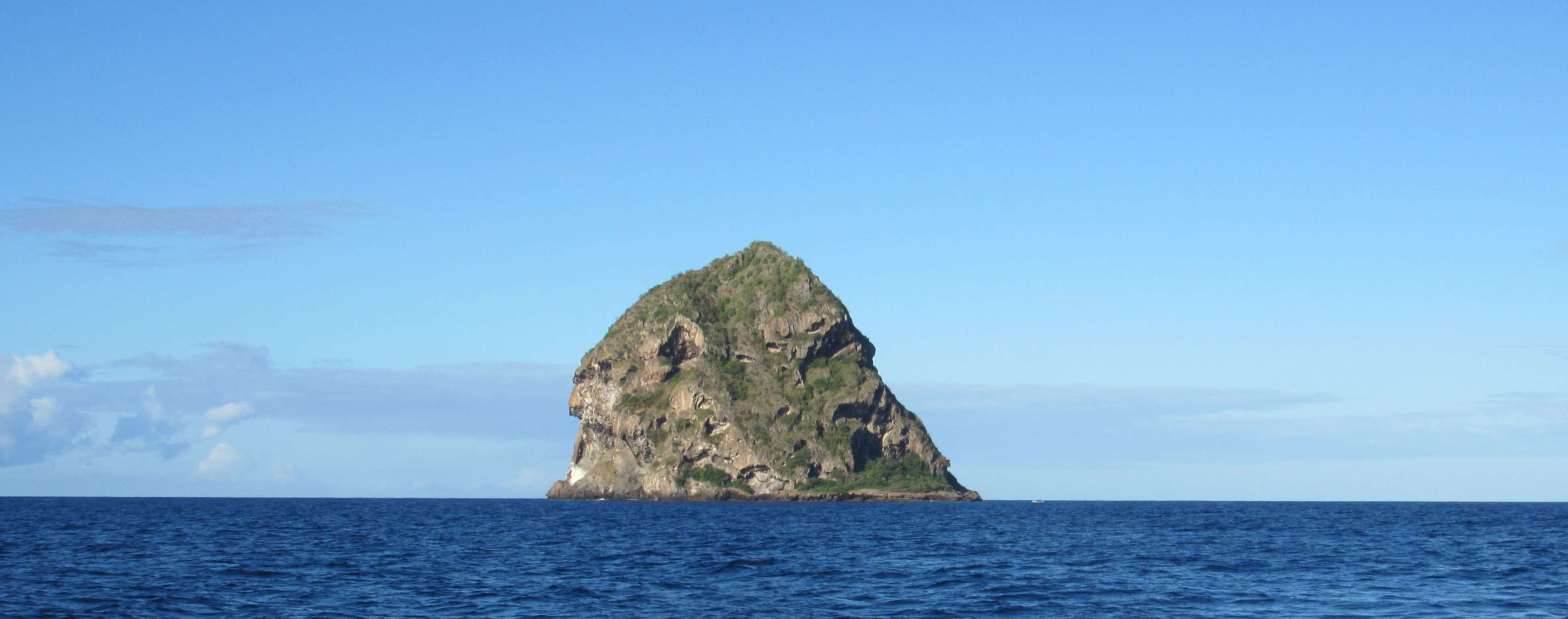
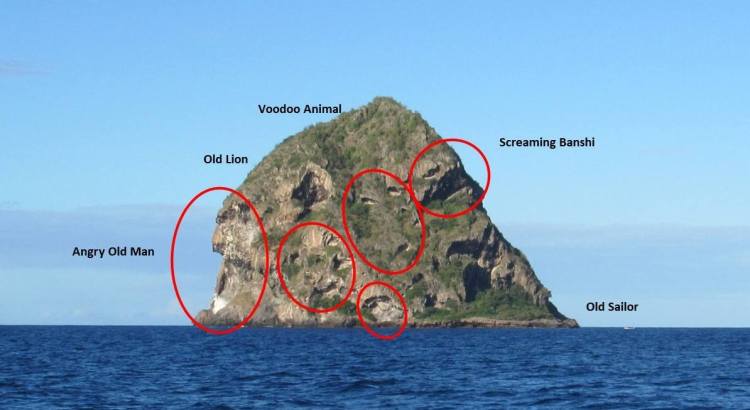
On the way to St. Anne, you have to sail around the south-west corner of Martinique and round Diamond Rock. If you are sailing south, you may have some good wind until you round Point du Diamant, then head winds for 10 miles to St. Anne. If you head west from St Anne, you have a down wind run to Diamond then you have head winds after rounding it. Diamond Rock is named, obviously enough, because it looks like cut diamond from a distance. Having rounded this a number of times, I thought of other things about this rock other than diamonds. How the British lifted cannons up to the top in one of the many Special Military Operations at the time is one of them. But much like looking at clouds, Diamond Rock seems to have many faces imbedded into it. If only they could talk! Maybe they would fill in some interesting historical details of Martinique that I may have left out. Next time we sail by I’ll look for more and maybe ask them some questions.
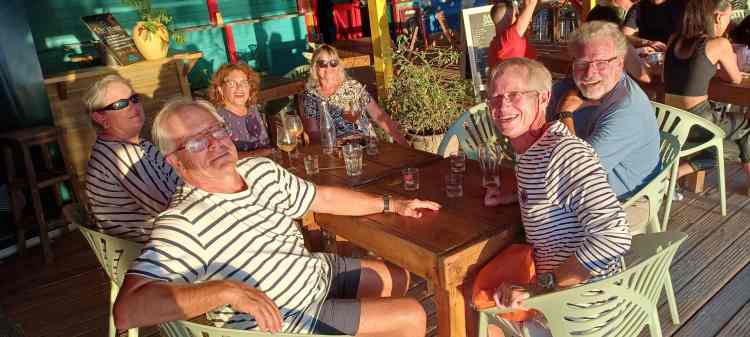
Well, we had French Sailors Night Sun Downers on the beach front bar with cruising friends on ROXY, PANDORA and MARIPOSSARAH II.
It was a fun time with a great Green Flash sunset! I’m convinced, that if Columbus stayed longer, he would have enjoyed Martinique as much as we have.
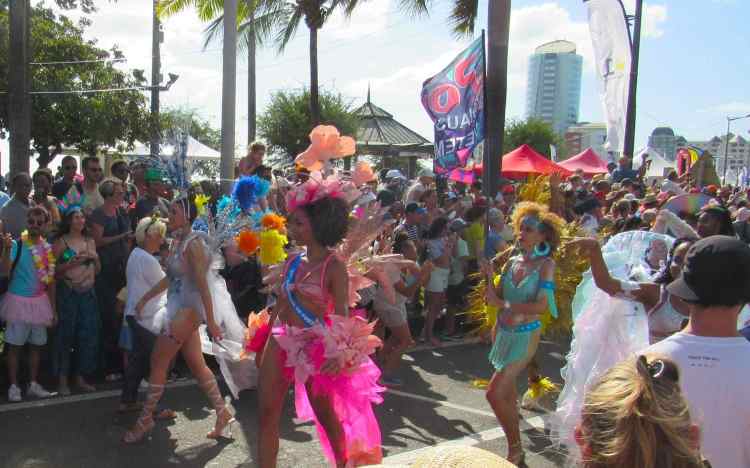
We made our way from Dominica to Martinique, in time to participate in the Fort du France Martinique Carnaval. “Participation” means being part of the crowd. This was our third time participating and it is much like being in Times Square on New Year’s Eve. I posted video on Facebook.
,
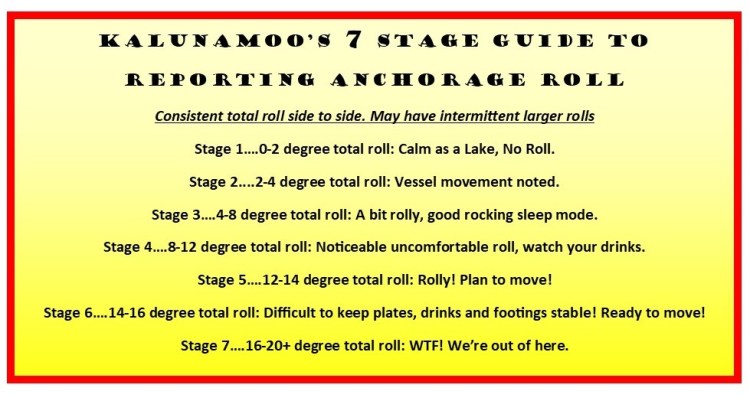
Before going to Fort du France, we stopped in St Pierre and anchored in the shadow of Mt. Pelee for two days. This gave us an opportunity to go up to the Depaz distillery to sample some of their wares. Agricole rhum is not my favorite, but I did buy a bottle to sample aboard. A swell developed and so by the second night we moved from a stage 2-3-4 swells to frequent stage 7’s. That prompted us to move on.
We motored to Fort du France but knowing the small anchorage would be crowded, we kept on and anchored in Trois Ilets. This is on the other side of the large bay. The anchorage is fine except it is open to the east. The only time there isn’t wind blowing down on you is for a few hours in the very early morning. Otherwise, a good chop develops which makes any dinghy ride very wet. There is no swell, so the boat doesn’t roll but going ashore can be a challenge. That, combined with the lack of a proper dingy dock, does not lend itself to a popular anchorage for cruisers. The up side is that a convenient 20 minute ferry ride brings you into Fort du France (7 EU round trip).
Obviously, living on a boat makes one very well aware of the water surface conditions. Maybe Predict Wind can get their computers to report roll stage conditions at anchorages, that would be great. They “predict” for passages but not for destinations. Boats, yachts, and ships all react like corks and reflect those conditions. It is only a matter of relative size of the craft to conditions that determines survivability. The trend toward catamaran for cruisers, in large part, can be attributed to their ability to be “less rolly” than monohulls.
All this led me to consider waves. Certainly the waves of people at the carnival jostles one around and waves of covid 19 cases demonstrated how individuals can be affected. Ocean waves have been the objects of fascination for centuries, certainly by those ashore, no less than those afloat. Dramatic paintings and photographs of the crashing, churning white foamed “angry sea” abound. Not to mention the scene of the Andrea Gail desperately climbing vertically over a wall of water. Most dramatic are the images of the exploding water along rugged coastlines, themselves shaped by the very same waves. Artists have long been fascinated by this phenomena and perfected the art of glass and resin manipulation to freeze these images into 3-D sculptures. All of this seems reactive. Humans are nothing if not proactive in affecting their natural environment (by design with their cleverness or inadvertently by their stupidity).
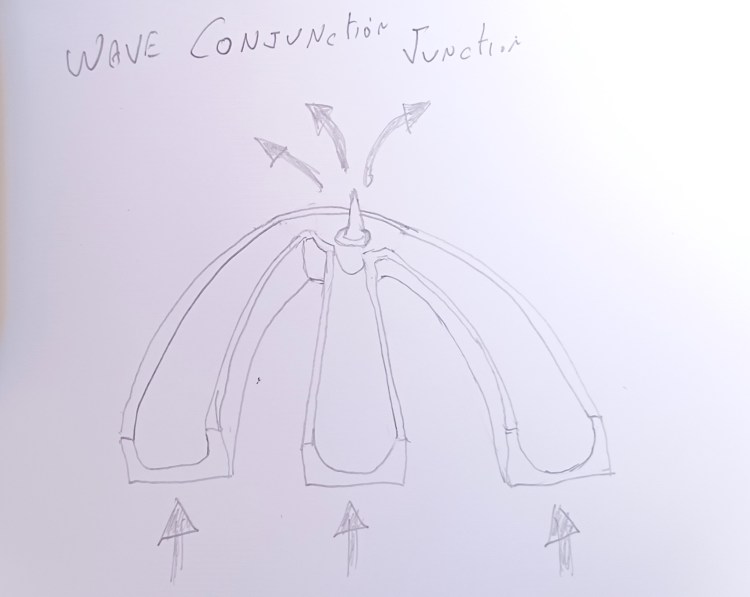
Wave Conjunction Junction
Wave Fan
With that in mind, I have searched in vain (on Google) for things that can produce these artistic images using real waves in real time. I call them Wave Sculptures In Real Time. WASIRTs (pronounced “wa-certs”) for the easily pleased. The drawings here are some ideas that I had that may qualify. The thought is that these could be constructed of reinforced concrete and placed in appropriate locations for natural wave actions. They could be staged at different levels to operate at different tide levels. More portable units could be constructed for an ongoing “tour” of WASIRTS at different locations. Smaller versions could be marketed to beach goers as attractive beach play things. Clearly, they may inspire others to utilize what nature provides and turn lemons (waves) into lemonade (WASIRTs). Yes, I know there are some useful things waves are already doing (wave motion to produce electricity, etc). But wouldn’t it be nice to sit on your rolling stage 5 anchorage and watch those swells and wave explode into majestic displays of spent energy and knowing that it was a human designed effect instead of heading toward a calmer anchorage? I’m receptive to those who would answer a RFP to participate in these WASIRTs.
Major hurricane Maria devastated Dominica in September 2017 when Kalunamoo was in Trinidad. Afterwards we sailed to Dominica in February 2019 and in February 2020. On both of our visits, the evidence of hurricane destruction was clearly evident. Large sections of forest were leveled, houses were ripped apart but the population was coping and rebuilding efforts were seen. New bridges and roads were being built (with aid from many countries, especially China) and so the country was slowly getting back to what it was pre-hurricane.
Chinese solar and wind powered street lights
This year we visited again and spent almost 2 weeks there when the Salty Dawg Sailing association scheduled a rendezvous of their members. We are also members, and our good friends Lynn on ROXY and Bob on PANDORA (president of the SDSA) did a great job of organizing activities for the 25 or so member boats that joined in. This was all done in conjunction with the local Portsmouth Association of Yacht Services (PAYS) who really appreciated the appearance and support of the cruisers at the rendezvous. Dinners on the beach at night, live music, island diving, tours and hikes, were offered every day and it was great fun, if exhausting, for everyone. One acitity that was planned was an organized visit to the local Saturday market to buy local produce followed by a cooking demonstration. It was a great way to learn about the local cuisine and enjoy local produce. A dinner serving Lion fish helped keep that invasive fish in check.
We took two “easy” hikes, one thru a rain forest (yes it rains there!) and a one to the Syndicate Waterfalls. Both tested our endurance. The first for the wet terrain and the second was for the eight quick water calf high streams, that that had to be forged to see a very Caribbean waterfall. Both well worth it. But exhausting (at least to these two of a certain age). We also took a van tour to Red Rocks (unique red clay like landscape), the Chocolate Factory (a locally grown and produced chocolate) and the Cold Springs (a pond bubbling with foul smelling sulfur).
Syndicate Falls
Red Rocks
Chocolate Factory – Local Beans to Bar
Cold boiling sulfur springs
All of this was great fun and highlighted how Dominica is quite different than most of the other Eastern Caribbean islands. The reason stems from colonial times when Dominica and St. Vincent were the only 2 islands in the Lesser Antilles that were not “dominated” by European powers at the time (Spanish, Dutch, English or French). These two islands were left to the natives as the other islands were exploited for their agricultural riches (mostly sugar). The rugged topography, rich volcanic soil and ample rainfall all lent to maintain the natural beauty of this tropical island. Of course, eventually even European agreement fell apart and Dominica did become a pawn in the English/French rivalry and was somewhat developed, but not to the extend of the other islands. All this to say that Dominica was “on its own” for quite some time and perhaps that left it much like the islands before Columbus – without the imperative to develop for European’s benefit. The veneer of modern civilization certainly covers the island, cell phones are ubiquitous, a few high-end resorts are here, decent roads, but I get the feeling that modernity is not at the heart of the island. More importantly, they realize that their natural environment requires protection from the encroachments that would destroy it.
This is certainly true in the town of Portsmouth and Prince Rupert Bay where we, and most cruisers anchor. The big cruise ships dock on the other end of the island in Roseau, Dominica’s capital. The original site of the capital was Portsmouth but the threat of malaria from the surrounding mangroves was too great to ignore. Fortunately, that threat no longer exists. So, oddly enough the only “cruise” ships that visit seem to be tall ships.
In addition, marine areas are set up – Cabrits/Toucar Marine Park – which restricts water access to only guided tour boats. No dinghy or anchoring by cruisers are permitted. This enhances and supports the local economy and controls the impact on the environment. The dependence on small local operations, such as the PAYS organization demonstrates this. PAYS provides moorings while it’s two dozen or so members provide tours and other services on an individual basis.
We have seen this also when we took a tour through the mountains. As I wrote at the beginning of this blog entry, major hurricane Maria devastated tracks of forest with its winds and rain. Since then, the government took advantage of nature’s “clear cutting”. It encouraged and sold these parcels to locals to farm these areas and produce fruits and vegetables both for local consumption and export. Dominica does export to other islands now and this will add to their exports. No one expects this to develop into a “United Fruit/Chiquita” type economy but these small scale local initiates may be a good way forward for the island. Keeping profits on the island to reinvest for themselves seems the best way ensure a more stable and prosperous future. Eco tourism will continue to be a major influence and, of course, foreign investments, will also play a part. One hopes that with more income locally generated, Dominica remains one of the more unique islands in the Caribbean. Dominica is truly the Nature Island of the Lesser Antilles.
A question that often comes up among the “newbie cruisers” we meet (and some friends ashore) is “don’t you get bored seeing the same places all the time”? I can understand the newbies concern. After all, they are out cruising to see new destinations every day. It a big world and there is not enough time to see it all. I’m amused about the question from friends ashore. These people lived in the same house or neighborhood almost their entire life and never complained about being bored with that.
I bring this up as, yes, we did go cruising to see new lands (or islands). Its 12 years in and we certainly only “scratched the surface” of the earth seeking new lands (or islands). But a funny thing happens while cruising, you get to really like certain areas and no one gives you a gold star for the number of places you stepped foot on. In our case, the neighborhood is almost 500 mile long, contains over 10 different countries, various cultures, food cuisines, languages and personalities. And no snow.
So, after 12 years island hopping our neighborhoods, we came to like them all. We just traveled up to St Maarten/St Martin for 3 weeks after a 5 year hiatus. It felt like visiting an old friend. The shawarma vendor, Little Jerusalem is still there, although a new place seems to offer better fare. Lagoonies is still the hangout for cruisers although the Naked Pirate is eager to offer some competition. The same Dutch priest still says the 5PM Sunday mass with a musical track provided by the keyboard player. Other locals are still around, both on the French and Dutch side of the island. Some things did change. The old carousel ice cream place (with a real Carousel) no longer has a Carousel. Some French restaurants haven’t recover from the hurricane a few years ago but Thursday nights at the French town of Gran Cas is resuming after the hurricane/pandemic interruption.
But the point is that far from being bored with the island, it was hard to leave after only 3 weeks. We do call ourselves cruisers but living in a neighborhood nearly 500 miles long is not boring. And did I mention that there is no snow?
The cruising part is the sailing between islands. These sails can last 6 to 12 hours and can entail ocean type seas and weather. Jumping over islands can be overnight sails or a few days. That brings me to our sail from St Martin to Antigua. The winds were again forecast from the North East, but like the sail to St Martin, the wind was more like East North East. This meant we were sailing more directly into the wind and seas. Not terrible, but not a walk in the park. With these winds, sailing further west to the U.S.V.I. is not attractive. As much as we like the U.S.V.I, we will forgo them at this time and decided to head south.
We again stopped in St. Barts overnight to cut down on sailing at night. After we left St. Barts heading to Antigua, Otto (Otto, the Dark Lord of Direction, Ray, the Guiding Hand of the Helm and the Lady of Perpetual Steering, that I wrote about previously) kept tripping the circuit breaker. Remember we had trouble with the breaker after leaving St. Anne, Martinique. This time I couldn’t switch it out for another as I was not sure that was the problem. It only tripped when it was steering, not on standby. In any case, we faced sailing for at least 10 hours hand steering in lumpy seas with head winds.
This was the first time we faced a long passage without the auto pilot (ok, 10 hours is not really that long – unless you have to steer constantly). But I was pleasantly surprised when Kalunamoo decided to steer herself. Balancing the sail trim, Kalunamoo can stay on course indefinitely with only minor tweaks on the wheel. One of the benefits of hydraulic steering is that the rudder is constantly “locked” by the position of the helm. No break or securing the helm is needed to lock the rudder. Turning the wheel can easily tweak a degree or two of rudder angle and keep the boat on course. Actually, our track was much better steering this way than with Otto in control. And it was not tiring at all.
Before arriving in Antigua, I noticed a small diesel fuel leak by the injector pump (we did some motor sailing in and out of port). Our intended over night stay in Antigua and then a sail to Guadeloupe became a formal check-in and two-night stay in Antigua. Both issues were resolved. Gordon on COHO had a spare circuit breaker which was the problem (I hope, as a real test is when we sail “out there”) and the fuel leak was fixed by new copper washers at one of the fuel lines. We are now ready to continue to sail south and meet up with other cruisers and revisit our other neighborhoods. The Salty Dawgs have plans for gatherings in Dominica and then Martinique. Well, welcome to the neighborhood.
Vacation in New York was wonderful. It was cold, but still wonderful. We are now back onboard to return to the drudgery of relentlessly warm Caribbean sun, the absolute perfect water temperatures, the rhum that’s always smooth and potent, and the pleasures that always flow (mostly).
Kalunamoo received from Santa over 70 lbs. of adornments. These were carried in our luggage and back pack on the flight from New York to Antigua. One of the good things about Antigua, there are no hassles when you bring things like chart plotters, electric cables, diesel engine parts, generator mother boards, propane tanks parts, refrigerator parts, oil and fuel filters, computer printer, can goods, electrical relays, timers and meters, microphones, microphone stands, amplifier speaker, solar panel controllers, and boat fenders. They are all routine personal items in our luggage. Just like what other tourist bring on their vacation.
Other countries are not so accommodating when arriving with stuff like that. Grenada, in particular, was upset one time when we flew in with one small outboard motor propeller in our luggage. Besides the paperwork that is required, an import tax is assessed on things like that. We pleaded that it was just a poor refurbished propeller that somehow got mixed up with our underwear and so sorry we didn’t declare it and hoped that it would not impact the Grenadian economy by not paying the import fee. They let us go through. Trinidad wouldn’t impose any import tax, but the paperwork and procedures is enough to give one pause before bringing things in (although we do it all the time).
Santa was very generous and Kalunamoo really appreciated the thoughtful gifts that arrived. Like all other dads and moms, we spent days reading instructions and putting things together so that Kalunamoo could fully enjoy the assembled presents.
While in Antigua, we spent a few days in Jolly Harbor Marina installing those presents . We were awakened at midnight on the 31st as we understand that the New Year brings out those who like to see and hear fireworks at midnight. Odd. We went back to sleep. We then moved out to the anchorage for a few more days and then sailed north.
The easterly trades were moderate but they tended to clock to the south east on the day we sailed. The seas were still running 6 foot short swells from the east from the previous week’s stronger trades. What this meant was that the sail up toward St Martin was with wind well down on our quarter with a cross swell. It was not a terrible sail, but neither was it particularly enjoyable. At times, with the wind shifting dead astern, we needed to jibe to maintain any speed. We anchored in Columbier, St. Barts at sunset and the next morning made the final 2 hour sail to St Maarten (the Dutch side) in the same weather conditions.
Coming from New York, bridge tolls are the norm. Any substantial waterway that a normal car can’t traverse without sinking has a toll bridge. This is not strictly true as the city fathers know that knowledgeable New Yorkers could always find a way not to use a bridge and so not all bridges have tolls. But, of course, New York City is made up of islands and is not connected to the mainland (the rest of the United States). Therein, tolls are ubiquitous and not cheap.
Simpson Bay Bridge
I write the above because when you sail to St Maarten (the Dutch side) there are two bridges that vehicles use to traverse their island. These bridges need to open to let boats taller than about 15’ pass under. The bridge toll, however, is levied on the vessels, not the vehicles using the bridge. Now, remember history. New York City (New Amsterdam) was founded by the Dutch. Somewhere along the way, someone decided to toll cars vs. boats in New York but not here. The British, of course, were involved in this history at some point and the revolution etc. so I’m not sure who’s to blame. In any case, to make a long story short (too late!), you need to pay a bridge toll here, not to go over it, despite the fact it is designed to specifically accommodate vehicles, but to go under it. To add insult to injury, they made it so low that it must be opened so that most boats can go through. In other words, boats pay not to use a roadway but are charged for the engineer’s neglect to make it high enough to go under! It cost us $21 each way not to drive over the bridge. In New York, the Verrazzano Bridge cost $10.17 to drive over it and nothing to sail under it. We have not been here since 2017 but when we paid the toll, the receipt showed that we last paid the toll in 2017. Apparently, they keep good records. But the big story is not the tolls. The bridge is famous for watching the big boys go thru it. It’s a spectator sport.
As you can see the bridge is not that big and yet mega boats have to navigate them. Some of them not so successfully. Here is one video of what can happen: https://www.youtube.com/watch?v=vRVWr4sIyCs
Swiming with Lee and Sharon, ALLEGRO
We anchored in Simpson Bay Lagoon in St Martin (French side) after paying the toll. This saved us Customs and Immigration fees to the Dutch authorities (after all, they got the bridge tolls). The Lagoon is completely protected from any swells. Unfortunately, it is not recommended to swim in it so we dinghy to the outside to go swimming. The bay on the French side is better for swimming. You have to go under the French bridge, but there is no charge – viva la France. The problem is that there is a very narrow and shallow channel beyond the French bridge to the anchorage area.
We haven’t been here in about 5 years and in the interim there was a hurricane that caused substantial damage. Most damages have been repaired but there are still some businesses that have not returned. There is plenty of restaurants (both on the Dutch and French side) and, ship chandleries with tax free supplies which are always welcomed.
The French bridge
While here we are meeting cruisers that we haven’t seen in years, (Wahoo, Persephone), Salty Dawg cruisers we met recently (Fayaway) in Antigua and the musical family we have known from New York (Stell N Snuggs).
Stell N Snugs
Jam with Dave, Trudie, John, Chris
We plan to sail to the U.S. Virgins but are awaiting a good weather window. We don’t want to replay the down-wind sail that we had to get here. No rush to move on, especially going west which means that we will eventually need to go east – basically upwind! Maybe we will stay long enough to do some Out and About here.