
Previously on Kalunamoo…
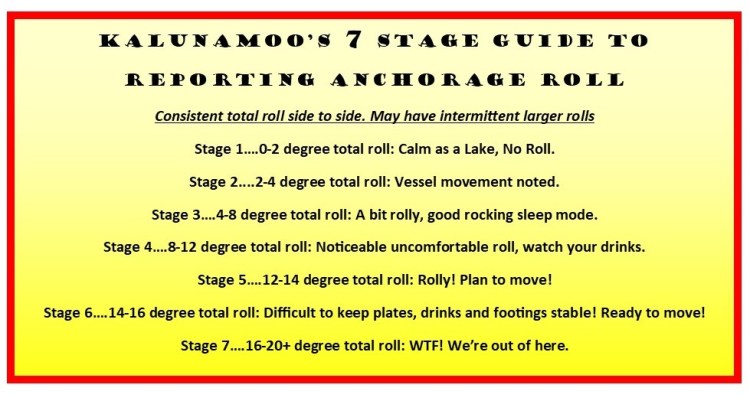
The last night in Portsmouth, Dominica, we shifted from the south end anchorage (Stage 7+) and anchored back in the north end as the swell would be less and we would be sheltered from the expected north wind. And that is, what we experienced except that the north wind never really filled in. However, at 4AM there was no wind at all. There was a bit of swell, Stage 3 at most. However, we were jolted awake by some loud creaking sound.
Creaking sounds on Kalunamoo are endemic. Loud ones, not so much. Jumping out of bed and dashing to the cockpit, I saw a red wall alongside the starboard side of the boat. Fortunately, it was not a wall. Unfortunately, it was the side of a large commercial unlit trawler that was on a mooring.
When we anchored in the afternoon, we did see this trawler but I reasoned that it would not interfere with where we dropped the hook. That was fine until the wind died. At that point, boats start meandering around their anchor or mooring based on currents, waves and swell. Each to their own particular characteristics. The end result was that Kalunamoo and the Big Red Trawler had a close encounter of the worst kind. When we rolled into the trawler our starboard wood railing was damaged and a chunk of cap rail was gouged out. I started the engine and pulled away from trawler. Nothing really serious, but both will be repaired in Trinidad.

Sailed South…
At dawn we weighed anchor and said adieu to Dominica and sailed to Martinique. This February “swell event” was experienced in all the Lesser Antilles and resulted in a number of boats, large and small, being driven ashore. We were fortunate that only a little cosmetic damage was had.
We sailed, accompanied with our friends, Ted and Barbara on RAVEN to Martinique intending to anchor in St. Pierre. Upon arrival in the afternoon, the “swell event” was still underway and it was obvious that it really was an untenable anchorage. A few boats were already driven to the beach so onward to Fort de France.
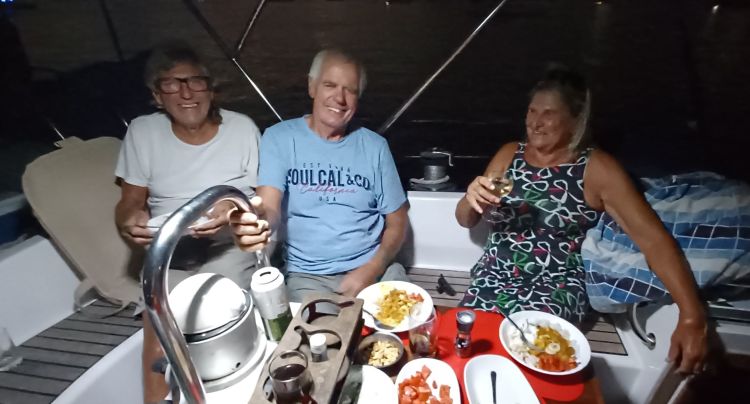
Carnaval was just starting so the anchorage was crowded, RAVEN found a spot to anchor but we sailed over to Trois Ilets. No swell and a good anchorage to stay while the seas calmed down. Carnaval in Fort de France proceeded but we have been there, a number of times and so we were not inclined to go. Two days later we sailed to and anchored in St Anne. We met up with long time cruisers we knew there (HORTA, IMAGINE, CASA TU, and ex-cruisers from NADA). The St. Anne/Le Marin area is a great place to stock up on French wine, cheese, croissants, baguettes and all things French which we did.
.


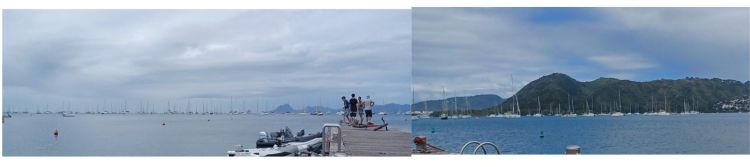
The anchorage in St. Anne is huge. It can easily accommodate well over 3-400 boats. Perhaps too easily. Le Marin is just around the corner and is home to well over 1000 boats in slips and moorings. It is one of the largest yacht centers in the Caribbean.
Anchoring…
Anchoring is our preferred way of staying put while not actually sailing. But one of the consequences of population growth which does not exclude the cruising community is overcrowding. Not, a new phenomena, our grandparents probably complained about it, but we noticed a disturbing trend toward “cruisers”. In the French islands one sometimes gets the feeling that cruisers are looked upon like Lion Fish, an invasive species that must be carefully controlled. To a certain extent I can sympathize, as in fact, boats/ships, large and small, are invasive and are not native to the habitat, they inhabit. Of course, this can apply to all civilized humanity, a species not known to enhance their natural surroundings.
“Aquatic invasive species (also called exotic or non-native) are plants and animals that invade an ecosystem where they don’t belong. If the invasive species has no natural predators in its new environment, its population can grow unchecked. Their abundance causes damage as they can consume native species, compete for food and space, or introduce disease.”
So anchoring comes under suspicion for environmental destruction. In Florida, apparently, it even covers destruction of one’s esthetic view. Anchoring among coral has long been forbidden. It can damage and kill coral. An issue that is surfacing underwater (pun intended) is the awareness of the effects of plowing the seabed. Here in the Lesser Antilles the French islands of Guadeloupe and Martinique seem to be most active in pointing out the problem and have taken proactive steps to mitigate the problem.
Here as elsewhere, anchoring in sea grass is being restricted to protect these areas where turtles, juvenile fish, and the general fauna of these underwater lawns call home. Many boat anchors are called “plow anchors” and for good reason. You can imagine how they affect the lawn. Surfing the web, you can easily find the following:
“Every time an anchor is dropped and comes into contact with living organisms at the bottom of the seabed, it usually results in some kind of physical damage, dislodgement or an increase in sedimentation. If anchoring isn’t done right, this kind of damage can happen at various stages, during the placing, retrieval and while at anchor too. But it’s not just the anchor itself that poses a hazard to the environment. The cables and chains can cause serious damage too…Seagrass beds, for example, provide a nursery and home to many types of fish, molluscs and crustaceans too. They may not always get as much attention as coral reefs but they are some of the most productive ecosystems in the world. It’s been estimated that the world’s seagrass meadows can capture up to 83 million metric tons of carbon each year. Anchoring can devastate this fragile marine ecosystem in just seconds.”
https://www.pata.org/blog/what-impact-does-anchoring-have-on-marine-environments
To combat this problem, localities are placing moorings for visiting cruisers (and charging for them). These permanent eco-mooring “anchors” are less destructive but not totally so. In addition, they are limited in number and anchoring may be prohibited.”
“One problem associated with eco-moorings is the potential difficulty of finding an insurance policy to cover the system…investigated the feasibility of using eco-moorings as management options for Marine Protected Areas (MPAs) in the UK. The study highlighted the lack of an established insurance market for the moorings.”

https://www.fiseagrass.org/moorings-fishers-island
The standard instructions for anchoring is to set the anchor in sand, not coral, not sea grass and to dive on it to ensure it is only in sand. That may be easier said than done. I fear that the organisms in the sand may not like that either but until they speak up, sand it is.
A Tragedy…
Lastly, a sad report. Last week a sailboat was spotted anchored in St. Vincent apparently “abandoned”. Upon inspection, it was found ransacked with blood all over the interior. Shortly thereafter, 3 escaped prisoners from Grenada were apprehended in St. Vincent by the police, tipped off by locals. Backtracking, and piecing together information and confession of the three violent criminals, the sailboat was anchored off the popular Gand Anse beach, in Grenada, with the captain and his wife aboard on Sunday night. The three commandeered the boat, attacked the two, disposed of their bodies at sea and sailed to St. Vincent. The bodies have not been found.
The boat, SIMPLICITY, was owned and sailed by Kathy and Ralph. They were Salty Dawg members and this was their first sail down to the Caribbean. We may have seen them in Antigua with all the other Salty Dawg boats back in November, but can’t say we knew them well. But as fellow cruisers, our hearts go out to their family for this senseless tragedy. Being in the wrong place, at the wrong time is just unfathomable.
After this incident we heard from a cruising couple we have known for years. They happened to be home in Kansas City and they asked about Kathy and Ralph. They experienced the shooting in Kansas City first hand. Only weeks before they were part of the celebration for the KC Chiefs. They and the crowd took cover and were safe, but traumatized.
Life can deal terrible news of tragedies almost every day. When it hits close, it makes seeing the sun rise for another day a true blessing.
 Kalunamoo
Yes, heard the tragic news here and immediately thought of you guys. Glad you are ok, but it is sad. The environmental anchoring issues are important and interesting too. Be safe.
LikeLike
Such an improbable tragedy at sea for first year cruisers who were doing everything right! The beauty of sailing/ cruising is by far my happiest times for my last 25 years: BEST FRIENDS EVER met and introduced by cruising only! The ease of these anchorages on these gorgeous Caribbean islands can only enhance the joy of cruising. However, the senseless death of our comrades in Sailing the Seas makes all of us aware that the storms and the strong wind shifts aren’t the only enemies of the cruising world. An inconceivable event…Mary Baggett / Meander Hailing from Wrightsville Beach, NC
LikeLike