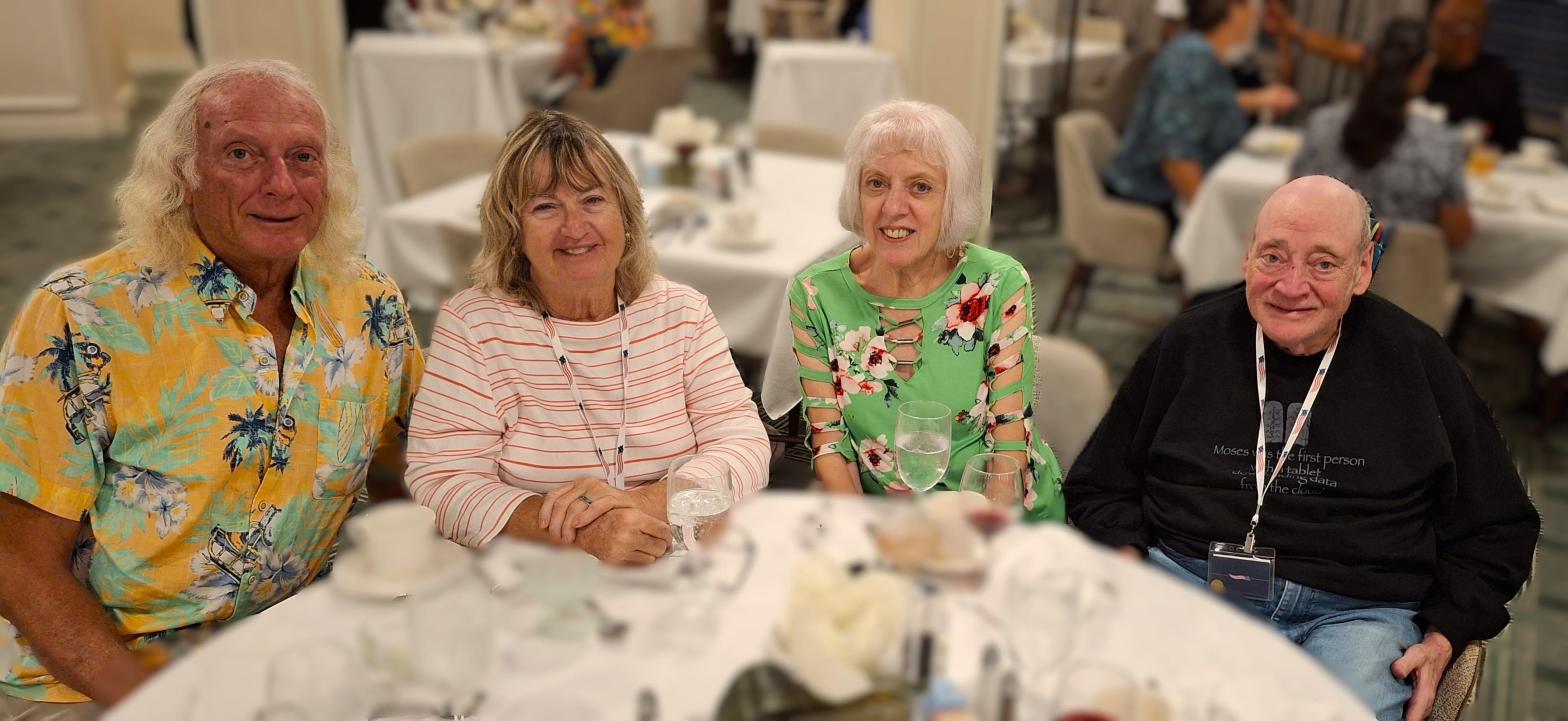
In 1883, Samuel Clemens (AKA Mark Twain), wrote Life on the Mississippi. It recounted his re-visiting the Mississippi River about 20 years after he left Hannibal and his short career as a steamboat pilot on the river (1856-1861). He sailed as a passenger from New Orleans to St. Paul and commented on the changes that he saw on the river, the towns and the population along its banks. I have no intention, nor ability, to duplicate such an endeavor. I have only been to New Orleans once, in 1971, when the ship I was working on pulled into the shipyard to get a new propeller. But last week, Maureen and I, along with my sister and brother, took a river cruise from New Orleans to Memphis and these are some of my comments on the Mighty Muddy Meandering Mauling Mellowing Masterful Mississippi River.
This river drains 40% of the United States – between the Appalachian Mountains and the Rockies. It takes about 90 days for water from the source, Lake Itasca, MN, to reach the Gulf of Mexico, 2340 miles away. We only travelled the lower river which was impressive enough.
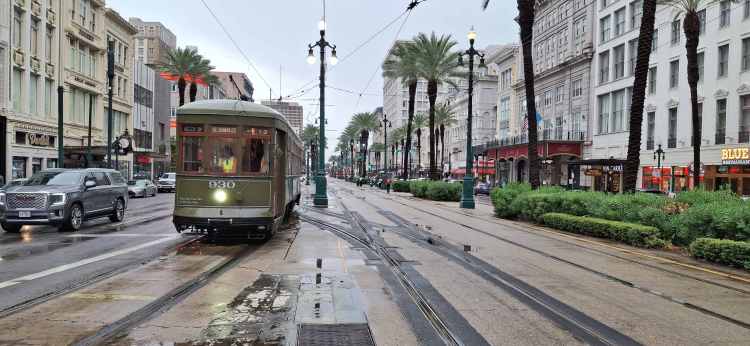
Our stay in New Orleans was short. One day to walk along Canal, Bourbon and Frenchmen Streets (we had dinner with ex-cruisers Roy and Dale, s/v Wahoo, at an Italian Creole restaurant), music at the Spotted Cat and a bus tour of the Garden District, the 9th ward, Jackson Sq. and seeing the effects of hurricane Katrina. This gave us a very short overview of the city. Much too short for any extensive immersion into this classic city. But a sampling of food, music and vibes was gleaned before boarding the American Cruise line’s, American Melody, for a cruise up the river.


We set sail on the 180 passenger, diesel powered, 7 foot draft boat and escaped the passing rain showers hugging the Louisiana coast. The heat and humidity which we are accustomed to in the Caribbean was successfully quelled by the air conditioning in all indoor spaces. Truly the south is as pleasant as a New England spring, as long as you don’t venture outside. This is most disturbing to those who would be inclined to keep windows open at night, although the flying night visitors would probably consume most of your fleshy parts by morning.
Our fellow travelers, on the Melody, were as friendly as we have always met on our own liveaboard ventures. Twain remarked that on his cruise he could always tell a New Yorker by what they wore. Maybe so, but today accents can be distinguished (between Brooklyn and Topeka). The marketing target for these cruises seems to be retired people who forgo water slides, late night discos, and adult beverage binge drinking. The riverboat gambler, the newlyweds, and the TikTok generation are not banned but would not be comforted by the cane carrying, early to bed, hard of hearing clientele. I believe these travelers are more interested in museums than mud-baths and motor coach tours over hiking treks and thong bathing suits.

On board was Christen Hall, whose great uncle was Mark Twain. She gave daily lectures and presentations on the history of the Mississippi River, its people, culture, steamboat and industry activity. Women of the River and Exploding Steamboats were also presented. Very informative. These talks preceded the cocktail hour, both were well attended.

On our first stop, we pulled up to Vacherie, LA alongside a floating dock. We were lucky it was floating. The River was at a very low level. This is not unusual at the end of summer. The winter snows and spring rains that test the River’s capacity were long gone. But this low water level meant that the walk up to the top of the levee was at least 50’ high. The first levee’s were placed by the French in 1717 to protect New Orleans from the River. They were 3 feet high. Since then, over 4000 miles have been placed all at considerably higher heights.

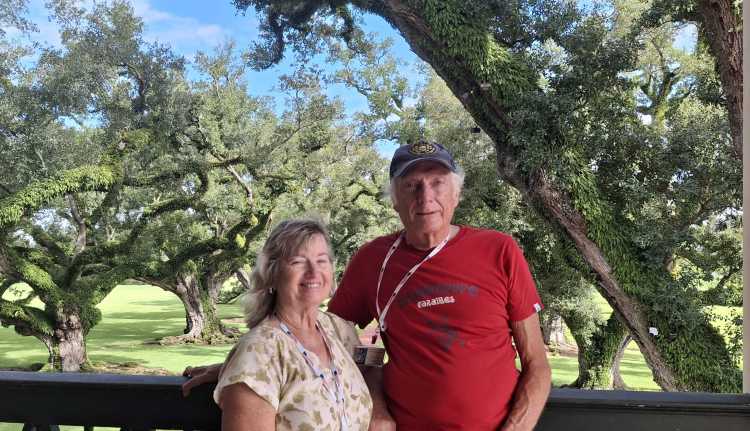
In Vacherie, LA, we motor coached to Oak Alley Plantation. The plantation house was completed in 1839 by Valcour Aime. He was known as the King of Sugar, one of the most wealthiest men in the South. Surprisingly sugar cane is still a major crop in the area. This, to me, was surprising since sugar cane and the wealth it generated has long been lost in the East Caribbean Islands. There are no rum distilleries here as all the sugar is sold to Domino Sugar Company. The plantation house has been restored although the alley of oak trees didn’t need restoration, as nature and time have been kind to them.

At night, the American Melody, proceeds up the busy river. Busy indeed! Ocean going cargo ships ply the river up to Baton Rouge. Tow boats push dozens of barges lashed together, loaded with sugar, soybeans, coal and a multitude of other products up and down river. Sometimes the Melody would pull to the side or wait to transit a bend in the river to let the long barges pass through first.
For two nights after dinner, the GiGi’s – two young female singers – entertained us with hits of the 1950-60’s. The audience danced (well some did) while the singers commented that they miss those days when you could actually understand the words to the songs. Odd I thought, as I don’t think they were born yet. Maybe their mothers sang to them in the womb.

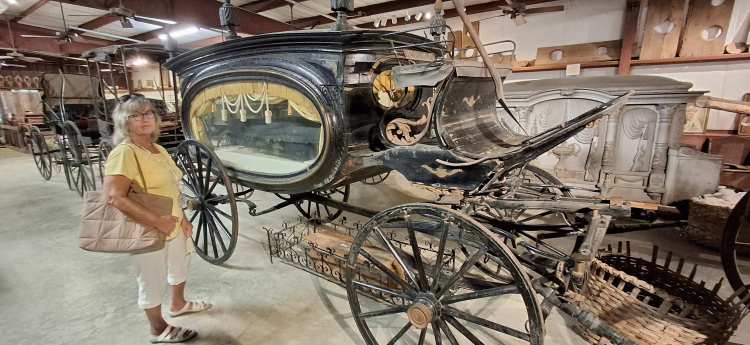
The next morning we arrived in the Red Stick city – Baton Rouge, LA – to again walk up and over the levee to see a city built on a low bluff along the river. The motor coach took us to the Rural Life Museum, a Louisiana State University (LSU) project. This extensive indoor/outdoor campus showed the “the way of life of our ancestors, [18-19th century] their hardships, toils, visions, inspiration, and determination by preserving…architecture and artifacts from our rural past.” I wondered if tourism was one of their visions. I am sure air-conditioning must have been on their minds. Also noteworthy, the state capital building is the tallest state capital building in the country. It looked like Elon Musk’s Spaceship to Mars.

At night after undocking, our resident professional entertainer, Steve Merritt, played piano during the cocktail hour and a few nights after dinner. He sat with us for dinner one night and we heard his life story of spending 11 years working on a bicycle piano at Disneyland, Japan. (It was a piano mounted on a tricycle which he played riding around the park). He worked another 11 years for them in California and on their cruise ships. Does this explain why he seemed a little daffy? The pandemic hit the cruise ships hard but he eventually returned to “sea” on the American Cruise Lines river boats. He was entertaining, if a little long winded, but had great background stories about the songs and music he performed. Mostly true, I assume.

The next morning, I thought the Melody was out of control. It was aiming for the muddy shoreline perpendicular to the River’s flow. Was Steve at the wheel? Surely the abandon ship signal will soon sound as we crash into the levee dead ahead. But no, we were just approaching the Natchez, MS landing where you pull up to the river’s bank to let passengers on or off. The boat noses in, firmly planning the bow in the mud, or concrete apron, and passengers walk a long gangway off the boat. In our case, the bow opens like a landing craft and projects the gangway over the mud. All is well, but we still had to climb up and over the levee to get to town.


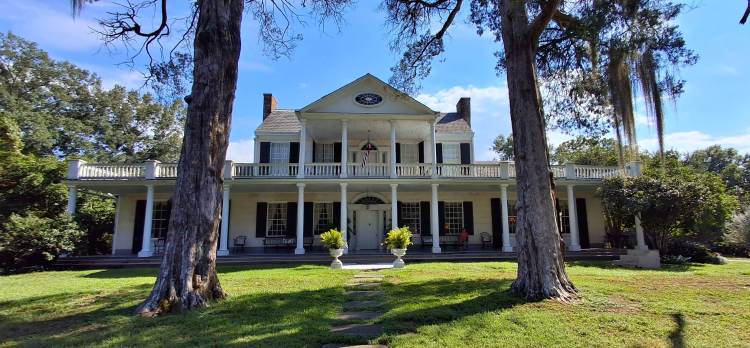
A tour of Antebellum homes, Dunleith and Linden was taken, along with Mint Juleps. All very Southern. These restored homes have electric lights and air conditioning but the furniture was old, no closet space, and there is no TV. In 1861 the demise of low-cost labor took a toll on the economy and their owners lost fortunes. Many of these homes today survive on the good grace of visitors and the income they provide. The owners live elsewhere. Mark Twain slept here a few times although not in those houses. I guess he just wasn’t that discriminating.


A visit to the boat’s bridge, to talk to the Captain and mate about boat operations was instructive. Don’t expect to see a big 6-foot-high steering wheel. Only a few paddle controllers for the rudders, bow thruster and engine controls. There is only one unlicensed engineer aboard, apparently there to keep visitors away from any moving parts. Radar, sonar, AIS, VHF are the main navigation tools. The whistle was never used, and there were no leadmen on the bow or quarters. The calling out of mark twain (2 fathoms) by the leadmen was the controlling depth from here on up. The captain had the required pilot license to navigate below Baton Rouge.

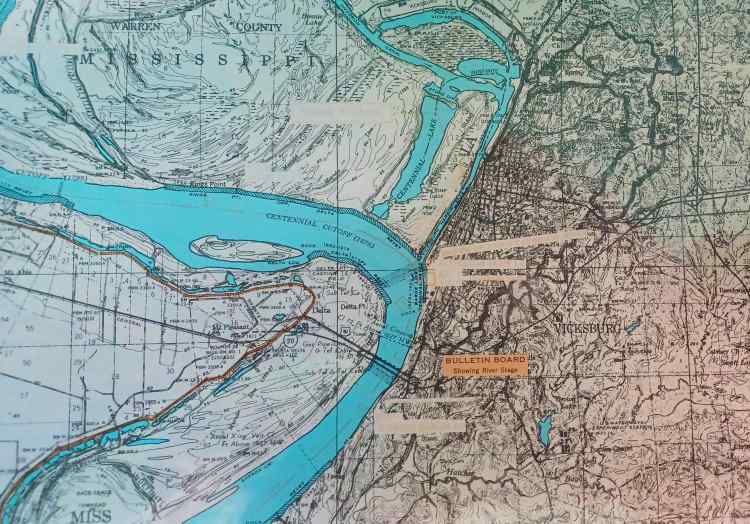
Vicksburg, MS is the site of the Civil War battle that determined the control of the River at that time. The city itself is built on a tall bluff so that after you climb up the levee to get off the boat, you still had to climb up to the city. Oddly enough, Vicksburg is no longer on the Mississippi River. It was founded and settled along it but the River had other plans and moved over and let the Yazoo River take its place. I guess it just gave up trying to flood the place. This was not unusual. The River has a tendency to meander and form new channels, ox-bow lakes, chutes, crossings, islands and scrolls. “He just keeps rolling along” so the song goes but the U.S. Army Corp of Engineers tries to keep it in line, and within it’s banks. The demarcation line between states like Louisiana, Mississippi, Arkansas is the middle of the River. However, when the river decided to move over, the line didn’t move and so parts of the states lay on both sides on the river. It seems man is the only one who recognizes these artificial lines while nature just keeps moving on. The massive 1927 flood really pushed the ACE to temper the River. Floods of 2011 were also damaging but somewhat mitigated by that time.


The Vicksburg National Military Park commemorates both sides of the bloody war between the states. It has monuments and markers of where each state’s militia stood their ground with far too many never leaving the grounds. A salvaged and restored iron-clad boat from the River is ashore, the Union’s gunboat USS Cairo. It was sunk by the Confederate torpedo (mine). The iron clad sloping sides resemble today’s sloping side radar reflective war ships.

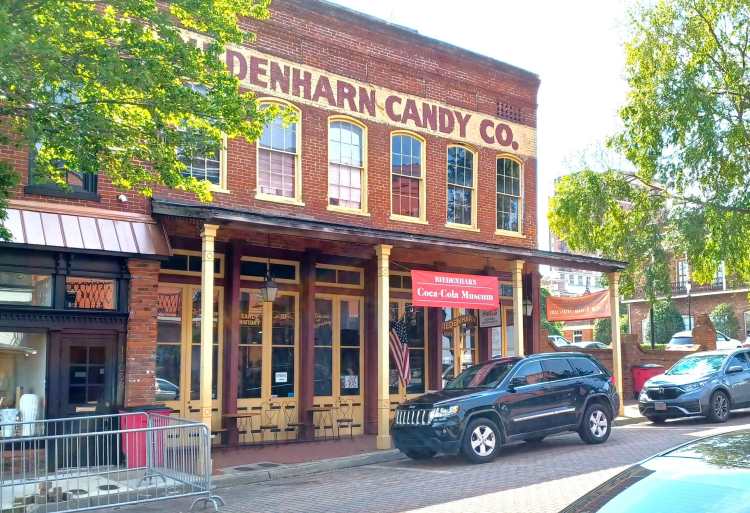
On Washington St., in Vicksburg, there is the Coco-Cola Museum where it was first bottled. You can get a cold bottle of this stuff that is made with the original formula using cane sugar. It is imported from Mexico! Locally grown sugar cane is replaced by corn syrup for us Americans. We sure do love our corn.
The run from Vicksburg to Memphis TN gave us a full day “at sea”. The River presented a more natural environment than the river down toward the Gulf. There were still long barges and tows but no ocean going vessels.

Those ships can’t go north of Baton Rouge. As I wrote, the River’s level was low, so the scrolls, sand bars and the ACOE’s mats to control the banks were all evident. The water itself certainly earns it’s reputation as being muddy. It dumps 1.3 million tons of mud into the Gulf of Mexico per day. But I’ll let Twain say a few words about the water.
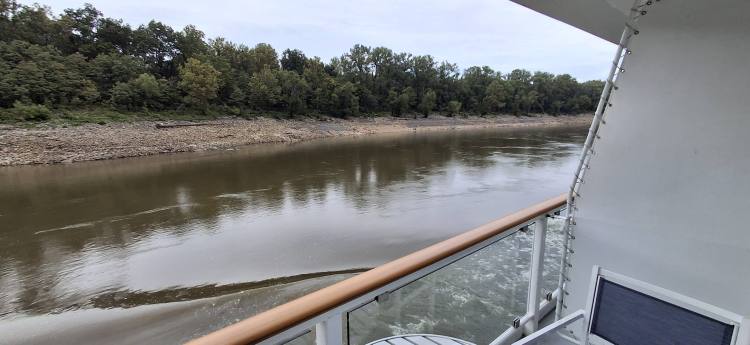
“…if you let a pint of this yaller Mississippi water settle, you would have about a half to three- quarters of an inch of mud in the bottom, according to the stage of the river, and then it warn’t no better than Ohio water – what you wanted to do was to keep it stirred up – and when the river was low, keep mud on hand to put in and thicken the water up the way it ought to be.
The Child of Calamity said that was so; he said there was nutritiousness in the mud, and a man that drunk Mississippi water could grow corn in his stomach if he wanted to. He says: ‘You look at the graveyards; that tells the tale. Trees won’t grow worth shucks in a Cincinnati graveyard, but in a Sent Louis graveyard they grow upwards of eight hundred foot high. It’s all on account of the water the people drunk before they laid up. A Cincinnati corpse don’t richen a soil any.’”
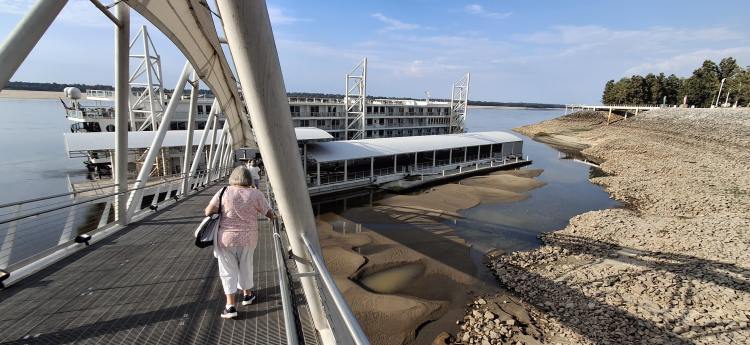
We arrived in Tunica, MS, just short of Memphis. The River didn’t have enough water in it to permit docking of the Melody there. No worries, we motor coached to Memphis and went straight to Graceland.
I am following the river
Down the highway
Through the cradle of the civil war
I’m going to Graceland
Graceland
In Memphis Tennessee
I’m going to Graceland
Paul Simon

It’s not that we are Elvis groupies. But unlike the Gigi’s, we actually did hear Elvis when he was alive and understood the words. Graceland is the place to go if you ever wanted to see and learn anything about Elvis. If you are interested in his tax returns, costumes, awards, movies, concerts, contracts, kitchen, jet planes and cars, and his receipt for a pool installation, and yes, his grave next to the pool, Graceland is for you.

Memphis was also the last stop for Martin Luther King, The Lorraine Motel, with an unchanged exterior, is now a National Civil Rights Museum. Progress has been made since then but it is sad to read about incidents like Tyre Nichols that occurs today.
The Rock ‘n’ Soul and Music Hall of Fame Museum is here, as is Beale St, and the second largest Bass Pro Shop – Outdoor World retail store housed in the massive Memphis Pyramid (inside: 600,000 gallons of water with over 1,800 fish; a cypress swamp with alligator pools and duck aviaries; a hotel; and a breathtaking observation deck at the top of the 32-story s/steel pyramid). Memphis is more than Graceland.

Our Mississippi river cruise was over. Definitely different than a cruise on Kalunamoo in the Caribbean but not totally different. The landscape was different, shoreside was different but the people and crew we met were all equally friendly and sociable. The Mighty Muddy Meandering Mauling Mellowing Masterful Mississippi River, the lower part which we cruised, was great to see and experience.
From the sugar cane fields in southern Louisiana, to the wide cotton fields of Tennessee, the River provides the backbone of our country that keeps flowing and which is still worth exploring. I’ll let Mark Twain have the last words about the River, although I might disagree:

“It is good for steamboating, and good to drink;
but it is worthless for all other purposes, except baptizing”
Life on the Mississippi, Mark Twain
 Kalunamoo
A wonderful blog. We sold BioTrek and will have to take that cruise sometime. Please let us know if you pass through Boston.
LikeLike
Great reading!
Perhaps you guys drank some of that nutrient-rich water? 😉
LikeLike