Very few people that I know have the ability to be bored without regret. Almost everyone, at one time or another, states how “bored to death” they are. Of course, they avoided death by immediately running off to escape that unfathomable, and evidently irreversible situation. They find solutions to avoid the vision of their imminent demise with activities that must be completed, with plans that must be made, with interactions with others that must be initiated, by phone calls the must be placed, and maybe with fantasies that must be dreamt.
We panic when our children proclaim their boredom and feel compelled to alleviate their suffering. When adults state their displeasure at the slack state of affairs, to be “bored stiff”, and feel rigor mortis setting in, we feel guilty of our excessive defense of the status quo. Wars have started this way
It is true that boredom seldom results in the advancement of civilization. Avoiding boredom, certainly is a major impetus to adventure and discovery. Although I always wondered if that apple didn’t fall on Newton’s head, would he still be sitting under that tree? But the state of boredom itself rarely results in discovering a new world.
And so, we are anchored in Rodney Bay, St. Lucia. Been here for 20 days, but who’s counting? A few days after arrival we took a slip in Rodney Bay Marina for some M&R (mostly M). Our generator needed some preventive maintenance along with minor fixes, our life raft was recertified, water tanks filled, engine fluids changed, laundry washed, and decks washed. We also had some personal M&R at the local dentist. We then went back to anchor in the bay where we are now. Keeping an eye out for the passing light tropical showers we plan to move on when the winds and feelings are right; we busy ourselves in daily routines.
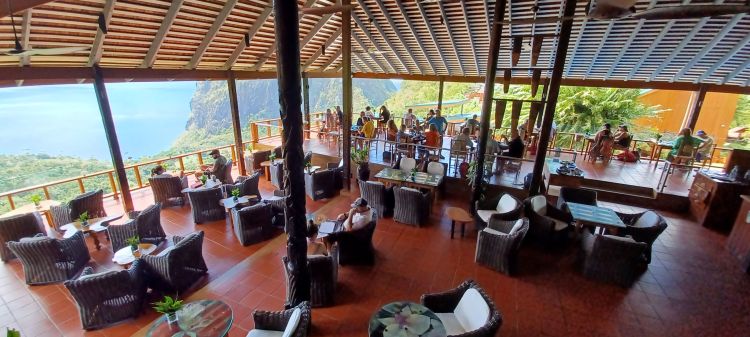
Other cruisers that we know have, had or are here now and have enjoyed their company. Recently a long day tour down island with a hired driver and van with three other cruisers (RAVEN, PANDORA, MOMENTUM 2, LOGOS, KALUNAMOO) was enjoyed by all. The mountainous twisty roads of St. Lucia can only be truly appreciated as a passenger. The driver is too worn out from the ordeal to say anything positive about the experience. Hence, we hired Eddie, our driver and guide, and he was more than gracious. The lunch at the impressive Ladera Resort and the spectacular views of the Pitons is always memorable. We also stopped off at the gardens and a nearby waterfall. Due to the ongoing local volcanic activity, the waters are very rich in minerals that streaks the rocks in bright colors. Definitely not your typical waterfall.
Lunch at Ladera
Mineral water baths to the right
On another day, the Ocean Cruising Club held a gathering for sundown cocktails at the marina pool and later a dinner at Spinnakers Restaurant in Rodney Bay. This organization is based in England and has worldwide members (which we are). The Salty Dawgs were also here and also had sundowners (we are members also)
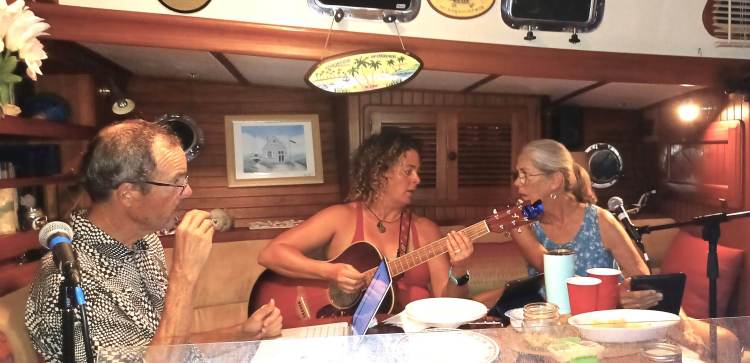
We also got together for a couple of jam sessions with RAVEN and MOMENTUM 2
Ted, Nikki, Barbara
Aboard RAVEN for a jam
Evelyn and Maureen
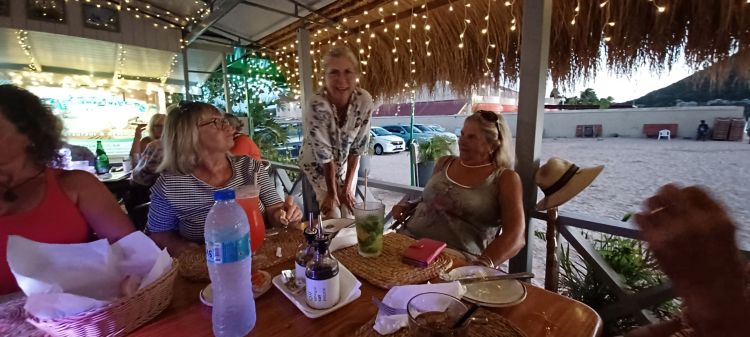
A well attended afternoon beach party in Rodney Bay hosted by Simon for long time cruisers Evelyn and Terry took up a nice afternoon.
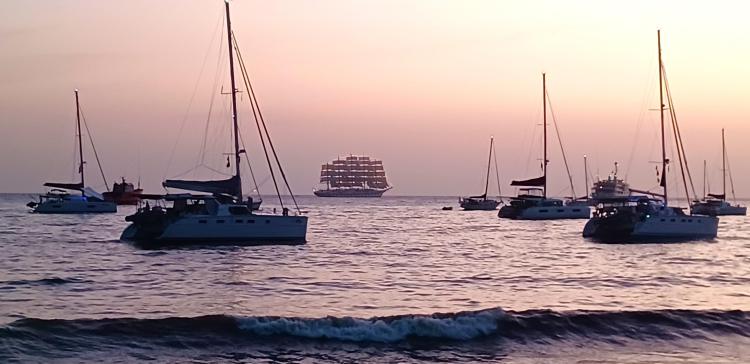
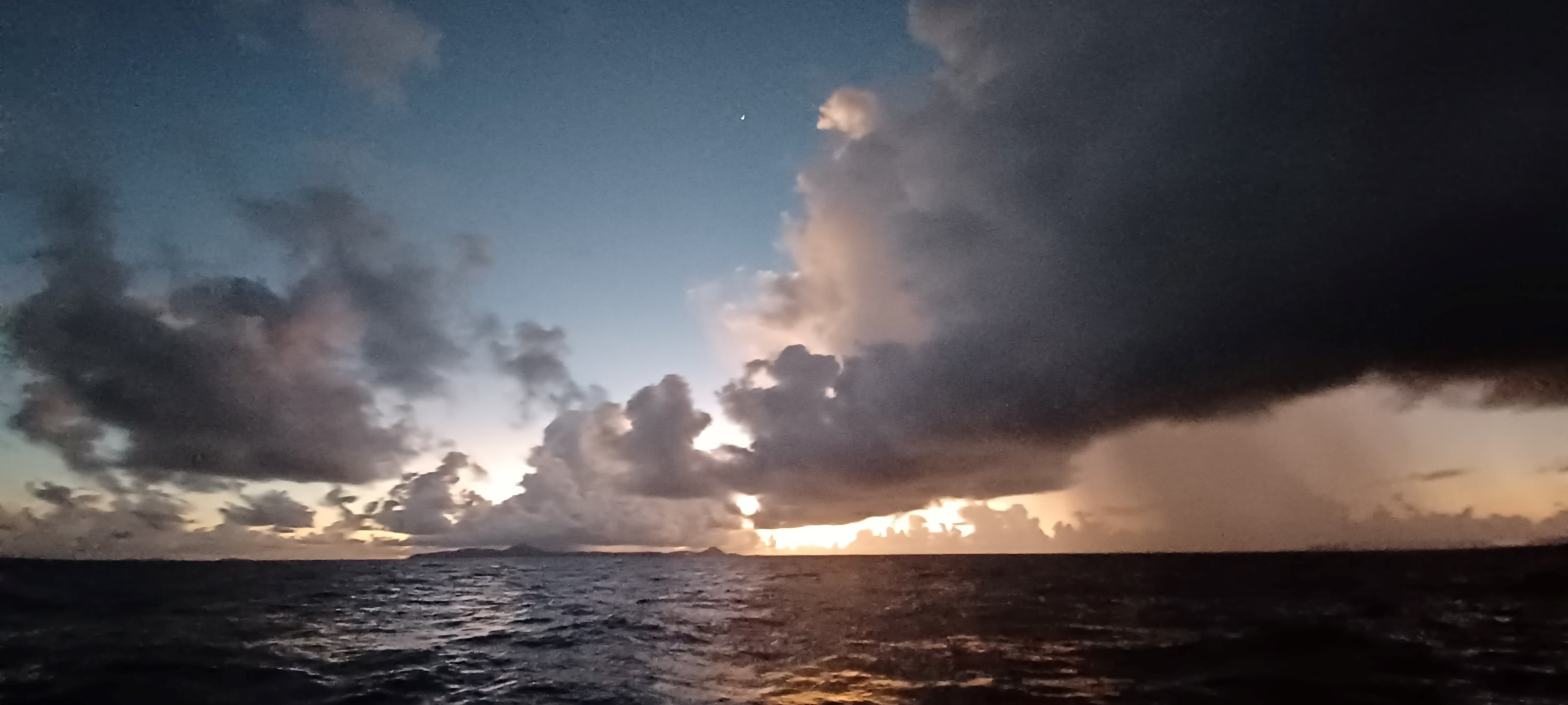
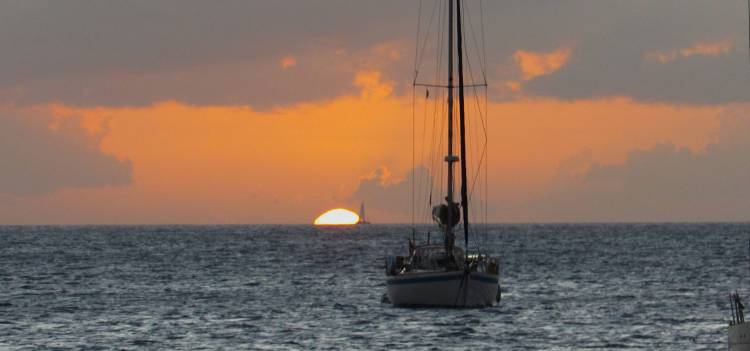
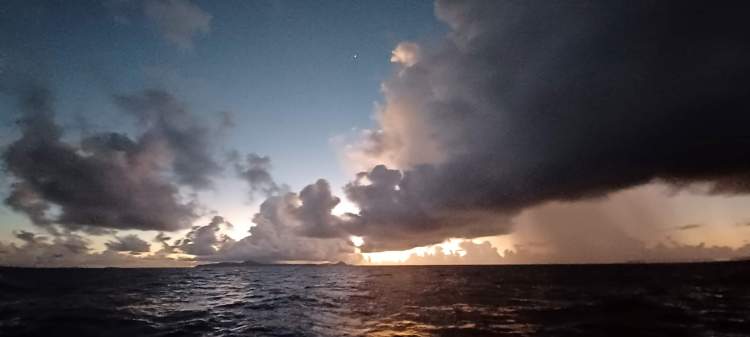
At this point, you may be wondering why I wrote about boredom at the beginning of the post. There seems to be little time to be bored. Well, the fact is that I don’t find being bored a particularly negative attribute. So, when the activities or demands of living on a boat in tropical splendor distract me from boredom, sometimes I miss it. I think I have that rare ability to be bored without panicking into doing something rash. Or anything at all. At the end of the day, when the sky becomes a glorious amalgam of red, orange, gray, blue, yellow colors of the setting sun, can no one appreciate the boredom of another sunset? “Stop and smell the roses” so the saying goes. Maybe just stopping is sufficient.
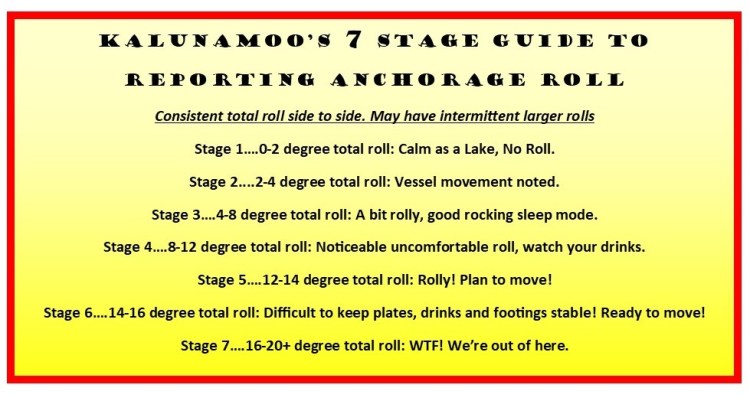
The last night in Portsmouth, Dominica, we shifted from the south end anchorage (Stage 7+) and anchored back in the north end as the swell would be less and we would be sheltered from the expected north wind. And that is, what we experienced except that the north wind never really filled in. However, at 4AM there was no wind at all. There was a bit of swell, Stage 3 at most. However, we were jolted awake by some loud creaking sound.
Creaking sounds on Kalunamoo are endemic. Loud ones, not so much. Jumping out of bed and dashing to the cockpit, I saw a red wall alongside the starboard side of the boat. Fortunately, it was not a wall. Unfortunately, it was the side of a large commercial unlit trawler that was on a mooring.
When we anchored in the afternoon, we did see this trawler but I reasoned that it would not interfere with where we dropped the hook. That was fine until the wind died. At that point, boats start meandering around their anchor or mooring based on currents, waves and swell. Each to their own particular characteristics. The end result was that Kalunamoo and the Big Red Trawler had a close encounter of the worst kind. When we rolled into the trawler our starboard wood railing was damaged and a chunk of cap rail was gouged out. I started the engine and pulled away from trawler. Nothing really serious, but both will be repaired in Trinidad.
Sailed South…
At dawn we weighed anchor and said adieu to Dominica and sailed to Martinique. This February “swell event” was experienced in all the Lesser Antilles and resulted in a number of boats, large and small, being driven ashore. We were fortunate that only a little cosmetic damage was had.
We sailed, accompanied with our friends, Ted and Barbara on RAVEN to Martinique intending to anchor in St. Pierre. Upon arrival in the afternoon, the “swell event” was still underway and it was obvious that it really was an untenable anchorage. A few boats were already driven to the beach so onward to Fort de France.
Carnaval was just starting so the anchorage was crowded, RAVEN found a spot to anchor but we sailed over to Trois Ilets. No swell and a good anchorage to stay while the seas calmed down. Carnaval in Fort de France proceeded but we have been there, a number of times and so we were not inclined to go. Two days later we sailed to and anchored in St Anne. We met up with long time cruisers we knew there (HORTA, IMAGINE, CASA TU, and ex-cruisers from NADA). The St. Anne/Le Marin area is a great place to stock up on French wine, cheese, croissants, baguettes and all things French which we did.
Kurt, Doug, Kattie
.
Maureen, Nada, Polda
Lizzy, Maureen, Harm
The anchorage in St. Anne is huge. It can easily accommodate well over 3-400 boats. Perhaps too easily. Le Marin is just around the corner and is home to well over 1000 boats in slips and moorings. It is one of the largest yacht centers in the Caribbean.
St. Anne, anchored boats to the horizon
Anchoring…
Anchoring is our preferred way of staying put while not actually sailing. But one of the consequences of population growth which does not exclude the cruising community is overcrowding. Not, a new phenomena, our grandparents probably complained about it, but we noticed a disturbing trend toward “cruisers”. In the French islands one sometimes gets the feeling that cruisers are looked upon like Lion Fish, an invasive species that must be carefully controlled. To a certain extent I can sympathize, as in fact, boats/ships, large and small, are invasive and are not native to the habitat, they inhabit. Of course, this can apply to all civilized humanity, a species not known to enhance their natural surroundings.
“Aquatic invasive species (also called exotic or non-native) are plants and animals that invade an ecosystem where they don’t belong. If the invasive species has no natural predators in its new environment, its population can grow unchecked. Their abundance causes damage as they can consume native species, compete for food and space, or introduce disease.”
So anchoring comes under suspicion for environmental destruction. In Florida, apparently, it even covers destruction of one’s esthetic view. Anchoring among coral has long been forbidden. It can damage and kill coral. An issue that is surfacing underwater (pun intended) is the awareness of the effects of plowing the seabed. Here in the Lesser Antilles the French islands of Guadeloupe and Martinique seem to be most active in pointing out the problem and have taken proactive steps to mitigate the problem.
Here as elsewhere, anchoring in sea grass is being restricted to protect these areas where turtles, juvenile fish, and the general fauna of these underwater lawns call home. Many boat anchors are called “plow anchors” and for good reason. You can imagine how they affect the lawn. Surfing the web, you can easily find the following:
“Every time an anchor is dropped and comes into contact with living organisms at the bottom of the seabed, it usually results in some kind of physical damage, dislodgement or an increase in sedimentation. If anchoring isn’t done right, this kind of damage can happen at various stages, during the placing, retrieval and while at anchor too. But it’s not just the anchor itself that poses a hazard to the environment. The cables and chains can cause serious damage too…Seagrass beds, for example, provide a nursery and home to many types of fish, molluscs and crustaceans too. They may not always get as much attention as coral reefs but they are some of the most productive ecosystems in the world. It’s been estimated that the world’s seagrass meadows can capture up to 83 million metric tons of carbon each year. Anchoring can devastate this fragile marine ecosystem in just seconds.”
To combat this problem, localities are placing moorings for visiting cruisers (and charging for them). These permanent eco-mooring “anchors” are less destructive but not totally so. In addition, they are limited in number and anchoring may be prohibited.”
“One problem associated with eco-moorings is the potential difficulty of finding an insurance policy to cover the system…investigated the feasibility of using eco-moorings as management options for Marine Protected Areas (MPAs) in the UK. The study highlighted the lack of an established insurance market for the moorings.”
The standard instructions for anchoring is to set the anchor in sand, not coral, not sea grass and to dive on it to ensure it is only in sand. That may be easier said than done. I fear that the organisms in the sand may not like that either but until they speak up, sand it is.
A Tragedy…
Lastly, a sad report. Last week a sailboat was spotted anchored in St. Vincent apparently “abandoned”. Upon inspection, it was found ransacked with blood all over the interior. Shortly thereafter, 3 escaped prisoners from Grenada were apprehended in St. Vincent by the police, tipped off by locals. Backtracking, and piecing together information and confession of the three violent criminals, the sailboat was anchored off the popular Gand Anse beach, in Grenada, with the captain and his wife aboard on Sunday night. The three commandeered the boat, attacked the two, disposed of their bodies at sea and sailed to St. Vincent. The bodies have not been found.
The boat, SIMPLICITY, was owned and sailed by Kathy and Ralph. They were Salty Dawg members and this was their first sail down to the Caribbean. We may have seen them in Antigua with all the other Salty Dawg boats back in November, but can’t say we knew them well. But as fellow cruisers, our hearts go out to their family for this senseless tragedy. Being in the wrong place, at the wrong time is just unfathomable.
After this incident we heard from a cruising couple we have known for years. They happened to be home in Kansas City and they asked about Kathy and Ralph. They experienced the shooting in Kansas City first hand. Only weeks before they were part of the celebration for the KC Chiefs. They and the crowd took cover and were safe, but traumatized.
Life can deal terrible news of tragedies almost every day. When it hits close, it makes seeing the sun rise for another day a true blessing.
After a very windy week in Deshaies, Guadeloupe we sailed south to Dominica. Before leaving Deshaies, however, we went up to the Jardin Botanique de Deshaies with our good cruising friends, Bob and Brenda on PANDORA. Not only is this a beautiful garden but has a great restaurant that serves a great lunch.
The winds calmed down and we, along with PANDORA and many other Salty Dawgs Sailing Association boats, headed for Dominica for their rendezvous in Portsmouth. We arrived a few days before the week of activities started as the winds were favorable to go south. Our schedule is really wind and sea conditional!
We took a mooring when we arrived but not before dealing with a sticky roller furling jib. That was sorted out and then we finally picked up a mooring. Dominica is a great “nature” island which I wrote about last year. This year was no different as we participated in a tour up the Indian River, the arranged BBQ’s of the PAYS (Portsmouth Association of Yacht Services) and other events with the Salty Dawgs. Bob rented a car one day, and the four of us went over to the east side of the island to the Kalinago Territory.
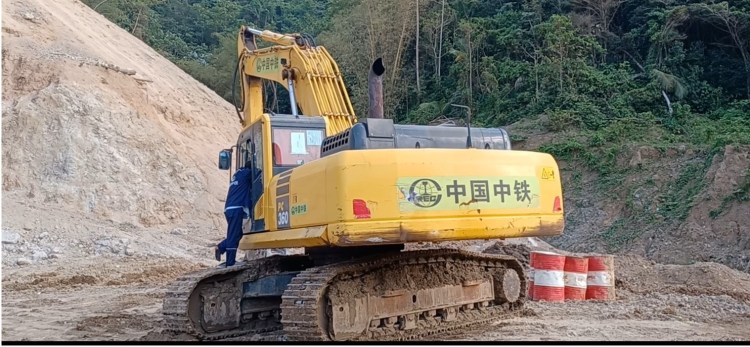
Thanks, Bob, for the great ride! It was a torturous road as it was being rebuilt along with heavy equipment and trucks heading for the new airport. All this is being done by the Chinese as part of their Belt and Road foreign aid program. Although the locals complain that few workers are hired by the Chinese for these projects, they will end up with better roads and infrastructure. However, the road light poles that were put in by the Chinese apparently haven’t fared very well. The solar and wind powered poles seem to have lost many of their pole top wind generators. Dominica may end up paying for all this but there is no doubt about the Chinese footprints in the sand.
The Kalinago area is home to the descendants of the original native Caribs of the islands at the time of Columbus’s voyages. There were, in fact, many native populations and villages on the islands which eventually succumbed to the European “invasion” of the 16th century. Like many areas, a healthy respect for the original inhabitants is increasingly recognized and appreciated. The British granted them this 3,700 acre territory in Dominica in 1903 for their own use.
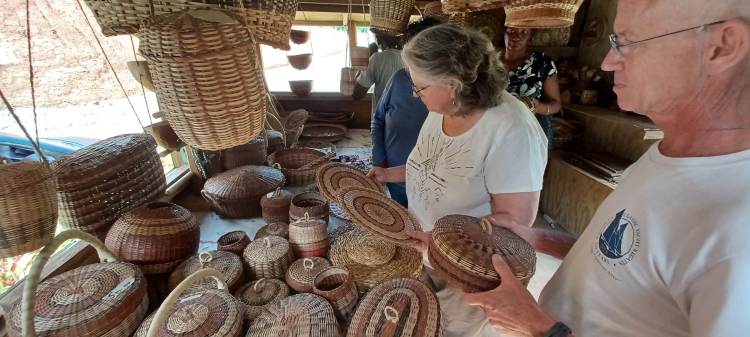
Since then, they maintained life on the island, intermarried and have maintained their territory. Brenda wanted to visit the area as they make, among many things, amazing hand made baskets.
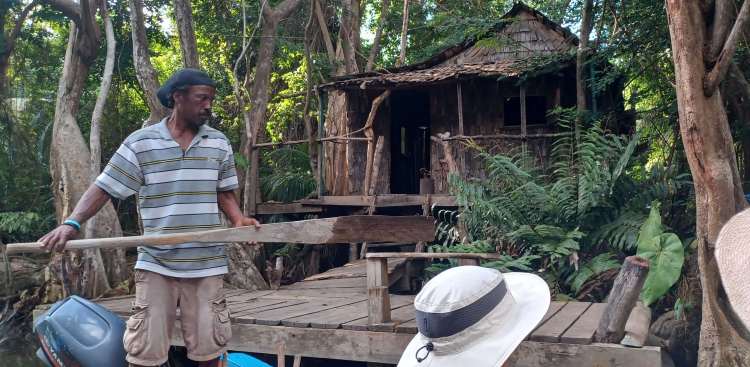
We haven’t been up the Indian River in a number of years and so we boarded a tour boat. It was a great afternoon on the “river”. Actually it is more like a big stream but it is still a wonder to explore. Part of the movie, Pirates of the Caribbean were filmed here:
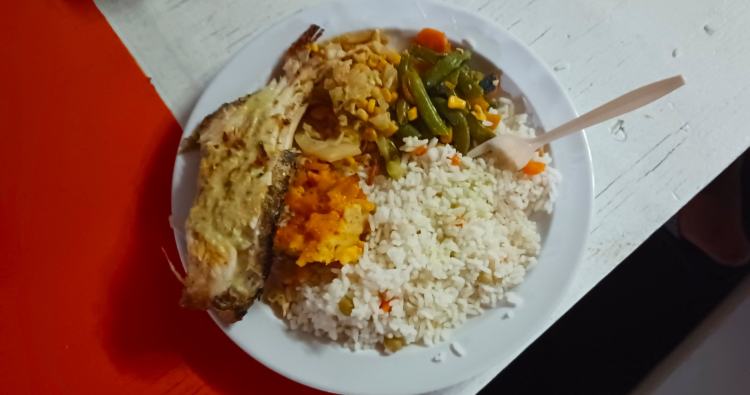
One night, the Dominica National Park hosted a free dinner at Fort Shirley which was appreciated. The next night was the Lion Fish dinner by PAYS where the guest of honor, the invasive Lion Fish, was consumed with relish to help control or limit its destructive invasion. The fish is actually very tasty and should be on ever fish lover’s plate.
Unfortunately by this time, a swell started rolling into the bay and it was becoming untenable as an anchorage. It was a 7+ on the Kalunamoo roll scale (WTF – we’re out of here). In addition, dinghies and even the PAYS boat launches couldn’t land ashore. We upped anchor and headed for the south end of the bay where it was calmer. A strong cold front was approaching which shifts the wind from the south to the north and, much like Mary Poppins, when the winds change, we do move on. Tomorrow, we sail south to Martinique and continue island hopping to Trinidad. Farwell Dominica, see you next year!
We call ourselves liveaboards cruisers. The emphasis is on liveaboard, mostly at anchor. Yet we do sail. It is the only way to really change our neighbor or neighbors. There are ten major islands and dozens of anchorages in the Lesser Antilles between the Virgin Islands and Trinidad. Each one is, mostly, a different independent country. The distance between them is usually an 8 hour or less sail between them.
Don’t assume, however, that the sailing between them is an easy sail. Many times, it is, if you choose the right “weather window”. These small islands sit essentially in the middle of the ocean. Actually, they divide the Atlantic Ocean from the Caribbean Sea, so the seas between islands are mid-ocean worthy seas.
All this, to explain that island hopping is not taken too lightly as a jaunt across a bay. Before crossing, a few things need to be done. First, you must clear out with Customs and Immigration and sometimes with the port authority. This is just paperwork but must be done in person when changing countries. Obviously, you must be in a port where these authorities are. Once that is done our home aboard has to be “secured for sea”.
This entails a multi-step process that includes: remove the dinghy engine using the spinnaker halyard to mount it by the main mast. Raise the dinghy on the aft davits and secure it to prevent any movements while at sea. Close and secure all ports below the main deck; stow the keyboard and all movable objects in the boat into a secure space, usually the v-berth; remove and stow below all sun awnings, covers and screening; set up all sail gear, remove sail covers, set up reefing points and ensure all loose deck gear including bicycles, kayak, BBQ, deck lights are secure; lower curtesy and signal flags. Then we start the engine, make sure it starts! Turn on all electronic navigation instruments, wind indicators, auto pilot, running lights, and cockpit gauges. Turn on the anchor windlass, remove the anchor snubber. If we are on the dock, disconnect the power and water connections, single up dock lines make ready the boat pole. At anchor, raise the anchor and clean the chain of any growth as it comes up.
Having done all that, we are ready to depart the dock or anchorage and proceed to a clear area to raise the sails, set our course, watch for traffic, check the wind, currents, and general weather conditions expected enroute to our destination. Our departure time is scheduled so that our arrival is at a convenient daylight arrival time. Many times, this may mean an overnight sail or a predawn departure sail.
Once all that is accomplished, we have a pleasant (hopefully) sail.
Needless to say, we spend more time stationary than actually sailing. After two months in Antigua however (including one month in New York), we were ready to go sailing. For one hop to Guadeloupe.
We set the alarm for 4:30 in the morning of our departure for the best “weather window” opportunity to sail south. The trade winds have been blowing strong from the southeast for a week, but they were going to back to the northeast. That is what we need to have a good sail south. It was a small window as in less than 12 hours the winds would become very strong. Too strong for anything but a very “salty” sail. Clearances and all the “secure for sea” items were done the day and night before. By 5:15 AM we were on our way in the predawn darkness. We actually moved the boat the night before to the outer limits on the anchorage so that we didn’t need to go thru the anchorage in the dark. Sunrise was around 6:30 AM.
We set a reef in the main sail and rolled out the stay sail. Since the wind is light in the lee of Antigua we motored south until the northeast winds picked up. Even with our shortened sail plan, we could do better than 6 knots and make a 7 hour passage. The wind was forecast to increase during the day and that is why we started with the shortened sails. It never gusted more than 20 knots.
It was a good day to sail. The sky was clear with only a few puffy white clouds, but the seas were still “angry” with 6-8 foot beamers making it a lumpy ride. Halfway down we heard a pop and the stay sail clew flew off the stay sail boom. Ugh! Roll the sail in, start the engine to keep us moving, and dig out a new outhaul block for the boom. That worked well, we only lost about 20 minutes or so.
The following few hours went fine but as we approached Guadeloupe clouds were piling up off the north end. Light rain showers/squalls were evident. Of course! The last hour into Deshaies will be in squally weather. Before this we even rolled out the jib and increased our speed to 7+ knots as our good friends Bob and Brenda passed us. They have the same size boat but it is a modern “fast” cruiser. Ok, there is a good reason for a fast boat: fewer hours making a transit.
We were both hit by a dry squall, ie. no rain but instant wind speed increase to around 30 kts. “Roll in the jib!”. Easier said than done when it is blowing like that. Maureen’s fingers took the brunt of the punishment, and we couldn’t get the last foot or so rolled in.
We did push on and made it to the anchorage in gusty winds. Deshaies is a lovely little French seaside town, but the anchorage is not that large and is subject to strong gusts which tests your anchoring capabilities. We found a good spot to anchor realizing that it was going to be very windy for a number of days. Be careful who you anchor behind! They may become very close neighbors in the middle of the night.
So now, we are here in Deshaies and yesterday the winds gusted to 30+ with numerous rain squalls. Today it is sunny but still gusting to 30 knots. This should calm down slightly each day and by close to normal by the weekend. By then, we will be ready to hop down to Dominica, with a better weather window, where we will spend some more time. A short video of the highlights is below:
The New Year just began and already patterns emerge. Our time in New York was spent celebrating Christmas with our three married daughters, sons-in-laws, grandkids, Maureen’s brothers and sisters, my brother and sister, extended family and friends. It was heartwarming. Heartwarming is the appropriate word as when the weather is cold (below 70 degrees) that is what I need. So, a white Christmas it was not, but it was heartwarming. Intending to fly back to Antigua the day before New Years Eve, we flew back a week later. Medical issues, which we will finish in the summer, delayed our return.
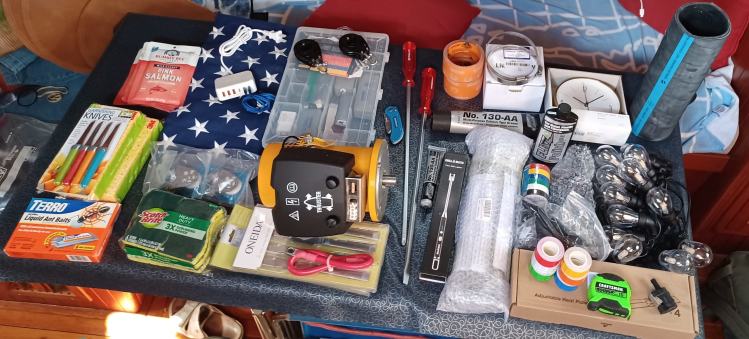
Before the holidays, Laura and Drew noticed a pattern and knew we were heading their way. Weeks before we arrive in New York, they start receiving our orders from Amazon, Defender, and other vendors. Everything from a large electric motor for our bow thruster to tools, LED lights, kitchen knives, BBQ grill parts, engine parts – all the things that are not readably available down in the islands. It is, as if Santa, FedEx’s our presents to avoid the Christmas Eve rush. We carried back over a 100 lbs of boat parts. The good news is that clearing customs here is very easy. No declarations to fill out (Trinidad), duties to be paid (Grenada) or brokers to be employed if shipped by boat, plane or sled. This pattern is duplicated in the summer. Those who are anticipating more discussion of boat parts and sailing can skip to the last paragraph otherwise, continue on; the discussion may get dense.
Our two months in the summer and two weeks in the winter travelling without Kalunamoo is the pattern we fell into over the last number of years (12!). Patterns, however, applies to virtually everything and everybody, and not just for humans. Leaves, flowers, fish, waves, artistic paintings, melodic music, animals, bacteria, planets all have patterns of behavior and form that repeat year after year. When these patterns are broken, people notice. Perhaps lotto numbers don’t follow a pattern although the players certainly do.
Science is a search for the “why” of patterns. A ball falls to the ground. A pattern is formed. A theory of why is formulated, and thereafter a method of future predictions is made possible.
All this brings me to artificial intelligence. Can you remember the fear that the year 2000 presented? How would computers react to the moment when “now” changed from 1999 to 2000? Doomsday scenarios entailed all sorts of effects. In short, many computer savvy people didn’t know what was going to happen. Fast forward to today when many computer savvy people don’t know the “why”, AI comes up with the information it comes up with. The “how” underlying the operation of AI is known: searching for patterns. If it happened before, its algorithm dictates that it will happen again. It does this by stringing words, facts, data points together and mimics previously discovered patterns. As I understand, it does not provide an insight to the “why” nor, which is more of a problem, provide the pattern it “discovered”. It’s a black box with answers.
I studied meteorology in college. Most of the history of weather forecasting relied on identifying patterns. “Red sky at night, sailors delight…” type of seat of the pants forecasting. However, after patterns are noted, either by ancient astronomers noting planetary motions or people noting wind directions before certain events, theories are formed to understand the “why” so that predictions by humans can be made. Humans learned! ,
So, it was with weather forecasting. I studied the fluid dynamics of the atmosphere and the parameters that could be measured to describe the state of the weather. The relationships of temperature, pressure, density, energy inputs, rotational inputs, feedback effects were mathematically developed: “physical laws”. One of the first uses of super computers were to calculate answers to these physical laws, using all the empirical data of worldwide weather stations, and develop “numerical forecasts”. Today they are called models. It developed the “why” of weather as much as the “what”. Even with super computers it takes hours of processing to run these models.
Some of the models used by the National Weather Service
Enter AI. As written above it searches for patterns and then just repeats it as a prediction. In the case of weather forecasting, it essentially does not provide the “why” of developments, just the developments. Using this method, recent news, reports that many times this method is more accurate than the traditional mathematical models and is much, much faster. This sound like great news. Do we really need to know the “why”? Just mimic the past and you know the future. Choose the right inputs, parameters, and mimic the past.
We all know history repeats itself, so why not use AI to search for patterns. I would love to see how AI advises us how to avoid wars, solve human caused environmental effects, how to best enjoy life, and what I will need to fix next on Kalunamoo. The hundred pounds of boat parts are slowly being ingested by Kalunamoo before we set sail south to Trinidad. The pattern we will follow will entail enjoying the fabulous weather, the clear waters, the amazing sunrises and sunsets, the frequent social exchanges with other cruisers and locals and the varied cuisines among the islands. We realize that we travel only a small section of this large planet, but we still find our patterns fascinating. Kalunamoo was called a “whimsical little ketch” a while back and we kind of like that description. And yes, whimsy can be a pattern that can be appreciated.
Our winter season in the Caribbean is well underway. After arriving in Antigua and taking care of some boat issues (see the last blog entry) , we have been kept very busy with activities of the Salty Dawgs. This group of nearly 90 boats that came down from the East Coast in November and kicked off the season here with cocktail parties, dinners, a dinghy drift, small boat regatta, meet and greets with local businesses on an almost daily basis. We participated as the “southern contingent” as we sailed up from Trinidad and not in the rally from the East Coast.
Lynn & Bill Morning Net Hosts
My participation has also been as the Net Controller for the daily 8:30 AM morning VHF net with Lynn on ROXY. She is the social director here for the Salty Dawgs. The net could also be called the Daily Calendar with Bad Jokes and Puns.
So, it has been a whirlwind of activities almost every day. We do manage to get in the water for some swimming exercise to work off some of the rum punches. We have also organized a few musical jams which are fun, and even melodic at times. Dave and Trudie on PERSEPHONE add a layer of professionalism, Mike on MERMAID is giving me harmonica lessons, and Lynn on ROXY is keeping me away from the mike.
Chill’n at Boom Restaurant
After we arrived in Antigua and were in English Harbor for few days, we moved over to Falmouth Harbor. There is more room to anchor there and is closer to Pigeon Beach to swim.
The weather has been warmer and dryer than normal. The water temperatures are even warmer than usual. This was true even in Trinidad. Climate change? Who knows? Nonetheless our water maker (rain collection system) stores 15 gallons for our on deck fresh water rinse off, even with light rainfalls.
We had an ex-cruiser friend Mary stay aboard Kalunamoo a few days. She caught up with other Salty Dawgs and it was good to see her again. She lost Doug a few years ago to cancer and we miss them both sailing on Zipporah.
Maureen, Bill & Mary
.
The Dawgs at 2-Six -8
Dinghy Drift in Falmouth Harbor
Thanksgiving Regatta
The Admirals Inn
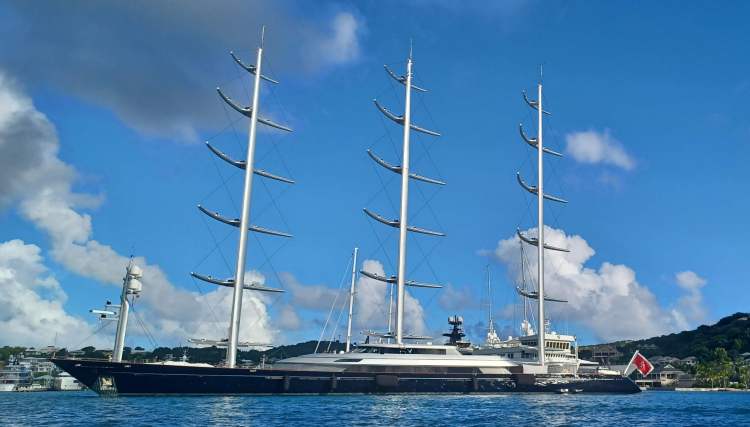
The Maltese Falcon
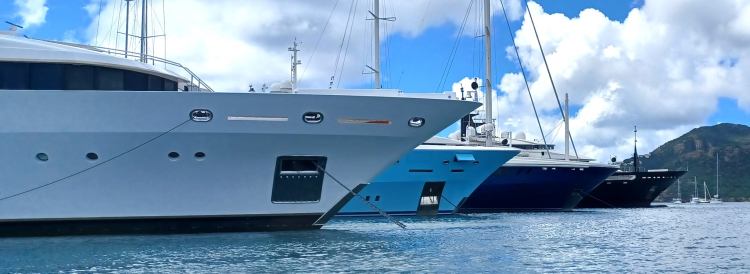
This week the Charter Boat Show in Antigua takes place. So, after the Salty Dawgs showed the way to Antigua, the Big Boys arrived. If you don’t have a boat to sail down on, you can always charter one of these and enjoy the island like we do. There are over 50 here now. They are big enough to invite your friends and family aboard. I suggest The Maltese Falcon to charter. It accommodates 12 and only costs $500,000 per week excluding fuel.
Take your pick!
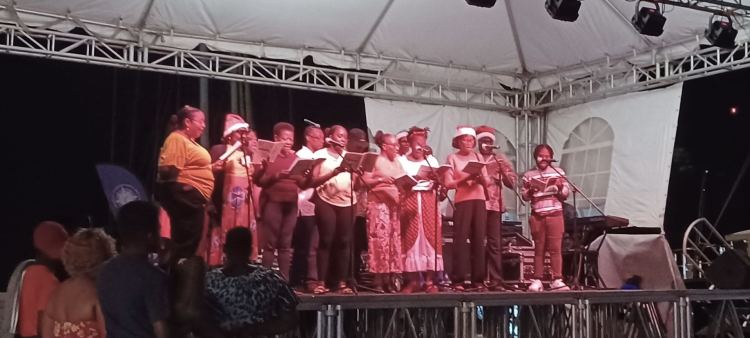
Time to get ready for Christmas as we fly to New York to be with family and Friends. Tree lightings and lights are out and about, but alas, no forecast for a white Christmas down here.
Its been two weeks since we sailed from Trinidad. About 24 hours after leaving Trinidad, we anchored in Bequia, the northernmost island of the Grenadines. The overnight sail north was very pleasant with favorable winds and weather. It was good to get out on the sea again and Kalunamoo performed very well without any “shake down breakdowns”. Bequia is a great little island, has a wonderful swimming beach, and has a truly Caribbean island vibe.
Jack’s at Bequia
The weather, however, was changing. The forecast of squally weather interrupted by either calms or gusty winds which made the decision of when to continue on, a bit of a game. We were headed to Antigua to meet the arriving Salty Dawg Rally group who were sailing down from the East Coast. Our cruising friends, Lynn and Mark on Roxy, also left Trinidad and were also sailing to Antigua (Lynn is the “social director of the Antigua Dawgs) but they made a stop at Martinique. The Dawgs, which we are members of, always provide fun times with scheduled events and ad-hoc activities. We also get to meet many cruisers that we know, have a great Thanksgiving at the Antigua Yacht Club and enjoy sailing around Antigua.
Of course, having a schedule is not the best way to cruise. Leaving enough time to cover the 400 miles between Trinidad to Antigua with options to stop off at any of the six islands on the way helps. The Dawgs have to sail 1300 miles with no stopping, except for Bermuda if the wind is right. Given the anticipated weather we decided a one stop voyage would be fine. The second leg, Bequia to Antigua is over 40 hours. In any case, the weather was as expected, but the boat performed wonderfully. Except when we wanted to start the refrigeration (reefer).
Since the reefer compressor was replaced two years ago, fifty percent of the time the compressor balks at kicking over. This only occurs when it runs on the generator. This is needed as it is a big 120 volt compressor. On shore power there is never a problem. But most of our time aboard cruising is not spent in marinas. It usually takes 3-4 times to kick the compressor on but once on there is no issue. This time it just would not kick on after multiple tries and several hours between attempts.
We came into English Harbor at 6AM, anchored in Freemans Bay. At 8 AM we called the Slipway Boatyard and made arrangements to go alongside and work on the reefer. Are we having fun yet?
Slipway Boat Yard
The reefer kicked over with shore power, and the reefer mechanic checked it out and found everything fine. The generator was also tested and, of course, it also worked to start the compressor. The problem is a mystery that we are still working on.
After two days we went back out to anchor alongside Roxy and the reefer ran just as it always had. Maybe it didn’t like the 40 hour passage. What also didn’t like the passage was the bow thruster. We use that only when docking but It didn’t work when docking at the Slipway Boatyard.
On the way up, we had to pump a lot of water out of the bilge and forward sump. Rainwater does accumulate but the amount was disconcerting. The problem was I could not find where it was coming from. Fortunately, wherever it was coming from was slow and only when we were sailing. That’s a good thing. Fun yet?
To check out the bow thruster everything in the V-berth must be removed. When we did that, I discovered the bow thruster motor submerged in 3 feet of water! The compartment was completely flooded. The electric motor was toast. The slow leak was from the new Bobstay fitting that apparently was not water tight. Underway, it is underwater. At anchor it is above water and you would never know it was not watertight.
Mark on Roxy and I took the whole motor out, disassembled it, but for various reasons, decided a new one was the best option. We will bring down a new motor and relay at Christmas time. Fun yet?
Bow thruster motor
Freeman’s Bay is a beautiful anchorage in English Harbor but notoriously swirly. This means that when the wind dies (usually at night) the anchored boats drift around haphazardly and risk colliding. After two nights of that we had enough. We moved over to Falmouth Harbor where there is no risk of that.
Anchoring in Falmouth is a piece of cake. We dropped the hook, let the boat settle, and then backed down on the engine to set the anchor. All was well until the engine gave a shudder. Didn’t think too much of it until that night when we discovered the end of dinghy falls (the line to lift the dinghy on the davits) leading down and apparently wrapped around the propeller. No fun yet!
It took about an hour, underwater, holding my breath, cutting the very tight ball of rope off the propeller and shaft. It was so tight that the rope actually melted and fused together. No fun there.
Finally, I got it free and barring any other calamities we are ready for some fun. Played Mexican Train Dominoes yesterday, and had the first official happy hour with the Dawgs. Most of the Salty Dawgs will arrive today and tomorrow and events will commence! So, the answer to Where’s The Fun? Right now it is here in Antigua!
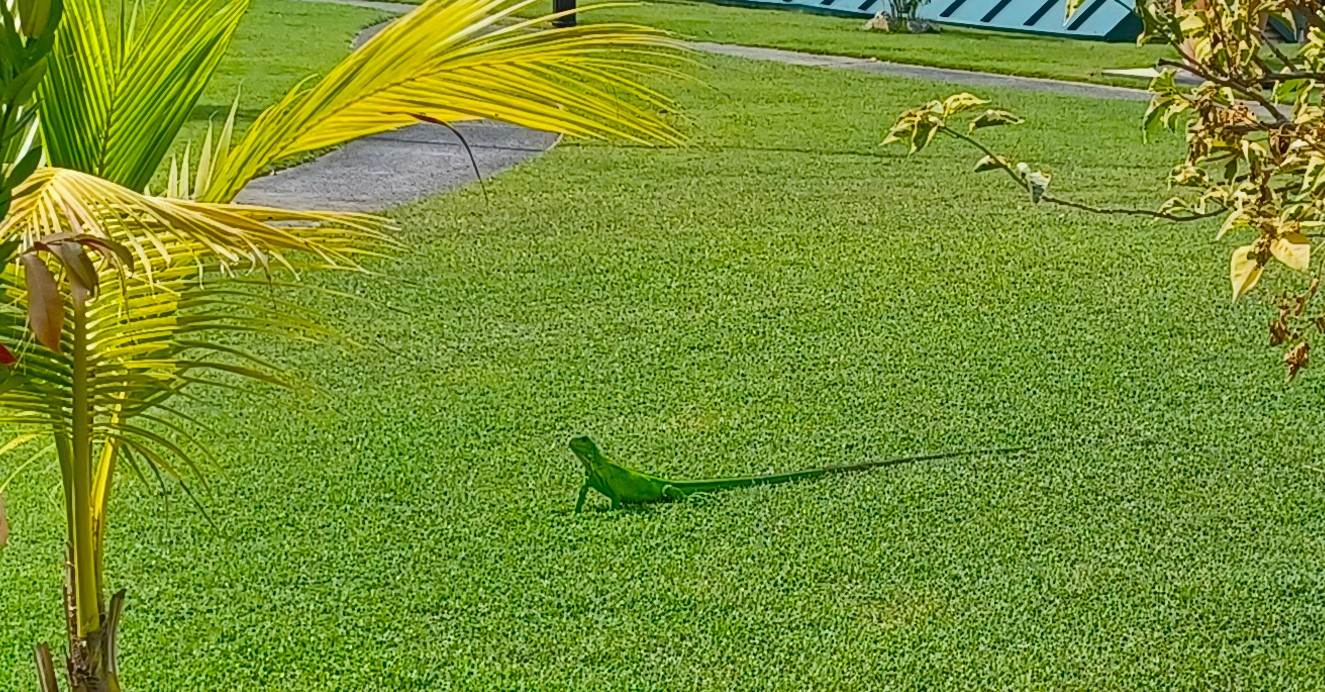
When the Green Iguana wakes up and sees his shadow, winter is coming. So it’s time to head North. Actually, he or she sees their shadow every day, especially this season. It has been sunny and hot, more than the usual sunny and hot weather. A rental air conditioner is used when on the hard and we even use our onboard air conditioner here in the marina. This is the only time I can appreciate a/c as the cooling Trade Winds on this island of Trinidad fails. So as winter approaches, we sail north. For us, it means the northern Leewards.
Our Trinidad season is just about over. Kalunamoo has been here since the end of May and for the last seven weeks we have been finishing up our M&R and getting ready for island hopping the Lesser Antilles. As written about in the last post, we have also been enjoying Trinidadian social events with cruisers and locals. We moved Kalunamoo over for two weeks at Crews Inn, a marina and hotel in Chaguaramas, to get her “feet wet” before we sail. The Inn also has a great pool so that we too can get our “feet wet.”
We will head north, making a few stops along the way before hitting Antigua. We will spend a month or two there, enough time to fly to New York for Christmas, and then let the wind decide where we go from there. The Salty Dawg Rally group will be in Antigua by the time we get there, having sailed down from the East Coast. It is always a good time meeting new cruisers and those we know from previous rallies. Thanksgiving at the Antigua Yacht Club will be on the agenda along with other salty Dawg events. I hope for a few jam sessions and other island social events.
It was in November 2013, that we first sailed down from Virgina to the BVI’s with the Salty Dawgs. It takes about 11-13 days for us to sail directly without stopping and have done four crossings. We don’t look forward to those long passages as much now. The one or two overnight passages are more than sufficient to keep us in sailing shape and in the Lesser Antilles. But we are often asked, so when are you returning from the Caribbean?
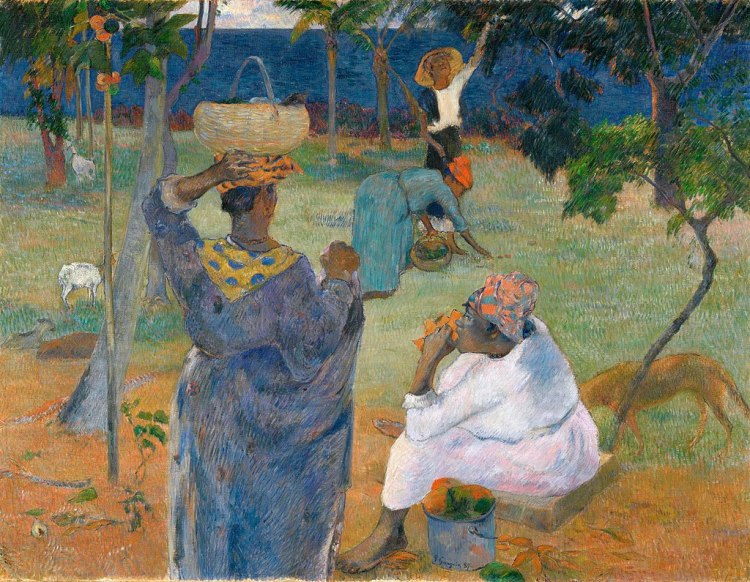
Among the Mangoes (La Cueillette des Fruits), Paul Gauguin
Paul Gauguin, a painter of some notoriety, first visited the Caribbean, Martinique, in 1887 after spending a short time in Panama. He lived in St Pierre (before the eruption of Mount Pelee wiped it out). He painted almost two dozen art works while there before returning to Paris. In 1890 he sailed, (not on his own boat) to Tahiti and spent about three years in the Pacific.
Brenda’s weaving
I bring this up as we recently met a retired doctor, Steve, here in Trinidad. His sailboat, ALMOST THERE, was on the hard right next to Kalunamoo. Only retired a few years, he was enjoying the Caribbean and spending much of the time in Grenada. As we got to know each other, he mentioned that he loved to write. He just finished his first novel, The Dance, and was trying to get it published. I also like to write but don’t think a novel is in my future, but it is fun to “make up characters” and see where they lead. Actually, there are numerous cruisers who have written, and continue to write novels, blogs, magazine articles, how-to books, that we have met along the way. Other arts are also represented including painting, photography and even weaving. Our good cruising friend Bob and his wife Brenda on PANDORA spend time in the Caribbean and Brenda is a proficient artistic weaver. Cruising aboard, however, does cramp her capability. Not to worry, their basement home in Connecticut is outfitted with large looms for her weaving! Bob happens to be the president of the Salty Dawg Sailing Association and we will see them again in Antigua.
Dance (La Danse), Henri Mattis
Steve’s fictional novel, The Dance, takes place in Manhattan but its theme is Henri Mattis’s painting of the same name, or more descriptively, Steve’s interpretation of its imperative to pursue life’s unfettered joy. That is what drives most people although the paths and methods are many, obstacles persist, and results are often compromises. The goals may never fully be realized and as many have said, it’s the journey that counts. These are the senses that influenced our travel south to the islands. So when will we sail back, really, to the north? When will the dance end? Only the musicians know.
Kalunamoo has been in the Trinidad “shipyard” since the end of May. We returned at the beginning of September to find her non-skid decks painted with other works in various stages of completion. Since then, new interior cushions, exterior sunshades, cockpit enclosure, Max feathering propeller, led lights, galley faucet, bob stay fitting, cutlass bearing, refinished teak work, new covers for the BBQ and aft table, all have been installed, completed or nearly so. There are other things still on the list including stay and main sail repairs and routine maintenance items but all should be completed by the end of next month.
New Cushions
New Max Prop
New Bob Stay Fitting
Ok, so that took up most of our time here. You must remember that we are on Island Time which means that the number of hours in a day is much less than 24. In addition, the weather has been hotter than normal (fry egg in sun temps) which, as Einstein Theory of Relativity told us, slows time and work down. All this means is that when you rise at sunrise and do some work, before you know it you’re ready for a nap, maybe some lunch and then get ready for sundowners by sitting on the dock of the bay. Or maybe, it’s Thursday night’s potluck BBQ, or a Friday night music jam, or a Saturday night at the Wheelhouse or Sunday Dominoes, Tuesday Maxi Taxi to Massey shopping, or a Saturday morning trip to the fresh market in Port of Spain. Really, I can’t understand how all this can be done and still expect to get any relaxing boat work done.
Sitting on the Dock of the Bay
But that is not what I wanted to write about. It’s about chocolate. Maureen got me into the notion that chocolate is an essential nutrient for a happy life. Aren’t Candy Kisses sweeter than wine? Apparently so. While the Hershey/Dove/Godiva controversies continue in various venues, sailing in these Caribbean Islands, we learned of the Coca Trees and their beans.
Coca Bean in Dominica
I wondered if the Cocabean is actually where the word Caribbean came from. Most attribute the word derived from the locals. They were known as the Caribs (the botched pronunciation of Kalingo’s) to Columbus and his sailors when they entered the country without any pre-arrival notifications. Of course, without proper paper-work or authorizations to stay they were turned away, but that is another story. In any event, botched pronunciations were the least of the problems. But Europeans were nothing if not persistent and eventually they moved in, cultivated the land. Mostly for sugar, rum and chocolate. Well, the chocolate part never really took off at first but when it did, they managed to send plants to Africa where today 70% of the coca beans now originate.
Myan Coca Drink
The problem with chocolate is that from bean to bar, chocolate requires a bit of processing. It’s not like Candy Kisses grow on trees. The natives made chocolate drinks for centuries before Columbus, but I think the Europeans preferred rum. Maybe it was the sailors influence, I don’t know.
Be that as it may, coca beans are shipped to processers in the industrialized countries on a grand scale. The trouble is that the farmers of the beans only earn enough from their beans to wear Lady Godiva’s clothes. The beans of the Caribbean, like the African beans, are exported for pennies and return as relatively expensive candy bars. This has prompted entities like the FairTrade organizations and farmers cooperatives, NON GMO verifications, USDA Organic labels etc. to try and “spread the wealth”. Any resemblance of Colonialism is purely coincidental.
And so, over the years here in the Caribbean (or should I say cocabean?) local farmers are forming co-sops and small local entrepreneurs are producing retail chocolate from local beans. The results are interesting. We have bought and tasted “local” chocolate from Grenada, St. Lucia, Dominica and St Vincent (and from Africa). My favorite is Jouvay from Grenada, (Maureen still likes Candy Kisses) but they all have a place in the realm of chocolate delights. The small batch production limits their export capability but as this generates local income that is not syphoned off the island, we sailors can add chocolate to the ways we can support the islands. Besides, I think it goes very well with Caribbean Rum.
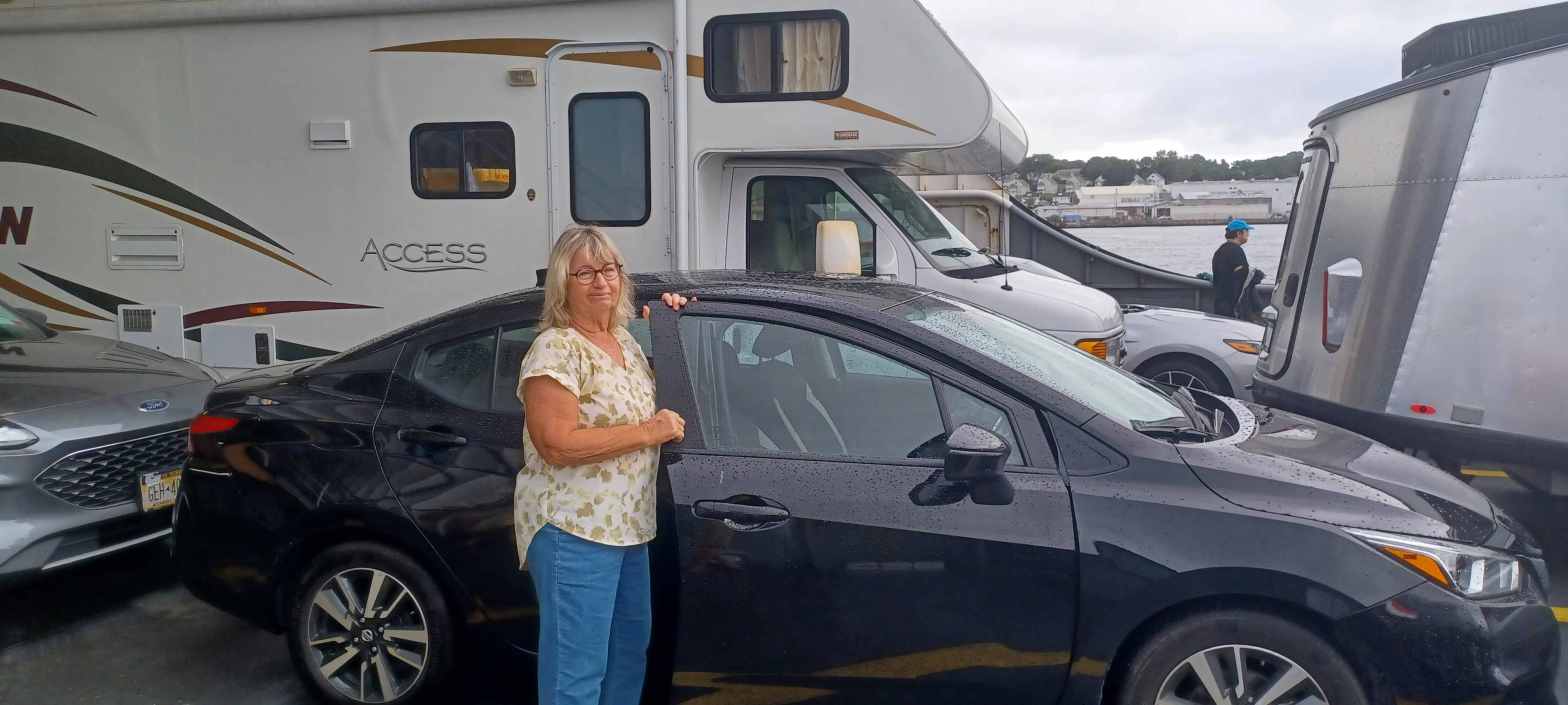
We left Kalunamoo in Trinidad on the first day of summer and flew to New York. Since then, we have chartered a Nissan and have been cruising on 4 wheels while putting over 2500 miles under the floorboards.
Our first 4-wheel cruise was to the south south-west about 600 miles. The weather was fair to squally, although visibility was good. We took the rhumb line course on the I-95 as far as Richmond then veered south toward the Cape Fear River. The run between Baltimore and Richmond was heavily travelled which necessitated a constant vigil of approaching, crossing, overtaking and out of command vehicles. Everything from small runabouts to mighty 18-wheel clippers occupied the same traffic lanes. Fortunately, separate inbound and outbound lanes are delegated to avoid head on situations. However, the lack of modern navigation in these vehicles cannot be excused. We have become accustomed to AIS to quickly communicate ours and other’s intentions. Our chartered Nissan relied on old style flashing lights and barely audible sound signals for this. I’m surprised they don’t still use flag signals. Believe it or not, other helmsmen behind their wheels even used individual finger signals to communicate their instructions. Since we were in constant cell tower range, we were able to use our chart plotter efficiently, although that female voice was sometimes confused and seemed to need to recalculate often. Most aids to navigation seemed to be missing although we never worried about shoals or bridge clearances.
Well, we made arrival by 1800, 12 hours after departure, and secured our vehicle in the designated parking area. Despite the threat of some strong squalls that was forecast, I was confident that the parking brake would hold.
We spent a week with Maureen’s family at Caswell Beach on Oak Island, NC. Had a great time and even visited some old friends from Brooklyn who migrated down there a few years ago. They are all land dwellers now, although I don’t hold that against them. The family took a boat tour of the Cape Fear River one evening and heard of the many movies filmed in the area (Cape Fear was not one of them). I was just fearful that the tour boat didn’t duplicate the bad fortune of Sir Richard Grenville who named the river Cape Fear when his ship became embayed there. Perhaps the only other passenger who knew this fact was a 3 year-old that couldn’t stop crying and screaming as soon as he embarked.
The Powers
On our return trip north to New York we pulled into Sparks, Maryland on Gun Powder Road. Who says those who name places don’t have a sense of humor! We visited with cruisers Judy, Judie, and Ed that have also swallowed the anchor and, believe it or not, are quite content. The great crab cakes that Judie makes must be part of their secret.
Bill, Judie, Maureen, Judy and Ed
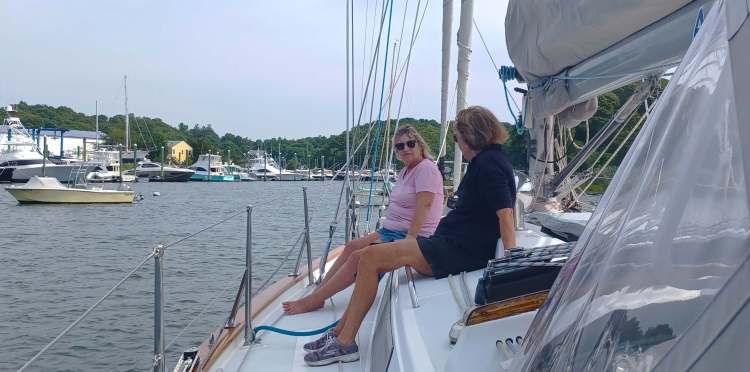
Other trips were made to Essex on the Connecticut River and to Cape Cod. Bob and Brenda (PANDORA), are good cruising friends, we met years ago in Florida. Bob is also the president of the Salty Dawg Sailing Association. They invited us up for a few days while he held a rendezvous for cruisers in Essex. It was a good time to meet and greet those who have one foot ashore and the other on board. Our afternoon aboard PANDORA, in Hamburg Cove, was delightful, although I am not a big fan of swimming in salt free water. It’s a buoyancy thing.
Between these jaunts, we watched our grandkids’ ball games, hung out out on Long Island beaches with the family, had backyard gatherings, family birthdays, visited other friends and, in general, caught up with most of our shoreside relations.
Michael, Timothy, Ryan, Caleigh and James
One week, I checked the weather window for the trip up to Cape Cod and it seemed ok. We booked the Nissan on the Orient Point ferry bound for New London. The early morning departure presented haze and light showers for the crossing. It was uneventful, no lashing and securing was needed. The gentle swell barely tested the parking brake. Heading up I-95, I eyed the gathering dark clouds ahead. Our speed over ground was substantial and I feared we would overtake the tumultuous tempest ahead. Alas, the cell phone sounded the alarm (almost like VHF 16), tornado warning (these are waterspouts on land)! I studied the possibilities and diverted our course and headed to the nearest protected “safe harbor”. Rains came, but no twister. Later we learned, it had touched down not far from where we were. In short order, we resumed our course up to Parkers Boat Yard and boarded their launch to ALLEGRO, lying on a mooring in the harbor.
Aboard ALLEGRO
We reunited with Lee and Sharon (ALLEGRO), had lunch with them and with Nada and Polde (NADA) and eventually sailed over to Hadley Harbor. Dug for clams and had a wonderful few days aboard. We hope to see PANDORA and ALLEGRO again in November in the Caribbean.
In between points of call, our time has been spent navigating various medical quays. After pre-arrival notifications, and clearing in with insurance and billing formalities, we joined the queue in their anterooms. We hoped that whatever adjustments we needed, the required repair parts would be in stock. In such cases, maintenance and repair on multiple personal body parts would need to be scheduled for later calls. Preventive procedures included checking blood and urine levels and values and assessing if any needed additives or adjustments were undertaken. We also submitted to X-ray, sonagrams, EKG’s and Cat scans to reveal any hidden defects and, we are happy to report, that as of this date none have been detected. Fortunately, none of these required berthing arrangements nor being put on the hard like a “fish out of water” for any considerable time. Departures were quick although many of the final written survey reports are yet to be received.
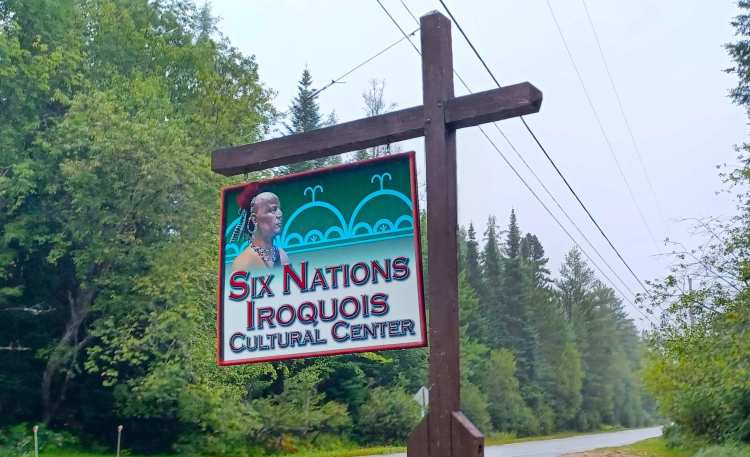
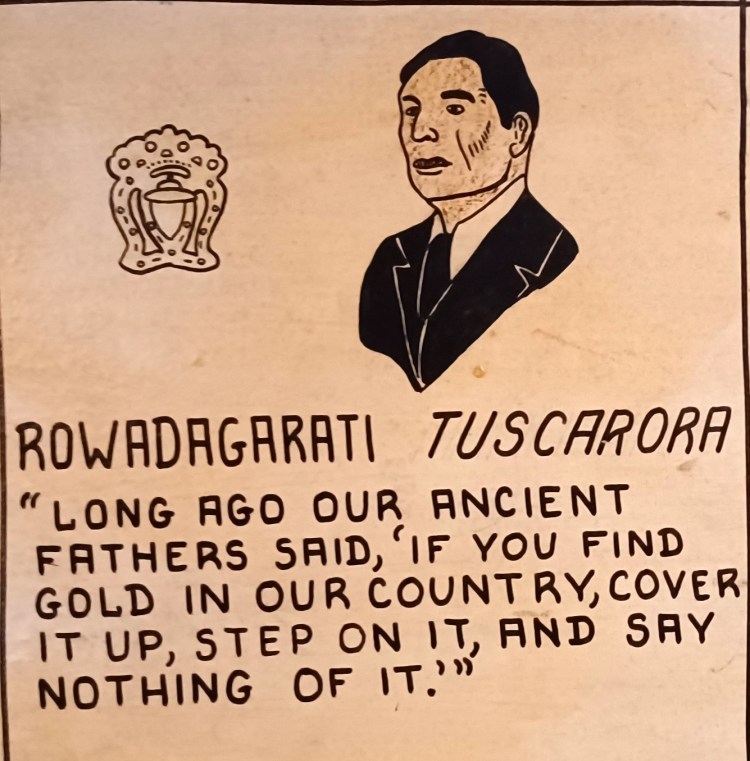
Our final transit in late August was up to New York’s Adirondack high peaks area of mountains and forests to see Melanie and Dave. It was an opportunity to wear long pants and jackets. Heavy foul weather gear was not needed nor was there any danger of the lakes freezing, so that was encouraging. This is the land where the indigenous people’s origin story describes how Skywoman descended from Skyworld. Sweet Grass, the Three Sisters and Mother Earth held major influences over them way before the “white man” arrived. One only wonders what Europe (and the U.S.) would be like today if these natives sailed east and imposed their lifestyle there instead of vis versa.
Melanie and Dave
Well, we had a good visit with Melanie and Dave (even played Mexican Train Dominoes) as they meld a lifestyle of their own – far from the maddening urban crowd and toward Mother Earth’s sensibilities.
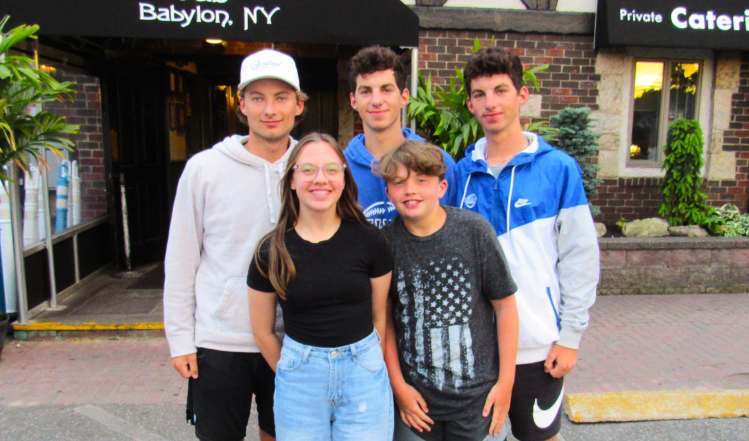
A few days later and a couple of hundred miles due south, we pulled into Atlantic City where we met up with Liz, John and two of our grand kids. This is the land diametrically opposed to where we just came from. The land is table-top flat, the tallest peaks are the sand barriers keeping the Atlantic Ocean off the boardwalk, and the main occupation is prospecting for gold in the obscure corners of dimly lit caverns of electro-mechanic machines with loud noises. Needless to say, we were unsuccessful as to the prospecting but had a good time with the family anyway.
The “rare” Blue Moon of August crossed the Skyworld yesterday as ancient folk lore mashed up with the astrodynamics of calculation, luminosity and position. It has been that sort of summer. Two months of land navigating the realities of life ashore compared to the ethereal voyaging at sea on the blue pearl, awakening us to the daily interactions of friends and family that are dearly missed. But I take note of a few lines in the Thanksgiving Address (Words That Come Before All Else) that Native Americans recite to give thanks. “So now let us bring together our minds as one and give thanks to each other as People”.
We will rejoin Kalunamoo next week as we resume voyaging on familiar waters. We give thanks to the sea that rocks us to sleep, the wind that propels us, the fish, animals and plants who graciously sacrifice themselves to provide our sustenance. And to those who we meet, we strive to find where “our minds are one.” It was a good summer.













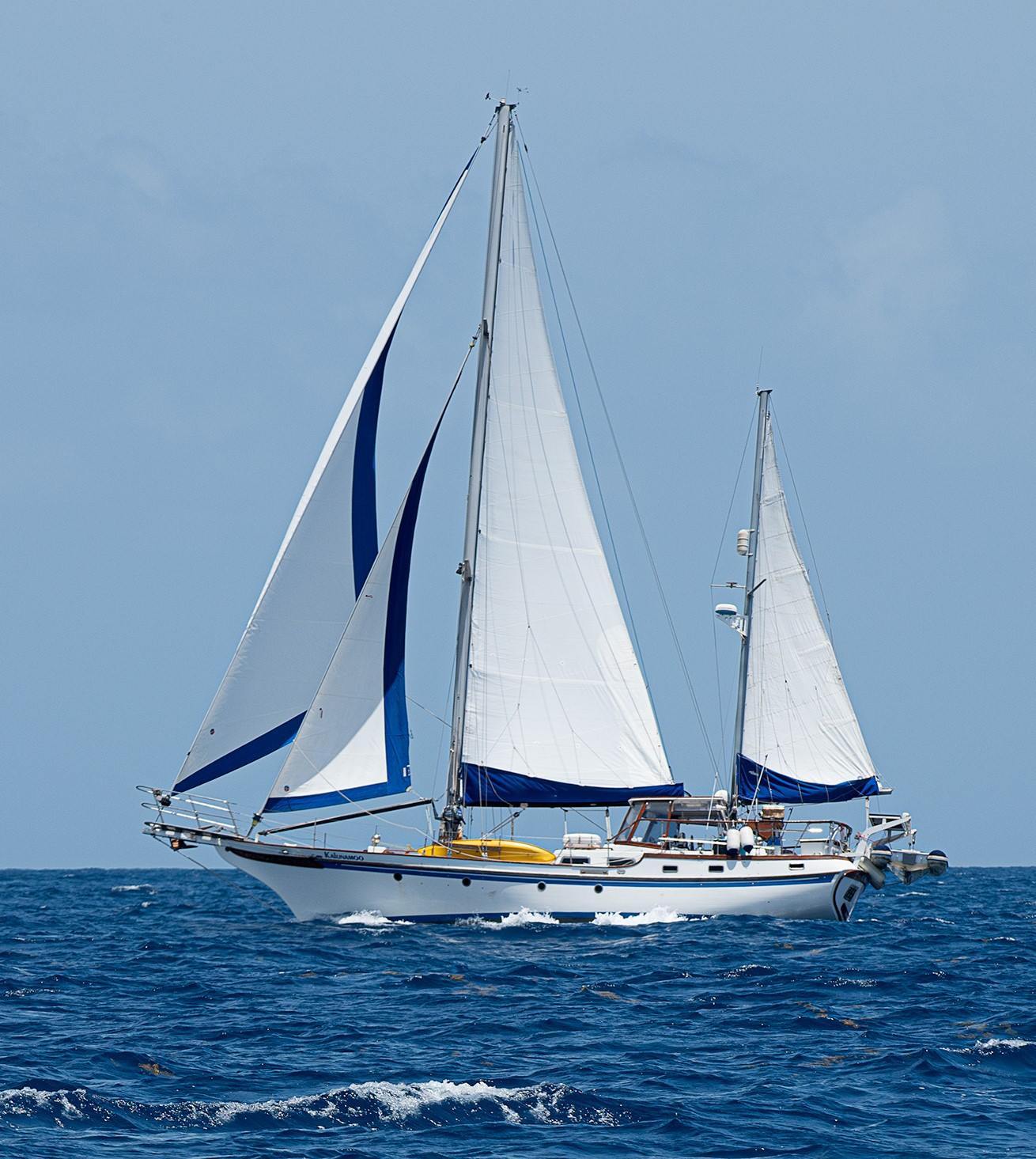




















 Kalunamoo