BREAKING NEWS!

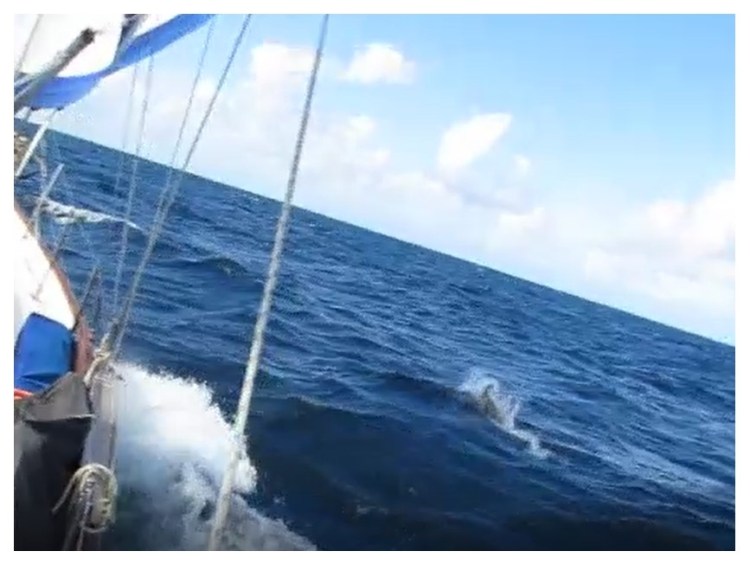
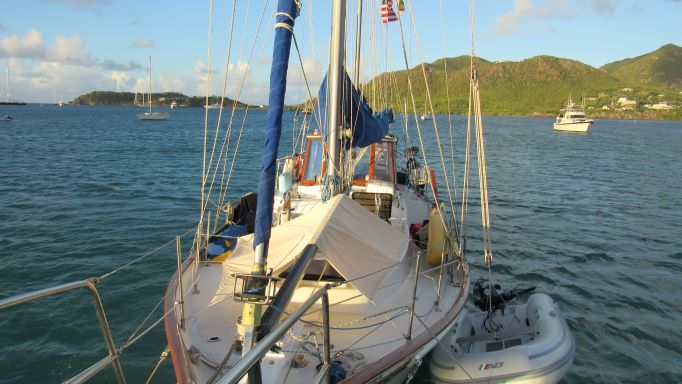
In a surprise attack on a sunny afternoon a pod of marauding dolphins descended on the unsuspecting and peacefully sailing ketch Kalunamoo. It was feared that what started out as a pleasant sail could end up as horrific incident on the high seas. This occurred as the ketch with only its captain and first mate aboard sailed to the small island of Bequia off the coast of St. Vincent. This Windward Island, in the southern part of the Lesser Antilles has a long history of attacks. But even in today’s world, with all the modern navigation and communication capabilities, they still occur and fill the need to provide content for the 24/7 news cycle, not to mention the commitment to write blogs.

Early reports indicated that the ketch was surrounded by these mammalian marauders, menacing the startled crew into action that cannot be described as anything other than controlled confusion. “We were startled by the sheer audacity” reports the captain of the ketch. He reported that the first inkling that there was something amiss was the odd sighting of breaking waves off to the boat’s starboard side. In the distance, the captain explained, were “white caps” where none should have been. The wind was from the direct opposite side of the boat! “That is not normal”.

As the breaking waves moved ominously closer, the crew’s adrenaline rose to dizzying heights. Soon the first hints of what was happening appeared. Dark forms with fins piecing the surface of the water came ever closer. Lancers forcefully puncturing the interface between the bright blue sky and the deep depths of the watery abyss below, burst out from the boiling sea. These creatures, which up to this point could only be imagined, did not present themselves at first. They stealthily maneuvered closer and closer to the fast-moving boat. The hull, sensing the danger that might lurk beneath the waves, instinctively reacted to move quickly away. The sails strained to capture every bit of wind while the sheets heroically pulled the boat forward with increasing speed. But all to no avail. The boat was surrounded, there would be no escape. The creatures, seemingly pleased with the swiftness that they overtook their prey, leaped out of the abyss in a show of force. Splashing and twisting in the joy of their conquest, theirs was a dance of triumph. Was there a smile of delight that was noted as they taunted the ketch and her crew? Mocking the bow wave of the fast-moving ketch by “surfing” to their endless delight, other marauders circled and back tracked, for another run at their prey.

By this time the captain had enough wits about him to try and document the attack. “Maybe justice will be served” as verbal accounts always end up as “he said, she said”. The documentation could serve mankind well as the last remnants of an attack at sea. Or it could end up in a dusty corner of some obscure legal department’s sub-basement vault never to be seen again. But time was of the essence. The marauders would not stay long after their conquest and so photo documentation was needed quickly.

As it happened, the ubiquitous camera was down inside the dark cabin. Moving quickly in a rolling boat is not recommended by any seasoned sailor. Nonetheless, the captain did the necessary footwork and emerged from below with camera in hand. Documentation would be obtained only as the last of the marauders left the scene. Grainy photos that could be analyzed of some splashes, some fins but nothing of the drama that took place.

“There off for another conquest”, said the captain as they vanished into the abyss. Left staring at the sea’s endless rolling undulations, the ketch sailed on. Looking over his shoulder, with an eye toward the horizon for more unusual breaking waves, he only wondered what else lurked in the deep abyss of that dark and mysterious sea. “We only sail on the surface, but our imaginations are deep and oh, how they haunt us so.”

What could have turned out to be a very bad nightmare for those who sail at sea, this incident only reminds us that Breaking News is not something we can ignore. Whenever Breaking News occurs, usually about every five minutes or so, we must give thanks for the good fortune that it does not befall us. But if it does, make sure you document it well.

Three Birthdays, a Wedding, and a Funeral

We do live most of the year on Kalunamoo in the Eastern Caribbean – the Lesser Antilles – in the West Indies. That sounds exotic to many, and with comments such as “Living the Dream”, in many ways it is. We have gone to where the “weather suits my clothes”, the nights are dark, and the breeze always blows. Maureen and I never forget that we are fortunate to be able to live this way. Not, of course, that it is always idyllic. This blog testifies to that. Life is not a dream and if it were, nightmares do arise.

But for the 60 years that led up to this lifestyle, we lived a more average life of family, friends, and work. That life cannot nor do we want it, “turned off”. That is why the ability to communicate easily and fly for extended visits is important. We may not be able to attend all family and friend’s gatherings, but they are always in our hearts and minds.

And so it was, that early March was a good time to fly north. The snows would be ending, the weather a little warmer, and birthdays and a wedding were to be celebrated. And they were. This end of winter jaunt, we celebrated my dad’s 101st birthday. That was done with a lobster dinner, not the Caribbean clawless lobster, but with an honest to goodness Maine lobster. That was a treat for us also as the Caribbean lobster is fine, but the cold-water northern lobster does have an edge in flavor.

The marriage celebration, a day after my dad’s birthday was for our youngest daughter’s 2nd marriage. We wished Liz and John a long, happy and healthy life after the short outdoor ceremony and a loud music filled reception! Liz’s two children, our grandchildren, enjoyed the celebration and we are sure this Modern Family will prosper and enjoy a long life together.

We celebrated 3 other birthdays including our twin grandson’s 15th birthday, Timothy and Ryan and my own.

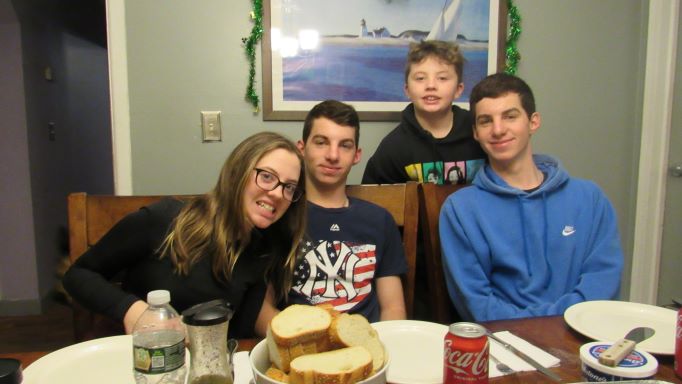
Mugging Calieigh, Timothy, James and Ryan

I celebrated my 74th birthday. Almost three quarters of a century! Boy that is a long time. I barely remember my first days in kindergarten. Actually, I also have a hard time remembering where I left my eyeglasses ten minutes ago. However, I do remember standing online to get the first polio shots (1954), watching the Andrea Doria sink on B/W TV (1956) and the first man to walk on the moon (1969), the day I married Maureen (1971); seen too many soldiers march off to war (1950, 60, 83, 90, 01, 14) and saw many of the 27,000+ sunsets that have occurred. I hope to see many more.

Into all lives come dark days. My sister’s husband, who was otherwise healthy, came down with a bad “cold” shortly before we flew to New York. The “bad cold” turned out to be Covid and he was hospitalized. Despite the treatments and medical procedures, his condition was on a downward trajectory. The news that he passed was never anticipated only a month before when he entered the hospital. Like a sudden storm the outcome is never certain and, in this case, hope gave way to tears and memories.

I dedicate this blog entry to John Mallon who I was introduced to as a Brooklyn guy that dragged raced cars, rode a motorcycle, wore leather jackets, looked like Al Pacino (in retrospect) but captured my sister’s heart. They lived a life together far from the stereotypical image that I just wrote. John, joined the Army, moved to New Jersey, raised two great kids, watched four grandkids grow, bought boats that he loved repairing, rebuilt their home after hurricane Sandy, played golf, plus many other memories that I could mention and definitely passed too soon. As Maureen always says, we mourn the loss but celebrate the times we shared.  

After John’s wake and funeral we will fly back to St. Lucia and rejoin Kalunamoo, continuing to “live the dream” but never forgetting the larger world we are all part of.

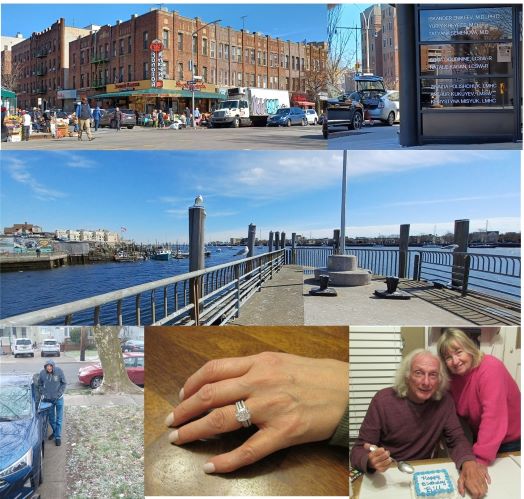
The World of Brooklyn, “Little Odessa”, Sheepshead Bay, a Cold Day, A Wedding!, A Birthday Cake

Living Among Visitors

This is about boat life. Boat life is different than land life in many ways and one of the major one is Visitors. I am not referring to visitors who stay aboard for a few days or even a week or two. They are like house guests and are certainly welcome aboard Kalunamoo. We may share a rather small space with them but, like most house guests, fit in to whatever routines we all enjoy. At these times, we have the opportunity to demonstrate our life aboard, the benefits, the freedoms, the adventures and even some of the difficulties. They bring a new dimension to our life and generally don’t result in mutiny or anyone forced to “walk the plank” overboard. They either admire this or depart questioning our sanity.

The other Visitors that I refer to are those who become, what land people would call, neighbors. They are those also on boats, that arrive in the same anchorage, that become Visitors again. I say again because we may have crossed paths with them previously. This could have been days, weeks, months or years ago. Unlike a stationary house on land where a neighbor change is infrequent, a change of a visiting boat happens frequently. Some may only be Visitors for a few days, some for much longer periods. Of course, living on a boat is fluid (pun intended). Not only do we have the capability to welcome new Visitors, both known and unknown, but we can change Visitors quite easily ourselves by moving on.

The interesting part of these changing Visitors is that many are fleeting cruisers. What I mean to say is that some of these boaters – cruisers if you will – “visit” much like visitors staying on our boat. They arrive here part time to enjoy the life-style and take advantage of all the pleasures that can be found here. No problem with that. In fact, it is enjoyable to spend time with people who enjoy being here. And since they have their own boat, we don’t need to worry about mutinies. Some will spend the season and then sail to their land homes and perhaps return the next. Some will venture on to other islands and some will sail around the world (maybe even for multiple times). We may see them again, or only hear about them through the Coconut Telegraph (the informal sailor’s word of mouth relay– boat by boat). Each brings a new perspective of what it means to be here and on a boat.

All of this is actually one of the main cruising activities – the social encounters; not only with other cruisers, of course, but with the local population. The longer you cruise, the more it becomes a natural way of life. And that “natural way of life” can be discerned in long term cruising and full time living aboard people. One of the identifying features is the ambition to keep moving, or not. Yes, cruising is, by definition, movement. Newly minted cruisers have an inordinate desire to move on. A few years ago, we met a couple who not only just bought their first cruising boat and seemed to be island hoping every week or so, but were headed for the Panama Canal and then, in short order, across the pacific. Well yes, life is short, and you shouldn’t delay your dreams if you have the opportunity. But on the other hand, nobody gets into heaven any easier because you loged more miles (earlier perhaps). In the end, we all go at our own pace, which for us is pretty slow, at this point. None of this is irreversible and living on land can become an acquired adaption for many former cruisers (CLOGs -Cruisers Living on the Ground).

Certainly, seeing new places and experiences is a major impetus to cruise. We like to see new places as well. But seeing old and new Visitors satisfies a part of this. The world is a big place but even in small places, there is plenty of detail that goes unnoticed. And that takes me full circle back to my comments on Visitors.

Since November, we have been keeping company with many cruisers in the Salty Dawg Rally. The pandemic travel restrictions does limit island hoping but meeting the many new cruisers with the rally was fun. After an extended stay in Antigua, we made it to Guadeloupe and then Martinique and were pleased to find long term cruisers we haven’t seen in years. Martinique seems to be a focal point at this time of the year. Even though we haven’t been here in two years, conversation resumed as if we just saw them the night before.

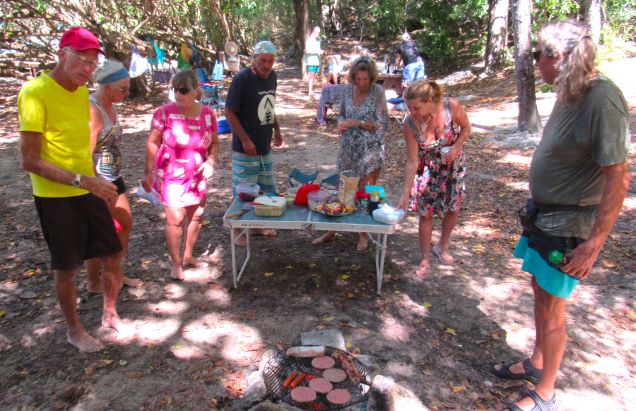
One of the things we have missed, in the last two years is what John on Out of Africa always organized was a braais. This is basically a backyard BBQ for neighbors. It is a BYOFB (Bring your own food and beverage – or some say F**k’n Beer). In others words, something to throw on the barbie and a dish to share. In any case, the “backyard” is the nearest beach that a grill can be mounted on some rock and some wood gathered to set a fire.

John, just back on his boat after some time in South Africa, does this on Thursdays at the Anse Tonnair beach, not far from St. Anne. Drive over with your “car” as there is plenty of free parking.

Free Parking

Since France is still in a State of Emergency large gatherings with food on the beach are not allowed. I should say a word about how the French seem to view rules and regulations. Unlike the Italians, where rules and regulations are treated like suggestions, the French are sincere in their laws. But they tend to trust people to follow them. People are shocked, SHOCKED, that no one checks to see if they are following the laws! Well, there is no problem with the braai as we were actually off the beach and kept our social distance, mostly. Other cruisers, both new and old showed up and as they say, “a good time was had by all”.

Backyard BBQ

Our time in Martinique will be short as we need to get down to St. Lucia next week and a short visit to New York. Our cruiser friends in St. Lucia have already anticipated our arrival as we make plans (and get covid tested again!) to visit another neighborhood.     

The Butterfly and Water of Gwada

After a few days in Deshaies, we sailed down the coast to Malendure near Pigeon Island and then to Pointe-a-Pitre. We make this move in consideration of the winds. Pointe-a-Pitre is in the middle of Guadeloupe, between the two butterfly “wings” of the island. That means sailing around the south end of the mountainous Basse Terre part of Guadeloupe and then north on the east side of it. Even in moderate east winds the southern point gets pretty windy due to the compression of the winds whipping around the end of the island.

This results in a direct up wind sail which is not what we like to do. This time it was not terrible but the seas were lumpy and it was a motor sail up to Pointe-a-Pitre. The reason to go there is that it is good place to base a car tour of the entire island. It is centrally located and you can drive to both the low island of Grande Terre and the mountainous Basse Terre. It is also a major city worth a look at including a modern Memorial ACT museum. The anchorage is protected from any swell but it is a commercial harbor with a large container terminal near the anchorage. But since we are currently traveling in a mini-convoy of cruisers that we know, it is a good place to arrange sundowners, restaurants, rum distilleries and just to tour around.

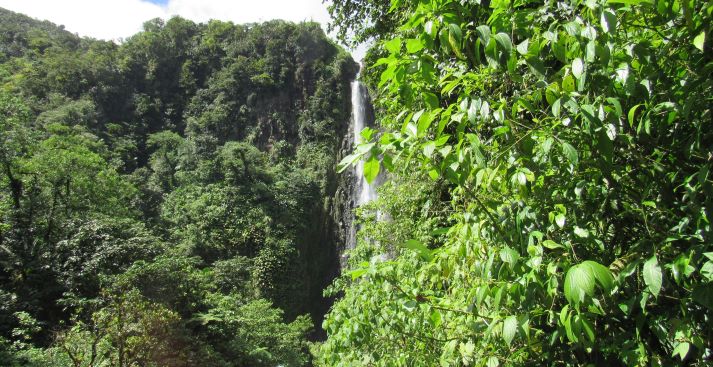
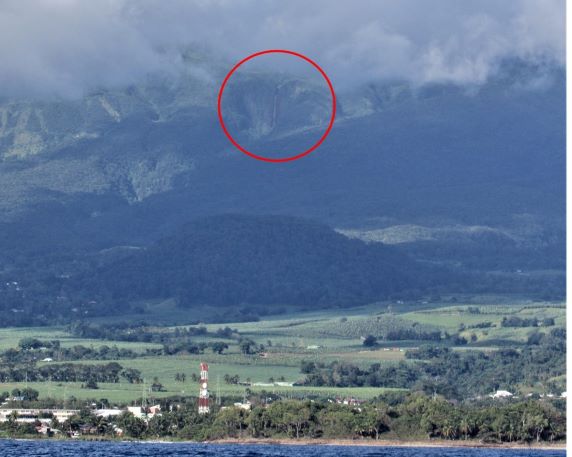
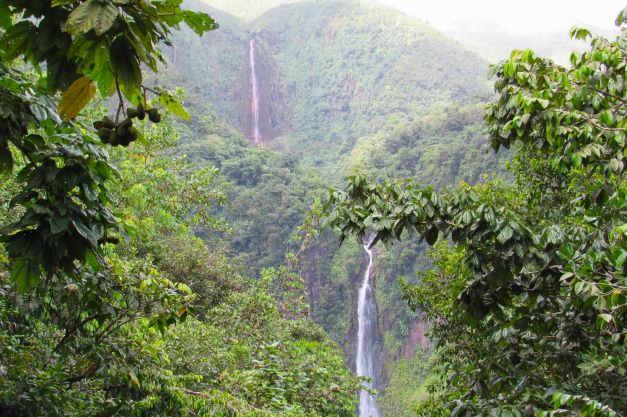
We had a three car caravan one day to visit the Chutes du Carbet. These are three waterfalls in line from one stream that come off La Souifriere, one of the main inactive volcanoes on the island. What makes these waterfalls interesting is that they are very tall, over 300’, and can be seen while traveling along the coast. See the green arrow on the chart to see where they are.

The lower falls

Actually, you can only see two of them from the coast as the upper one is usually in the clouds. Christopher Columbus saw these falls when he cruised here years ago and it is reported that he stopped in to fill his water tanks. The local natives apparently didn’t appreciate his arrival and chased them away. Maybe they didn’t get custom clearance or health certificates to stay or something. In any case, our hike up to see them up close (the falls) was a half hour climb but mostly on well maintained trails and walkways. The trail goes all the way to the top for those interested in hiking another two hours. I was not interested, or at least my legs were not.

Chutes du Carbet

Hike through these lush tropical forests are always amazing. I am always impressed by the size of the trees, ferns, leaves and flowers. Some of them are as big as a car (well almost).

For those interested, unlike Columbus we did fill our water tanks at the marina in Pointe-a-Pitre for $0.08 a gallon. Many cruisers these days have “water makers”. Actually, the machinery doesn’t make  any water, it just takes the salt out of the water your floating in. High pressure pumps and very fine membranes do a reverse osmosis (RO) trick to prevent the salt ions from passing thru. All well and good but the cost and maintenance is another bill that must be accounted for. I’m not against them but there is readily available shore side water (and some of it is actually RO water). Granted, we, and especially Maureen, watch our water consumption so that we don’t have to run and fill tanks less than once a month or longer (usually longer). But looking at the water falling hundreds of feet in these rain forests, emptying into the sea, one wonders about reinventing the wheel. I guess I like Criss C’s solution to fill our tanks. OTOH, we do have and used, a rain catchment system to supplement our water supply.
Dinghy Raft Up Lunch

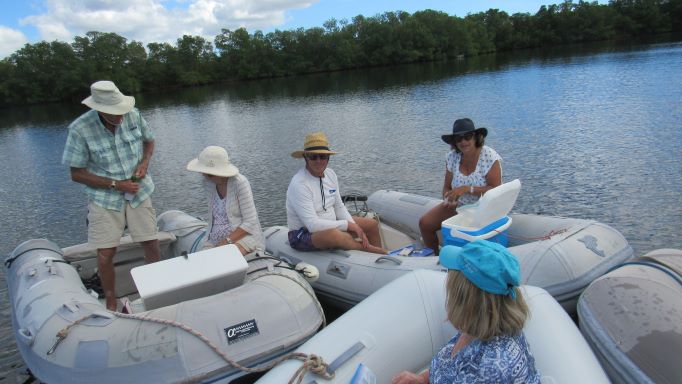
On another day we took a dinghy trip up the Riviere Salee and had picnic lunch of French wine, cheese and bread in La Manche a Eau. among the mangroves. A good GPS chart is a good idea if you want to wander through the many channels and byways here. The area is between the two main land masses of Guadeloupe.  That is always a fun trip although the dinghy ride back to Pointe-a-Pitre is a rough sometimes wet, up wind ride across the wide harbor. Well, at least we didn’t have to sail up wind.

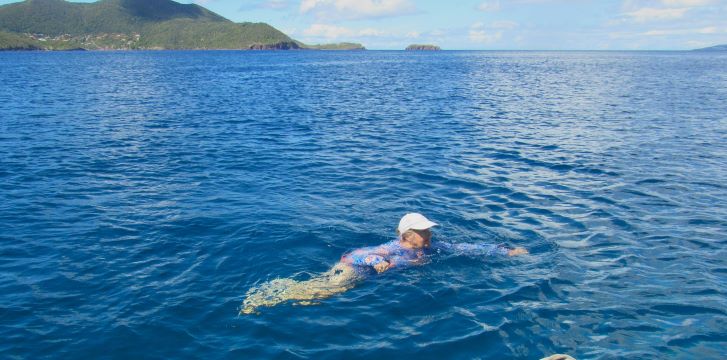
This water was made for Swimming

We are now in Les Saintes but will sail to Martinique tomorrow. The Butterfly island has a lot to offer but we have a time schedule to be in St Lucia by the end of February. Marie Gallant is another island here that is worth a stop but not for us now. The weather window decides when to move, so tomorrow is the day. And today a northerly swell arrived and we are in a stage 3 to 4 roll!

Cruising Again

For the first time in 22.5 months Kalunamoo was neither in Antigua or St. Lucia. We sailed from Antigua on January 17 to Deshaies, Guadeloupe in stiff easterly trades and made the jump in a little over 7 hours. That was a fast sail for us although Maureen didn’t appreciate the lumpy ride and neither did her stomach. But, as was written in the last blog, it was a shake down cruise but in this instance, it shook us down and not Kalunamoo.

We are now in Deshaies, the home of the TV show Death in Paradise. It is amazing how many people get killed here! It brings new meaning to the term “I would die for some time in such a beautiful island”. Well, it is a fictional TV detective show, but the island is beautiful, nonetheless.

This is a French island, actually a territory of France, just like St. Martin, and Martinique and so you really are on French soil. The last time we were on French soil was in pre- pandemic March 2020  in Martinique. At that time the only masks we wore were for the Carnaval. Now, masks are everywhere, and proof of vaccination is carried as restaurants and other gathering spaces are required to ask for it. We also had to have a covid test before entry and fill-out entry papers before arrival. That was all done but I had difficulty emailing it to the authorities and actually didn’t send it until after we arrived. On other islands, you appear before Customs, Immigration, Port Authority and Health Authorities when checking in. The French have a different way of operating. On entry, which you do on a computer at a tourist t-shirt shop, nothing was asked about all the requirements Somewhere in their computer system all these forms and documents gather together. I think. Maybe not, but at least we did our part.

A number of cruisers we know also made the voyage down from Antigua. Most of them from the Salty Dawg rally as it was time to start cruising. The pandemic does slow things a bit as entry to the various islands is still somewhat complicated, and somewhat expensive. In any case once they arrive it doesn’t take too much effort to get together for daytime gatherings and sundowners at night either ashore or on other boats. The great French food is always a draw. Even in small villages like Deshaies, the line for the day’s baguettes and croissants forms early in the morning. The sunsets at the waterfront cafes and restaurants may be something to die for or at least dream about.

We took the bus into Sainte Rose ($2.20 Euros) to get a Digicel sim card for our MiFi. This is used for internet connections as public WiFi’s are becoming less available. It also works great on the boat and no need to go ashore to “get connected’. This French Digicel plan works in all the Caribbean islands so hopefully when we get to St Lucia it will. While in Sainte Rose we stopped in a large vegetable store which had some interesting looking items:

I suppose all this ends up on the plate of the great French/Caribbean food that is served in restaurants.

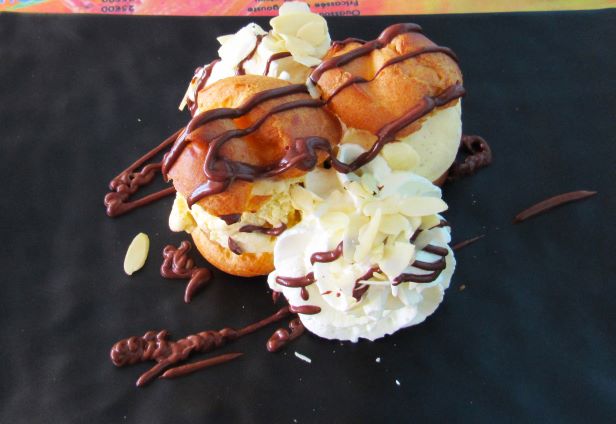
And of course, there is always desert.

We will be spending a week or two in Guadeloupe before sailing south to the other French Island, Martinique. Most of February will be spent there. As mentioned above it has been almost 2 years since we have visited these French islands and so we have a bit of catching up to do. We need to brush up on our very limited French vocabulary also!

Use It or Lose It

Be kind and gentle. That is one of the principal edicts I grew up with. It originated in the Religion classes in grammar school despite the capital punishment (slaps on the knuckle) from the religious Brothers. Well, maybe it didn’t actually mean to be that way in the real world or I misinterpreted them and expected the world would actually abide by them.

In any case “be kind and gentle” was taken to heart as I thought it was a fairly good dictum for a human being. It made sense. The dictum, however, seemed to be at odds with the “competitive spirit” that abounded in my early years. Maybe that is why organized sports seem more like gladiator theatrics than something that was intended for pleasure. Competition may bring out the best in us, but I know it can also bring out the worst.

As time went on, the dictum extended to more than human interactions. When interactions with mechanical contraptions came to occupy my time – erector sets, Lionel trains, the home built go-carts, fiddling with auto engines and buying a muscle car to drag race – all seemed tempered by the “be kind and gentle” dictum that floated in my head.

How this translated to actual conduct was similar to how the other dictum – “everything in moderation”- was handled. This other dictum was a little more difficult to abide by. Was it because it seemed to make less sense? Well, that is a discussion for another time. In any case, in terms of dealing with non-human or animal interactions, “be kind and gentle” and “everything in moderation” resulted in limiting all physical mechanisms to a level below their capability.

The rational for this was, beside the above philosophical underpinnings, was the understanding that these physical mechanisms will reward you with their extended life and reliability. By not pushing them to their design limits, they would last longer, run better, and generally make life better for everyone. This carried through for many activities. I never ran the Lionel trains at top speed to destruction, the go-carts were never overloaded to bend the axels, the drag-racing car was never pushed to explosion. Well mostly. Remember the “all things in moderation”? And how sometimes its hard to follow? Dropping a valve in a new engine tested that (among other things). Nobody’s perfect.

So, what has all this to do with Kalunamoo? We flew back to our boat in Antigua after the New Year. Our Christmas Holliday was great, saw most of the family, but otherwise mostly hid from the virus for most of the time. We were successful because if we weren’t it would have been very difficult to return to Antigua. Snow storms, cancelled flights, closed borders, or positive covid tests, could easily derail travel plans. While we were up in New York for three weeks, Kalunamoo was well secured in a slip in Jolly Harbor Marina. We turned off everything on the boat except the battery charger and that means the refrigeration was off. Whatever food we had, frozen or otherwise, was given to friends who kept it in their refrigerators until we returned. Upon return we turn on everything and start the refrigeration.

A three-hour flight delay was the only hiccup in our travel plans. We climbed aboard Kalunamoo, 13 hours after driving to the airport in New York. Once aboard, we turned the refrigeration on. About two minutes after that we smelled something burning. It was the cooling water pump for the refrigerator throwing smoke and sparks like it was New Year’s Eve. Well, welcome to 2022 and the start of a new year fixing boats in exotic places.

The pump is not an uncommon one, although not readily available here, but a work-around was found. The forward air conditioner uses the same type of pump so I switched out the burned out one for that. No air-conditioning until we get a new pump. Not a big deal as we very rarely use it, and only when in a marina.

The old pump and “new pump” installed

“But it was working fine when we left 3 weeks ago!”  Which brings up the third dictum, “Use It or lose It”. We have experienced this too many times. Most cruises have. Things don’t keep well when not in use. Batteries go dead, rust runs rampart, mold grows wild. Sometimes it just feels like the item is acting childish, getting back at us for showing benign neglect of non-use.

The assumption is that if something is not used, the time of none use is added to the overall life expectancy of the item. This is not true. If the life expectancy is 2 years, it will die in 2 years whether you use it or not. Cruisers know to do a “shake down” cruise after an extended boat layup. The reason is simple. All those boat parts continue their inevitable path to Davy Jones’ Locker while you are off vacationing. The “shake down” cruise is the boats way of shaking you down for the neglect you have shown it by not using it.

This last dictate, learned late in life, seems to trump the first two. “Be kind and gentle” and “Everything in Moderation” seem to crash head on into “Use It or Lose It” if longevity was expected. Maybe it is a paradox of life but it is a certainly on boats. Diesel engines, I am told, need to be pushed to their limits. No kind and gentle treatment is needed. They will die when they want to, whether you push them or not.

Well, it still is a shock when non-use of an article results in its failure. This certainly applies to the mechanical contraptions we deal with. Oddly, this is even built into the electronics we use every day. Imagine someone who saved an IBM AT personal computer from 1985 and turned it on today. How would it ever connect to the internet?

So, yes, be kind and gentle, exercise moderation but always Use It or Lose It.

Final word (and a political warning). Democracy only works when it is used. Use it or lose it.

The Last Month

The last month of the year reminds me of musical chairs. The music starts on Thanksgiving and everyone starts moving around. Who’s hosting sundowners tonight! Who’s sailing up to Barbuda when the window opens! We’ll circle back and meet for dinner aboard! Get those Christmas Lights up! The Christmas Winds are creeping in! Where will you be when the music stops? Watch for those Northern Swells! Christmas dinner for 18, make reservations now! Got a good view for the New Year’s Fireworks?

We took a week break and ducked out to Deep Bay. It’s not as secluded as it once was. The big resort takes a chunk out of the southern shore-line but that is not too bad. Their loud poolside DJ doesn’t perform every day and when he does, sport-casting the pool activities at the resort, doesn’t last too long. Deep Bay unfortunately has attracted swarms of biting jet skiers. These decibel breaking speedsters can be as annoying as those tiny noisy mosquitos that fly into your ear at night. They popup around noon and blast through the bay to experience the noisy, jolting, twisting, turning ride with as much straight line breakneck speed that these one and two man floating engines of annoyance can muster. Safety is the last thing they seem to regard, not to mention the drone of their high-powered water pump missiles.

Wayward Wind and Kaluanmoo, Deep Bay, Antigua

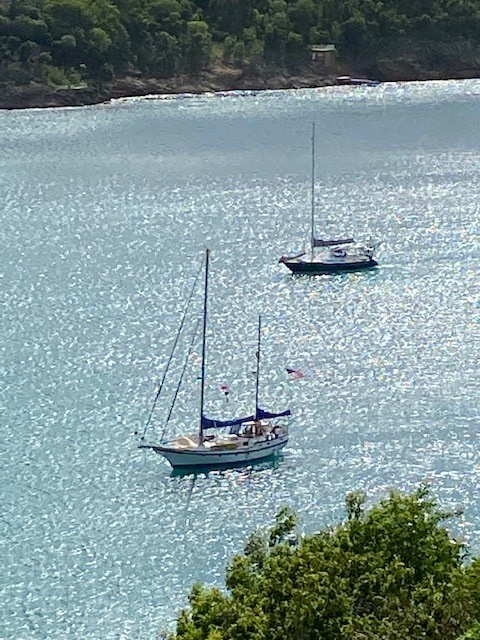
Despite this, most of the time, we did enjoy the quiet (other than the whistling winds in the rigging). A couple of Salty Dawg boats did stop by and so we did have some sundowners with Peter and Beth of WAYWARD WIND.

We anchored right next to Dozy Girl. This local sloop was firmly secured and we had no worries that she would drag in the moderate winds of the bay. That is always a concern as one never knows how well the captain of that upwind boat set his anchor. The last thing you want to awaken to at two in the morning is the sound of boats bumping in the night. And you know they don’t want Grey Poupon. You’re lucky if they greet you with cloths on. I should mention that this never happened to us. I usually keep a pair of shorts handy.

We did go bump in the night recently in Freemans Bay, English Harbor. Oddly enough it was not due to strong winds or rain squalls. Actually, there was no wind at all. And that was the problem. The current there swirls and if there is no wind each anchored boat does it’s own thing. We anchored near (a respectable distance given the circumstances) our friends boat (ROXY). Well, at four in the morning Maureen hears a “bump in the night” and sure enough we were stern to stern with ROXY. Davits just touched. No damage. Mark and Lynn never even woke up. We fended off, pulled some chain up so we wouldn’t collide again and went back to bed. Yes, the shorts came in handy.

Mast Walking

But I digress. Dozy Girl would definitely not drag. She couldn’t. She lay 15’ underwater with her mast sticking up like a flagpole in the middle of the bay. It is an interesting snorkel attraction in addition to the wreck of the Andes close by. Some even thought it fun to try a mast walk. From what I heard when one of the tour boats (booze cruise catamarans) that passed by was that the boat broke loose in a squall, lost its rudder and sank. Other details I couldn’t hear. The Andes, by the way, caught fire and the captain tried to bring it to the beach before it sank. He didn’t make it, but it makes a good snorkel dive, a lot of fish now call it home. Luckily there have been no swells recently so the water clarity is good. Considering that this area of Antigua usually has very murky (sandy) water close into shore, both Dozy Girl and Andes provided good snorkeling.

So our week break in Deep Bay will end tomorrow as we will head back to Jolly Harbor. We’ll actually go into the marina on Sunday and prepare for our flight back to Brooklyn on Tuesday. The latest CDC procedures require us to have a covid test on Monday. Our up-state daughter will be down before Christmas for a few days after we arrive and we will celebrate her birthday. We will then spend the Christmas Holiday in New York with family and friends. New Year’s eve will be with my 100 year old dad, then celebrate our other daughter’s birthday on the 3rd of January and fly back to Antigua on the 4th.  By then the music will stop and we will run to the open chairs and have a seat. But we will be back on board and a New Year beckons. Hopefully, island hopping will be easier although that could be the start of another round of musical chairs.

Reality Rallies

About 50 sailboats descended on Antigua since we arrived here three weeks ago. They were all part of the Salty Dawg Rally that left the U.S., mostly from Hampton VA, around November 1. The rally, which we participated in a number of times, brings the first wave of cruisers into Antigua and starts the winter cruising season in the islands. Our good friend Bob on PANDORA is the rally director and did a great job of organizing the rally. Along with another good friend, Lynn on ROXY, they organized daily social events for the last two weeks which culminated in a Thanksgiving Regatta (due to no wind, it was a kayak race) and a Thanksgiving Dinner at the Antigua Yacht Club. In short, it was a very busy social scene since we arrived, quite a change from the socially quite summer in St. Lucia.

At Pigeon Baech
At Indian Summer Restraunt

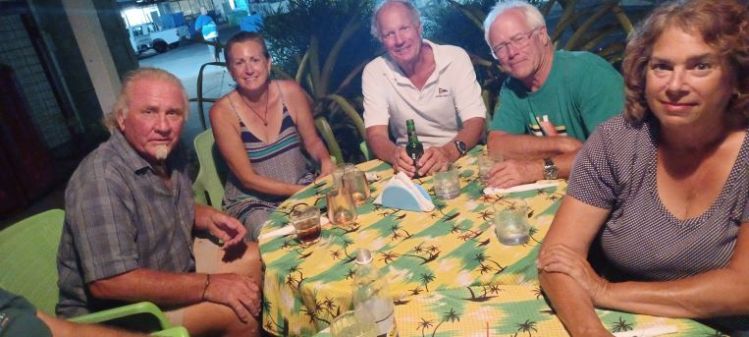
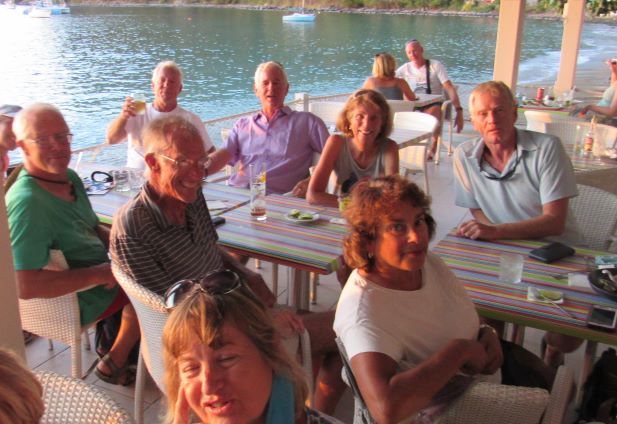
Happy hours, dinners, tours, jam sessions, sun downers, beach gatherings and just plain gatherings were part of our social calendar.

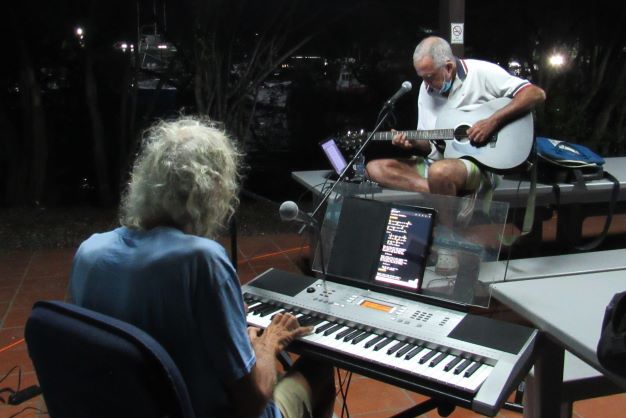
Jam at English Harbor

Living on a sailboat and cruising around sounds like a lonely adventure with few opportunities for social interactions. This may be the case if you are constantly sailing, as many do, around the world and spend a very limited time in port. Mostly, however, cruises spend 95% of the time in port. At those times, cruisers gather socially, intermingle with the “locals”, compare adventures, help repair or exchange repair tips, and form friendships that last from weeks to years. It also develops, excuse the pun, very fluid arrangements among cruisers. You may not meet again for months or years but somehow just pick up the friendship where they were left off.

Chicken ad Beer, Antigua Yacht Club

Two trends we have noticed over the last ten years is the popularity of rallies and the size of boats. Rallies have encouraged, and enabled people that would not ordinarily go from day sailing on the weekend to long distance, ocean going, sailing. This is good as it introduces many to this type of sailing. The downside is that long distance sailing is not the same as day sailing, in the same way that because you have a driver’s license means you can drive in the Daytona 500. Rallies do support and can assist in the transition but it still requires more than a few hours of instruction to appreciate the challenges that are faced. The fact that you may be hundreds, if not a thousand miles, from any help should give one pause before starting an off-shore cruise. But rallies also provide the structured framework of social gatherings. Social events in strange lands organized and attended by people you have come to know is a big selling point. The lonely sailor gives way to weeks of social events and is a major draw of rallies.

The other trend is toward bigger boats. Both longer and wider is the name of the game. It is not unusual to see boats and catamarans well over 50 feet sailing with a crew of two. Sometimes these are the first boats the owners have owned. Having owned sailboats for 40 years, starting with a 22’ Catalina, it amazes me how they do it. These bigger boats enable longer voyages and arguably a “safer” passage. But mostly they are more populated with family, friends and crew because they have the capacity to do so. It too, adds to the social experience of cruising or living aboard. The space offered on a large catamaran is like an apartment on the water. And not necessarily a small one. They do make great venues for sundowners and jam sessions!

Fewer pandemic restrictions are in place but island hopping is still not as easy as it was. Fully vaccinated sailors can go to other islands but PCR or quick tests are required and some additional paperwork is involved. This requires a bit of planning and restricts the unplanned and ad-hoc aspect of sailing. Once on island, masks, social distancing, curfews, and some beach restrictions may be in place, although none are really draconian. There has been some recent unrest, protests and strikes in the French islands of Guadeloupe and Martinique regarding the pandemic but nothing that really affected cruisers. News of a new variant is concerning but at the end of the day, we will have to live with whatever precautions should be taken while living our normal life.

Sunset in Falmouth Harbor

The reality of life, like sailing rallies, is that social events play a major part in our existence. No one is an island, as the poem said, and even on an island, or a boat, you are never far from a gathering. Or a new rum drink.   

Thalassophillia

What draws us to say we must go down to the sea again? What is it in that lonely sea and sky? Why is that restless body of water so alluring? Is it the amniotic fluid that we yearn to return to? When life was just beginning, when we were cushioned against the harsh realities that would define the rest of our lives; the warmth we became accustomed to; is it the desire to return? We breathed this sea before the cold winds announced our presence and we gave out a scream, maybe with cause.

In the early years of the 20th century, the idea of eugenics took hold and tried to explain why we are what we are. Genes were seen as the key to life, or how life manifests itself in individuals. It also provided a pathway that human-kind could follow to improve, by exercising discretion in procreation, the desired traits for the populace. Fortunately, it proved to be a false hope. In the meantime, Thalassophilla was assigned the meaning of “lover of the sea”. Excessively so. And it could be “cured”.

My own belief, if Thalassophila really exists, could be cured by experiencing a few storms at sea. If that doesn’t hit you in the head like a 2×4 nothing will. But there are other ways to the cure. It could be called the Chinese Water Torture route. It involves the mystical timing and evolution of breakdowns and boat failures that plague boat ownership. It seems failures and breakdowns occur in some predetermined time frame that only allows the next breakdown to occur after the previous one was rectified. Multiple failures happen but not as frequently as the constant drip, drip drip of failure, fix, failure, fix etc.

All this to explain our passage from St. Lucia to Antigua. After 5 months in St. Lucia for the hurricane season, we sailed north to Antigua. Note: only 2 named storms, including one hurricane, passed through the Lesser Antilles this season. Only one, Elsa, passing over St. Vincent, gave us a day of squalls with winds of 45 knots. The pandemic has really “clipped our wings (fins?)” as far as island hopping. We will remain in Antigua until January and see where we can go from here.

So, after 5 months, with M&R in St. Lucia, including the purchase of our new “car” – the ubiquitous dinghy – we took Kalunamoo for a planned 32-hour sail. We did go to Marigot Bay before this so it was not like the boat didn’t move for 5 months. It also was hauled for new bottom paint. We installed a new reefer compressor. We installed a new generator water pump. We had the stern teak damage repaired. All these were done sequentially as explained above in a “water torture” scenario.

Dominica at Sunset

The sail from St. Lucia was a sailor’s dream. Relatively strong 20-25 knot easterly winds gave Kalunamoo the energy to sail at 7 to 8 knots. Apparent wind was 60 degrees on the starboard bow and the seas were long enough for us to ride over them. No squalls, a clear dark night, and little traffic to worry about gave us a good ocean passage ride.

That was until we emerged from the wind shadow of Guadeloupe and the last leg up to Antigua. The course is now due north while the wind slacked a little. This gave us a relative wind of 45 degrees with more of the seas head on. In short, it was a motor sail for the last 6 hours of the voyage. Halfway up, Maureen and I noticed an exhaust smell inside the cabin. Sure enough, there was an exhaust leak somewhere but I could not determine from where. Not a tremendous problem, just another little drip, drip, drip of needed repair.

We dropped the hook in Freedman’s Bay, English Harbor at 10:30AM, 28 hours after leaving Rodney Bay. That was a fast run for us. We waited hours for Port Health to grant us “free pratique”. This age-old procedure prevents the spread of sicknesses from sailors arriving from foreign lands and causing a pandemic. Well, too late for that, the pandemic arrived at the airports a year ago. In any case, with negative PCR test results in hands, our CDC Vaccine card, and a completed Maritime Health Declaration, and temperature checks, we and Kalunamoo were granted “pratique” and allowed to proceed to Immigration, Customs and the Port Authority to complete the entrance procedures. We were done by 3PM. By 5PM I was ready for some sleep.

Freemans Bay, English Harbor

The exhaust turned out to be from a leaking injector seal. At least that is what I believe it is. A mechanic has been called and so another repair is in order. We will have enough time here in Antigua for this to be done. Cruising friends with the Salty Dawg Rally will arrive later this week and I am sure there will be many mentions of the drip, drip, drips on their boats.

Has this cured our Thalassophillia? Really, has anyone really been “cured” of anything or just accepted the fact that somethings just can’t be explained. In the meantime, we continue to sail on in anticipation of the inevitable next drip and hope it doesn’t cure our chosen lifestyle, as incurable as it may be.

Dr. Dolittle

St. Lucia is a beautiful island. The iconic Pitons, both Gross and Petit, are deservedly world famous and never fail to be included in tropical photographs of the Caribbean. The geography of the island has these pinnacle like mountains throughout, covered by lush vegetation. Driving on the roads, there are no “highways”, is challenging as the steep topography and hairpin turns are not for the faint of heart. We did the car tour the last time we were on the island. This year we decided to do little of that but remained, for most part, in Rodney Bay and/or the marina. Blame the pandemic for our reluctance to travel around.

We did however, after hauling the boat for a few days to get the bottom painted, sail down the coast to Marigot Bay. It’s just a little past Castries. As mentioned above the geography of St. Lucia with its old volcanoes and cones is very steep. This applies to the coastline also. Just off the coastline, the depth drops to hundreds of feet deep and you can do little to safely anchor. It’s just too deep. Rodney Bay is an exception. The other exception to the general rule is the small indents along the shoreline, almost like small fjords or bays with steep sides. Such is the case of Marigot Bay.

Half of the inner bay is home to the Marigot Bay Resort and Marina. A relatively high end resort, although St. Lucia is home to many. It is one that you can dock at. There are also moorings to be had but we were advised not to use them. The management of the resort recently changed hands and the moorings have not been “serviced” and could break loose. The resort itself is impressive, blending in well with the surrounding hills. You could do little to improve the location. The other half of the bay is lined with mangroves. All very lush, especially during the summer “rainy” season.

We took a berth at the “fuel dock”. Troy, the marina manager took our lines as we came alongside. It was one of only few slips that was available for “alongside” dockage. For the 5 days we were there, it was fine.

Since this is still the off season, the resort was not very busy. In fact, the marina complex of boutiques were mostly closed and the restaurants (pricey) were opened on a rotation basis. The pools were open and the general atmosphere was very laid back. It was a place to do little other than relax. Cruiser friends, Jim and Meryl on Kokomo and Lisa and Pierre on BioTrek were there so we did have company.

Besides the marina resort, there are other local restaurants, bars, shops and trails for those who like to climb hills. 

Maureen, Meryl, Jim

Across the bay, Doolittles, offered a free water shuttle to their beach front restaurant. The name comes from the 1967 film Dr. Dolittle where it was partly filmed. Nothing other than the name of the film is noted.

Dooittles Restaurant

Reading the history of the film (thanks Wikipedia) confirmed that the Island scenes were filmed here. Working on the way over budget film (considering the restaurant prices, I don’t doubt it) it apparently was not like working in paradise. The following is from Wikipedia:

In October 1966, scenes were later shot in Marigot BaySaint Lucia; this location was equally problematic, and problems with insects and frequent tropical storms delayed filming and left eight crew members bedridden due to vomiting, diarrhea, and high fever. The final scene with a giant snail was complicated not only by the poor design of the large prop, but because the island’s children had recently been struck by a gastrointestinal epidemic caused by freshwater snails, and mobs of angry locals threw rocks at it. Around this time, Jacobs was hospitalized after having a heart attack. Within a month, filming had fallen 39 days behind schedule in which the production crew had to decamp back to California for reshoots.

Well paradise always looks better on film. Our stay did not involve any tropical storm but we were glad we had enough netting to keep away the “no-seeums”. Did I mention half the bay (and along the marina docks) is lined with mangroves? The snails seem to be under control and the locals were nothing but very friendly. The film lost almost 11 million dollars. It did however win 5 awards including 2 Oscars and a Golden Globe award. Who knew?

We will soon leave St. Lucia and head to Antigua as the hurricane season is just about over. Our stay in Marigot was a pleasant diversion to do little and we could see visiting again, especially if their moorings are up to snuff. In Antigua we may do more than the little we did here. Hey, that sounds like a movie title – Domore!